Young Spoonbills forage harder after leaving familiar wetlands
Tracking juvenile Eurasian Spoonbills in Portugal suggests that entering unfamiliar areas changes how they divide their time and energy.
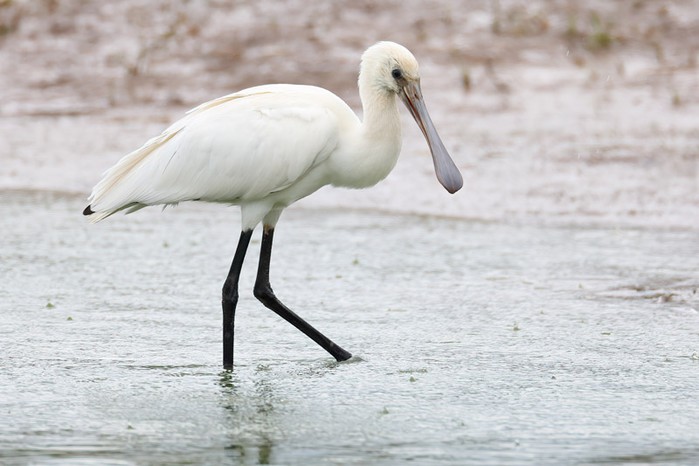
Young Eurasian Spoonbills that leave their natal wetlands spend more time and energy foraging, roost less and use a narrower range of habitats after reaching unfamiliar areas, according to new research published in Ibis.
The study followed 51 juvenile Spoonbills tagged before fledging at three protected wetlands in Portugal: the Tagus estuary, Sado estuary and Ria Formosa. Solar-powered GPS/GSM devices fitted with three-axis accelerometers recorded both the birds' movements and behaviours during their first year of life.
Sufficient data were available to classify 29 birds. Eighteen were 'leavers' that moved away from their natal wetland, while 11 were 'stayers' that remained nearby. The first journeys into new areas ranged from 15 to 1,550 km and lasted from one to at least 12 days.
Before any departure, the two groups behaved remarkably similarly. The only detected difference was that future leavers spent slightly more time preening. There was no clear evidence that birds destined to leave were already flying farther, foraging differently or using larger areas, making a simple behavioural predisposition to migrate less likely.
The contrast emerged after the leavers reached places they had not previously visited. Compared with stayers, they spent more of each day foraging, devoted more energy to feeding and roosted less. They also used fewer habitat types. Their use of human-modified habitat increased after departure, although the difference from stayers was not statistically clear.
Taken together, these results suggest that the differences found after moving instead appear to be a consequence of unfamiliarity with the new areas.
The researchers tested whether the changes were simply a short-term result of the energy used during travel. If that were the case, longer journeys should have produced larger behavioural shifts and the birds should gradually have returned towards their previous routines.
Neither pattern was found. Displacement distance was not linked to the scale of the changes, and foraging, roosting and preening behaviour showed no evidence of stabilising during the first month in the new area. The authors therefore conclude that unfamiliar habitat, its quality and the social conditions encountered there offer a better explanation than the journey itself.
The reduced number of habitat types used by leavers may mean that inexperienced birds concentrate on the first suitable places they encounter rather than exploring widely. All three natal colonies lie within protected wetlands, so departing juveniles are also more likely to encounter a smaller proportion of well-preserved natural habitat.
The detailed post-departure analysis was necessarily small, involving 11 birds with adequate before-and-after data. Five tracked juveniles travelled to Africa: two died during the journey and the tags carried by the other three stopped transmitting, which could indicate either tag loss or death. The study did not directly test the long-term survival or breeding consequences of the different strategies.
Nevertheless, remaining close to the natal wetland may currently offer an advantage to Portuguese Spoonbills, especially as winter conditions in Iberia become more favourable. The researchers suggest this could help explain the growing number of Spoonbills wintering on the peninsula.
Juveniles can also drive changes in migration routes and the colonisation of new breeding areas, making their decisions important at population level even when leaving is costly to individual birds. Longer-term tracking will now be needed to establish whether leavers eventually become familiar with their new surroundings and how the two strategies affect survival and recruitment.
The study, Exploring the exploration: implications of leaving or remaining at the natal site during the early stages of independence in a partially migratory bird, was led by Manuela S. Rodrigues of the University of Aveiro.
20 Aug 2026
Get Breaking Birdnews First
Get all the latest breaking bird news as it happens, download BirdAlertPRO for a 30-day free trial. No payment details required and get exclusive first-time subscriber offers.
Share this story