Young Gannet ‘hunt’ faces calls for ban as 2026 licence considered
Campaigners are urging NatureScot to refuse permission for the annual killing of young Gannets, while the agency says any decision will be based on the latest scientific evidence.
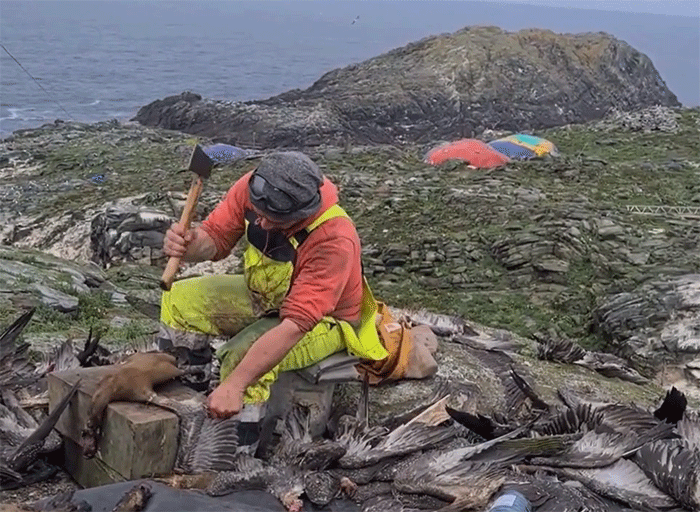
The ‘Guga’ hunt on Sula Sgeir has come under renewed scrutiny following recent press coverage, protests and a Scottish Parliament petition calling for an end to the licensed killing of young Gannets on the remote island north of Lewis.
Each year, if a licence is granted, a small group from Ness travels to Sula Sgeir to take young Northern Gannets, known locally as guga, for human consumption. Supporters regard the hunt as part of the cultural identity of Ness, with roots stretching back hundreds of years. Critics argue that the practice can no longer be justified, particularly at a time when Scotland’s seabirds are under mounting pressure.
NatureScot confirmed in late May that it has received an application for the 2026 hunt. The agency said it recognised there were “strong feelings” around the issue, but said its role was to make licensing decisions under the relevant legal framework and using the most recent scientific evidence.
The 2025 hunt was the first licence application from the Men of Ness since 2021, following a pause linked to Highly Pathogenic Avian Influenza. NatureScot reduced the maximum number of birds that could be taken from 2,000 to 500. A later response to the Scottish Parliament petition confirmed that 485 guga were taken in 2025.
Campaigners say the reduced quota does not go far enough. Protect the Wild has called on NatureScot to refuse the 2026 application, arguing that the hunt is no longer compatible with modern conservation or animal welfare expectations.
Devon Docherty, Scottish campaigns manager at Protect the Wild, has described the hunt as “one of the cruellest and most ecologically reckless wildlife practices left in Scotland”. He said NatureScot now faced a choice between continuing to approve a practice that “survives on tradition alone” or protecting the wildlife in its care.
The campaign has also been taken to the Scottish Parliament through a petition launched by wildlife photographer Rachel Bigsby. It calls for the Wildlife and Countryside Act to be amended so that licences can no longer be issued for the taking of Gannets on Sula Sgeir.
Bigsby has argued that the birds should receive the same protection as other Gannets in Scotland, saying: “The public has been clear, the people want Scotland to lead on conservation, not hide behind outdated legal loopholes.”
Conservation concerns have been sharpened by the impact of avian flu on seabirds. NatureScot figures released under freedom of information rules show the Sula Sgeir Gannet count falling from 12,271 apparently occupied sites in 2017 to 9,495 in 2023, before rising to 10,200 in 2024. NatureScot has linked the 2017 to 2023 decline to mortality from avian flu in 2022, while noting that some survey methods were not directly standardised.
The RSPB has urged a precautionary approach, calling for future licensing to be paused until there is clear evidence that the Gannet population has recovered to pre-avian-flu levels. The charity has also supported annual drone monitoring at Sula Sgeir to ensure decisions are based on accurate and current data.
NatureScot’s decision on the 2026 application will now be closely watched. To supporters, the Guga hunt remains a tightly controlled cultural tradition. To opponents, it is the licensed killing of young seabirds from a protected colony at a time when Scotland’s seabirds face disease, climate change and other growing pressures.
Whatever the outcome, the recent coverage has made clear that the Sula Sgeir hunt is no longer a little-known Hebridean tradition. It has become one of Scotland’s most contested wildlife issues - a collision between law, culture, animal welfare and seabird conservation.
May 2026
Get Breaking Birdnews First
Get all the latest breaking bird news as it happens, download BirdAlertPRO for a 30-day free trial. No payment details required and get exclusive first-time subscriber offers.
Share this story