Woodpecker skull structure helps prevent brain injury
New research reveals how specialised skull structures allow these birds to cope with the extreme forces generated during pecking
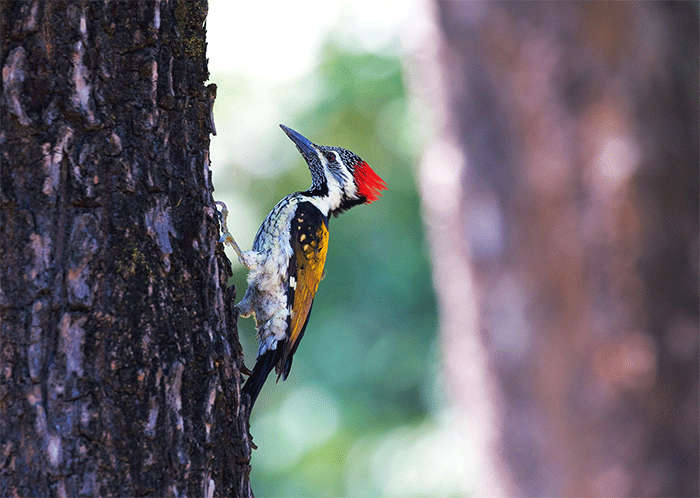
A life of constant hammering
Few birds lead a more physically demanding life than woodpeckers. Whether searching for insects beneath bark, excavating nest holes or producing their distinctive drumming displays, these birds repeatedly slam their bills into wood at remarkable speed.
Each strike generates powerful forces that might be expected to cause serious injury. Yet woodpeckers can deliver thousands of blows in a single day without apparent harm. A new study is now helping to explain how their skulls cope with these repeated impacts.
Designed to handle the impact
Researchers studying the anatomy of woodpecker skulls have found that their structure appears specially adapted to tolerate the forces created during pecking. Rather than simply cushioning the brain from impacts, the skull itself seems built to withstand and manage the stresses involved.
The bones of the skull form a tightly integrated structure that helps distribute the forces generated when the bill strikes wood. This design reduces the risk of damaging sensitive tissues during the rapid deceleration that follows each blow.
A different approach to protection
Earlier explanations often suggested that woodpeckers relied mainly on shock-absorbing mechanisms to protect their brains. The new research indicates that their strategy may be more complex.
Instead of acting purely as a cushion, the skull structure appears to channel and spread the forces created during pecking. This allows the bird’s head to tolerate repeated impacts while maintaining the precision needed to strike the same spot again and again.
Evolution of a specialist tool
Woodpeckers represent one of the most specialised feeding groups among birds. Their powerful neck muscles, strong bills and reinforced skulls form a highly integrated system adapted for chiselling into wood.
These adaptations allow them to exploit food sources hidden beneath bark or deep within timber - resources that many other birds cannot reach. The ability to excavate nest cavities also gives them access to secure breeding sites.
Lessons beyond bird biology
Understanding how woodpecker skulls cope with repeated impacts may also have wider applications. Engineers and designers are interested in how biological structures manage mechanical stress, particularly when developing protective equipment or impact-resistant materials.
Nature has had millions of years to refine such solutions, and the woodpecker’s skull offers a striking example of evolutionary engineering at work.
A remarkable natural design
For birdwatchers, the familiar sight of a woodpecker hammering away at a tree may now seem even more impressive. Each burst of rapid drumming is not just a search for food or a territorial signal - it is also a demonstration of one of the most specialised pieces of anatomy in the avian world.
Thanks to the unique design of their skulls, woodpeckers can continue their relentless hammering with little risk of injury, turning what would be a dangerous behaviour for most animals into a highly successful way of life.
March 2026
Read the full paper here
Get Breaking Birdnews First
Get all the latest breaking bird news as it happens, download BirdAlertPRO for a 30-day free trial. No payment details required and get exclusive first-time subscriber offers.
Share this story