New map identifies potential Pine Marten strongholds across Britain
European-scale model highlights woodland in southern and eastern England as well as established western and Scottish habitat.

Large areas of Britain may contain suitable habitat for Pine Martens, including parts of England from which the species has long been absent, according to a new habitat model highlighted by The Wildlife Trusts.
Researchers built the model using Pine Marten records from across Europe rather than relying only on the animal's restricted modern distribution in Britain. After cleaning and thinning the data, 4,189 records were used to identify the environmental conditions most closely associated with the species.
When projected across Britain at a resolution of 100 metres, the model highlighted extensive potentially suitable habitat in south-east England, wooded parts of the south-west, Gloucestershire, East Yorkshire and East Anglia. Sections of western Britain and south-west Scotland also ranked highly.
Mixed and broadleaved woodland was especially favourable, while heavily urbanised land and intensive arable landscapes were generally less suitable. Elevation was also important, with lower ground below 500 metres more likely to provide appropriate conditions.
Pine Martens once occurred across Britain but were reduced to small and fragmented populations by woodland loss and persecution. The species survived most strongly in Scotland and has begun to recover in parts of England and Wales through natural expansion and carefully planned restoration projects.
The new map could help conservationists identify where future feasibility work should be concentrated. It also shows that potentially suitable areas exist beyond the places currently occupied by Pine Martens.
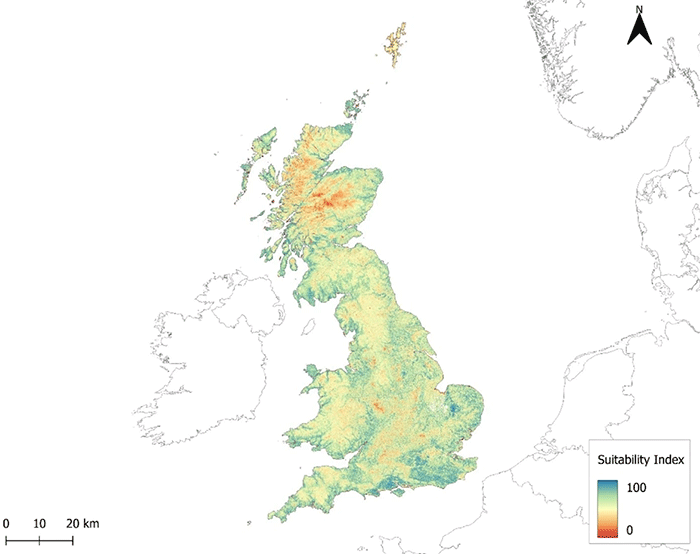
That broader European evidence is important because the surviving British range reflects centuries of human pressure as well as the animal's ecological needs. Modelling only present-day British records could wrongly treat absence caused by persecution as evidence that otherwise suitable habitat is unsuitable.
However, habitat suitability is only one part of any reintroduction decision. Road mortality, the connection between woodland blocks, prey availability, genetic considerations, possible effects on other wildlife and the views of local communities must all be examined before animals are released.
The scale of the landscape also matters. Individual male Pine Martens may range across approximately 2-25 sq km, so isolated woodland fragments that look favourable on a map must be connected well enough to support movement, breeding and a viable population.
“We now have a more complete understanding of where this special keystone species could potentially do well.”
Ella Lewis, Kent Wildlife Trust
The Wildlife Trusts linked the research to the South East Pine Marten Restoration Project, a partnership involving Kent Wildlife Trust, Wildwood Trust, Sussex Wildlife Trust, the Conservators of Ashdown Forest and Forestry England, with scientific and charitable support.
The underlying study appeared earlier in 2026, with its version of record published in August. The Wildlife Trusts' current account draws attention to its implications for restoring a native predator to more of its former British range; it does not announce a new release.
3 Sep 2026
Get Breaking Birdnews First
Get all the latest breaking bird news as it happens, download BirdAlertPRO for a 30-day free trial. No payment details required and get exclusive first-time subscriber offers.