Black and White-winged Black Terns divide feeding grounds while sharing colonies
Study finds the closely related marsh terns use different feeding habitats even though their chicks receive broadly similar prey.
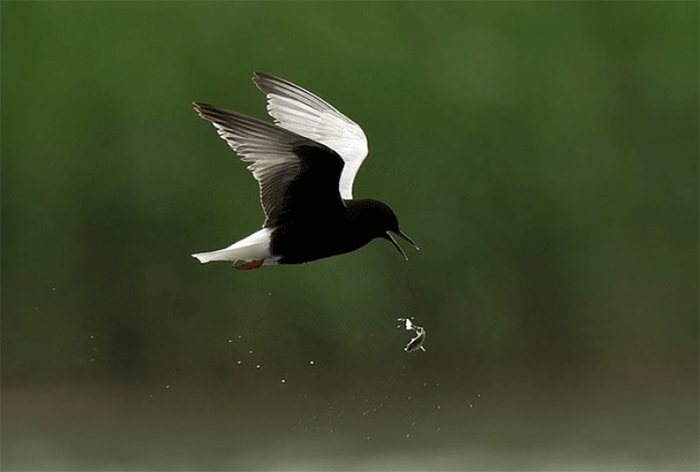
Black and White-winged Black Terns breeding in the same colonies divide the surrounding landscape when searching for food, new research in eastern Poland has found.
Scientists studied 11 mixed colonies in the near-natural Bug River valley. The colonies contained between 40 and 100 pairs, allowing the team to examine how two closely related marsh terns coexist while raising chicks in the same area.
Adult White-winged Black Terns were recorded feeding mainly over floodplain meadows, while Black Terns made greater use of the river channel. Both species used oxbow lakes at broadly similar rates.
To investigate what the chicks received, cameras recorded 5,924 minutes at 24 nests during the 2008-10 breeding seasons. The footage captured 643 prey deliveries, of which 435 could be identified to order or another useful prey category.
Despite the clear difference in feeding habitat, the chicks' overall diets overlapped substantially once variation between years was taken into account. White-winged Black Terns tended to deliver more terrestrial prey such as grasshoppers, while fish appeared more often in Black Tern deliveries, but the individual prey differences were not statistically robust after correction for multiple comparisons.
The distinction matters because a visible difference in one prey group can be misleading when many comparisons are made. By applying a statistical correction, the researchers reduced the chance of treating a coincidental pattern as reliable evidence of dietary separation.
“Niche differentiation was most evident in foraging habitat use, whereas trophic differentiation in chick provisioning was weaker and taxon-specific.”
Artur Golawski and colleagues
Brood size had a significant effect on the prey brought to nests, suggesting that the demands of the chicks also help shape provisioning decisions. The findings show that habitat choice may separate the species more strongly than diet alone.
Black and White-winged Black Terns are both adapted to dynamic freshwater wetlands, but the study shows that a mixed colony does not mean the adults use the landscape in the same way. Meadow insects and food taken from river channels can ultimately produce broadly overlapping chick diets through different foraging routes.
This division could reduce direct competition around mixed colonies and may help explain how Black and White-winged Black Terns breed alongside one another. It is particularly relevant as White-winged Tern has expanded westwards into parts of the Black Tern's European range.
The researchers caution that observations concentrated on feeding close to colonies. Longer trips beyond the watched area may have used other habitats and prey, so the study does not describe every component of the adults' foraging ranges.
The work also reflects three breeding seasons in one river system. Comparable studies elsewhere would be needed to learn whether the same division persists in wetlands with different water levels, prey communities and proportions of the two tern species.
Protecting a varied floodplain containing river channels, oxbows and meadows may therefore be more valuable than managing any one habitat in isolation. Each feature can support a different part of the feeding strategy used by the two species.
3 Sep 2026
Get Breaking Birdnews First
Get all the latest breaking bird news as it happens, download BirdAlertPRO for a 30-day free trial. No payment details required and get exclusive first-time subscriber offers.