


Female Dotterels roam across northern Europe in search of additional mates
Satellite tracking reveals females visiting up to five breeding areas during a single seven-week laying season.
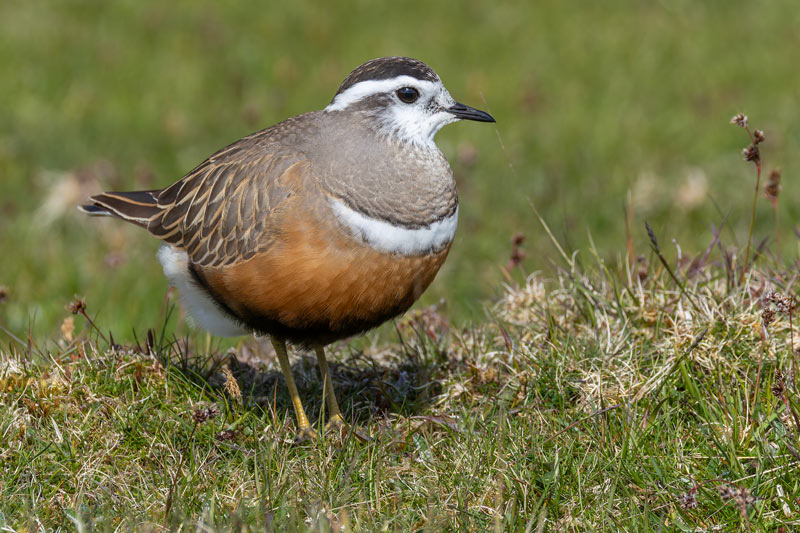
Female Dotterels can range across large parts of northern Europe during a single breeding season as they search for further mating opportunities, new satellite tracking has revealed.
Researchers followed 21 females over three breeding seasons after fitting them with solar-powered satellite transmitters weighing just two grams. Birds were tagged either on Norway's Hardangervidda plateau or while stopping in the Italian Alps during spring migration.
During an approximately seven-week laying period, individual females settled at between one and five breeding areas, with a median of three. Most successive sites were less than 100 km apart, but one bird moved 973 km between stops and the widest-ranging female covered 1,343 km in total.
The study, published in Proceedings of the Royal Society B, provides a rare view of a breeding system in which conventional sex roles are reversed. Female Dotterels are larger and more brightly marked than males, compete for partners and usually leave the male to incubate the three eggs and rear the chicks.
Early-season journeys were often northwards, which the researchers suggest may allow females to follow the retreat of snow and find birds whose breeding season is beginning later. Movements later in the season tended to be shorter and more local.
Females generally remained longest at their final destination, with a median stay of 41 days. Two birds returned to a site they had visited earlier; one made the return after spending about 20 days at a location 382 km away.
The movements show that female Dotterels can connect breeding areas previously treated as separate populations. That may prove important when interpreting local counts and assessing how the species responds to habitat and climate change across its northern range.
“Local populations of Dotterels may in fact be connected in ways we have so far missed, with the same females moving between distant sites.”
Bart Kempenaers, Max Planck Institute for Biological Intelligence
A count made at a single breeding area may therefore capture only part of a female's season. The same individual can appear in several places, while males remain behind with eggs or chicks, making the breeding population more mobile and interconnected than a conventional territory survey might suggest.
However, the satellite positions do not show what each bird did on the ground. They cannot confirm that a female mated or laid eggs at every site, and a long final stay could indicate either continued mate searching or that the female took over incubation herself.
The sample was also deliberately small because Dotterels breed in remote mountain and tundra landscapes and the tags had to be light enough for the birds to carry safely. The recorded journeys demonstrate what some females can do, but do not establish that every female follows the same strategy in every year.
The researchers say direct field observations will now be needed to establish how often females breed with multiple males and how environmental conditions influence their journeys.
3 Sep 2026
Get Breaking Birdnews First
Get all the latest breaking bird news as it happens, download BirdAlertPRO for a 30-day free trial. No payment details required and get exclusive first-time subscriber offers.




