Wild claim about eagles eating ponies triggers calls for lethal action
How one headline on White-tailed Eagle predation turned into an inevitable call to “shoot eagles”
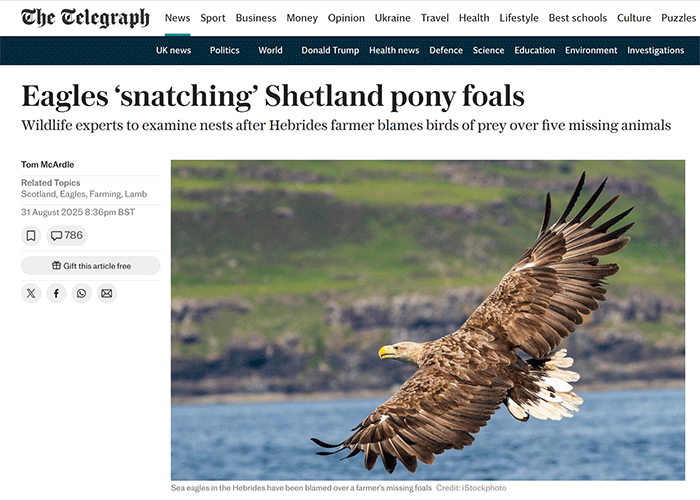
A recent blog post by Raptor Persecution UK (RP UK) takes aim at what it describes as a “sensationalist” and “absurd” claim that White-tailed Eagles snatched five Shetland pony foals on the island of South Uist. According to the post, the story — which has been widely picked up in the media — has stirred up demands for lethal control of the recovering eagle population.
Background – what was claimedThe blog notes that the claim concerns five Shetland pony foals, alleged to have disappeared and been carried off by White-tailed Eagles. RP UK states: “The absurd claim that White-tailed Eagles had ‘snatched’ five Shetland pony foals on South Uist hit the headlines at the end of August.”
They report that the crofter or farmer involved seeks help from wildlife authorities and that the story has been seized by commentators calling for immediate culling of eagles.
RP UK’s view of the claimRP UK is highly critical of the narrative. They argue that the claim lacks credible evidence and warn that the headline-grabbing allegation is being used to justify reactive wildlife policy. As they put it: “The -- inevitable call to ‘shoot eagles’ ” follows directly from the sensational framing of the story.
The blog contends that this type of story undermines conservation efforts and fuels rural conflict, and they emphasise that simply because an eagle appears large and impressive, that does not mean it can reliably snatch foals from open pasture.
Wider context and concernsThe White-tailed Eagle was once extinct in the UK but has been reintroduced in Scotland and is now present on islands such as South Uist. With their return has come renewed tensions in rural communities over possible predation on lambs and other stock.
RP UK argue that claims like the foal-snatching story exacerbate those tensions and risk leading to illegal persecution of protected birds. They stress the need for robust evidence rather than anecdotal or emotionally-charged reporting.
What we know at this stage- The claim of five foals being snatched is publicised, but no carcasses or definitive eagle-kill evidence have been presented in the blog post.
- RP UK call the story “absurd” because it leaps quickly from the disappearance of ponies to eagle predation without documented proof.
- The blog suggests that the way the story is spun inevitably leads to calls for lethal control rather than careful investigation and mitigation.
When rare or recovering predators return to landscapes, human-wildlife conflict can intensify. Stories like this, even if unproven, can influence public opinion and policy. RP UK’s critique is a reminder that high-impact claims require high-impact evidence, and that the consequences of weak evidence are not trivial when they might lead to calls for shooting protected species.
Going forward, RP UK urges those making predation claims to document the event rigorously and for wildlife agencies to respond with measured investigation rather than media-fuelled panic.
October 2025
Get Breaking Birdnews First
Get all the latest breaking bird news as it happens, download BirdAlertPRO for a 30-day free trial. No payment details required and get exclusive first-time subscriber offers.
Share this story