Urban Moorhens and Gulls Show Near-Total Microplastic Contamination
Microplastic-laden faeces from city-dwelling birds tell a troubling tale of pollution in even the most familiar habitats
Plastic pollution at unprecedented levels
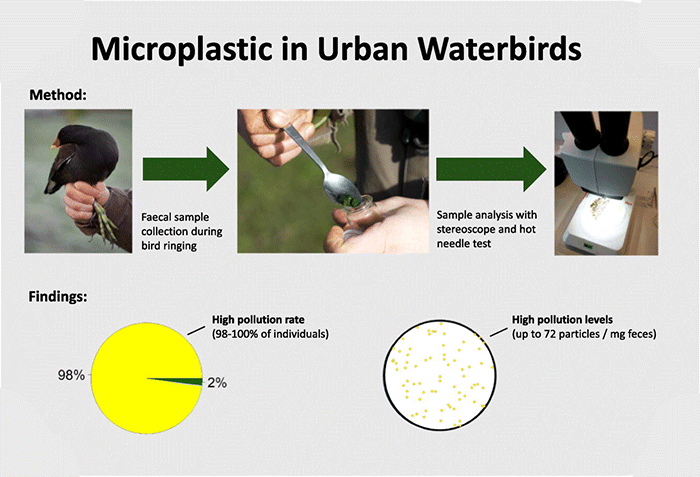
Urban waterbirds in Münster, Germany, are facing staggering levels of microplastic contamination, according to a new study that analysed faecal samples from four species. Researchers found microplastics in 98% of samples, with some containing up to 72 particles per milligram - a rate vastly exceeding previously reported figures from freshwater birds worldwide.
The findings, published in Science of the Total Environment, show that even small-scale studies using non-invasive methods like faecal analysis can uncover profound environmental problems. Birds sampled included Mallard, Jack Snipe, Black-headed Gull and Common Moorhen - all of which tested positive for microplastic particles, mainly synthetic fibres originating from urban sources.
Faeces as forensic evidence
Using samples collected during bird ringing between December 2020 and March 2021, the team detected fibres of multiple colours and types, with blue fibres being most common. The analysis revealed microplastic densities ranging from 0.26 to 72.03 particles per milligram of faeces - equating to up to 72,030 particles per gram.
Most previous studies have relied on invasive dissections, but this research highlights the power of using faecal samples to monitor pollution in live wild birds. The particles' passage through the gut system means they may already be influencing avian health, though this study found no clear link between plastic load and body condition in the Moorhen - the only species with sufficient sample size for statistical testing.
City birds at higher risk
Compared to earlier studies of ducks and other freshwater birds in rural areas or protected wetlands - where microplastics were present in 0–60% of samples - the nearly universal presence in Münster's urban waterbirds is alarming. Plastic fibres from sources such as synthetic clothing, wastewater, and tyre abrasion are likely to be accumulating in these environments.
Importantly, many of the affected species are partial migrants, meaning they may be transporting microplastics far beyond their wintering grounds. The Jack Snipe, for instance, travels to Arctic breeding sites, raising the possibility of long-distance plastic dispersal through faeces.
Next steps for monitoring and mitigation
While body condition appeared unaffected in this study, the authors caution that subtle or long-term effects may have been missed due to small sample sizes or because urban-adapted species like the Common Moorhen may be more resilient to microplastic exposure. The prevalence of soft fibres, rather than sharp fragments, may also mitigate physical harm in the short term.
The authors call for broader and seasonal studies, especially including species less accustomed to urban life. They also advocate for more stringent efforts to identify pollution sources and reduce synthetic fibre release into urban water systems. With microplastic levels potentially peaking during the non-breeding season - when birds rely more heavily on human-derived food - the study underscores the urgent need to clean up the environments we share with wildlife.
June 2025
Share this story