Understanding the plight of the much-loved English Nightingale
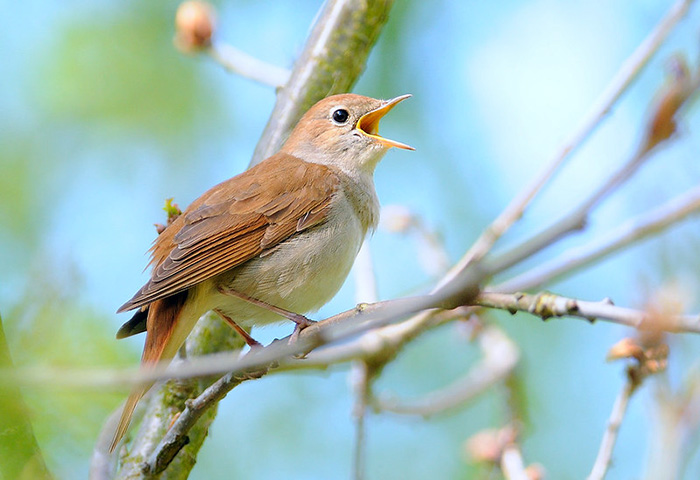
Long-famed for its complex and sweet-toned song, the Nightingale has been a source of inspiration for poets, musicians, and artists for centuries. Sadly, the mellifluous melodies of this secretive singer have become an increasingly scarce component of the English countryside’s soundscape in recent years.
Now, following innovative research by the British Trust for Ornithology (BTO) we have a better understanding of what is driving this inspirational bird’s decline.
Placed on the Birds of Conservation Concern’s Red List since 2015, the Robin-sized songster has not only declined in number as a breeding bird in the UK (-90% between 1967 and 2022), but it has also vanished from many of the areas where it was once commonly found.
Habitat loss has been a major concern in the UK as the Nightingales, which migrate here from Africa each spring, have suffered from a reduction in suitable breeding sites. Once widespread across much of south and eastern England, the diminutive songbird has lost much of its favoured nesting areas of scrubby woodland through increased development or degradation, partly as a result of an increase in deer populations.
But the Nightingale’s misfortune is not solely based on issues occurring in its traditional UK breeding areas.
A new study conducted by BTO scientists has discovered, through the deployment of tiny data-gathering tags attached to a number of the birds, that British-breeding Nightingales spend the winter months isolated from other European Nightingales, in a specific, small region in and around The Gambia, West Africa. This means that this already declining population is at greater risk from deteriorating conditions in these winter quarters, through such threats as prolonged drought and loss of habitat. Nightingales that have been tracked nesting elsewhere in Europe, spend their non-breeding season in different, much broader, areas of West Africa, and are therefore less severely impacted overall by highly localised changes.
Until now, it was not known that the regional populations of migratory songbirds had such defined connectivity; British breeding Nightingales rarely mix with other European populations while on the wintering grounds. It is hoped that advances in technology, through increasingly small and accurate tracking devices, may allow scientists to discover to what extent this phenomenon is widespread amongst other highly migratory species or restricted to certain species such as Nightingales.
Dr Chris Hewson, Senior Research Ecologist at BTO, says “Understanding how migratory birds are distributed in the non-breeding season in tropical Africa is both challenging and important for understanding their population declines. Through the use of increasingly miniaturised modern technology, we are rapidly gaining understanding which will put us in a much better position to be able to reverse the catastrophic declines of some of our most enigmatic and iconic species.”
He adds, “Here, we show that the English Nightingale population has a unique distribution pattern during our winter season, which leaves them vulnerable to both climate and habitat changes in Africa. This helps to explain why the English, but not other European, populations of the Nightingale are currently in decline.”
The full free-access paper, published in the Nature journal Scientific Reports, can be read here.
29 January 2025
Share this story