Swifts are more loyal to nest sites than partners
A 15-year study of breeding Swifts in Devon has found that most return to the same nest site each year, reinforcing calls for better protection of existing nests and wider use of Swift bricks in new buildings.
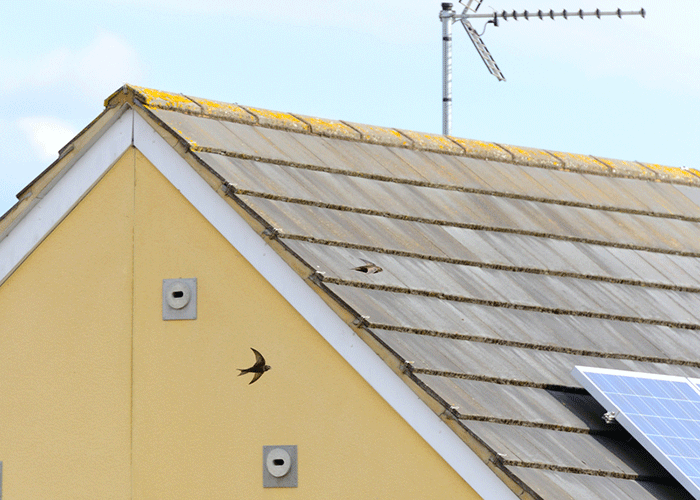
Swifts show stronger loyalty to their nest sites than to their partners, according to new research by the RSPB.
The 15-year study found that 94% of individual Swifts returned to the same nesting site used in the previous year, while only 59% of nesting attempts involved the same partner. The findings confirm what many Swift workers have long suspected - that the bond between a Swift and its traditional nest hole can be exceptionally strong.
The research was based on 190 individual Swifts from 243 nests in and around a Dartmoor village. Birds were identified using uniquely numbered leg rings, allowing researchers to follow which birds nested together and which nest box they used across successive breeding seasons.
Where both members of a pair could be identified in consecutive years, only 5.5% of known returning birds had “divorced” and paired with a new partner. Among pairs that remained together for two or more years, 89% reused the same nest site.
For a species now in steep decline, the results have direct conservation importance. Swifts have declined by 70% in the UK between 1995 and 2024, with loss of nesting places and reduced insect availability thought to be among the main pressures.
Swifts traditionally nest in small gaps and crevices in buildings, particularly under eaves and within older roof spaces. Modern building methods, renovation work and roof repairs have increasingly removed or blocked many of these spaces, leaving returning birds with fewer places to breed.
The RSPB says the new study reinforces the need to protect existing nest sites and provide suitable new ones. For Swifts returning from Africa, the loss of a traditional nest site can mean wasted time and energy during an already short breeding season, as birds must search for an alternative in an increasingly closed-up built environment.
Malcolm Burgess, RSPB Principal Conservation Scientist, said the research had documented “just how strongly faithful” Swifts are to their nest sites. He said this highlighted the importance of protecting nesting sites in neighbourhoods, warning that without more nest spaces and replacement sites where old ones are lost, further declines are likely.
The study also observed that where Swift nest sites were lost, the birds were forced to move colony. As Swifts often breed in loose colonies, the loss of individual nest sites can have wider effects, reducing the cues and opportunities that help other birds find suitable places to nest.
Swift boxes and built-in Swift bricks can provide safe nesting spaces, but their use remains inconsistent across much of the UK. Scotland has become the first UK country to make Swift bricks a legal requirement for new buildings, while elsewhere they are encouraged through planning policy but are not generally compulsory.
The RSPB argues that this does not go far enough. Carl Bunnage, Head of Nature Policy for RSPB England, said recent planning changes in Westminster were a small step in the right direction, but called for Swift bricks to become a legal requirement wherever possible, stronger controls on demolition where Swifts are or may be nesting, and better enforcement of the Wildlife and Countryside Act 1981 where nests are illegally disturbed or destroyed.
The research adds weight to a simple conservation message: for Swifts, the return to summer is also a return to a particular hole in a particular building. Keeping those places available may be one of the most practical ways to help the species remain part of Britain’s urban skies.
June 2026
Get Breaking Birdnews First
Get all the latest breaking bird news as it happens, download BirdAlertPRO for a 30-day free trial. No payment details required and get exclusive first-time subscriber offers.
Share this story