Seabirds trade survival for future breeding success after costly summers
An experiment with Kittiwakes found that birds facing high breeding costs were less likely to return, while longer winter movements were linked to greater future breeding success among the survivors.
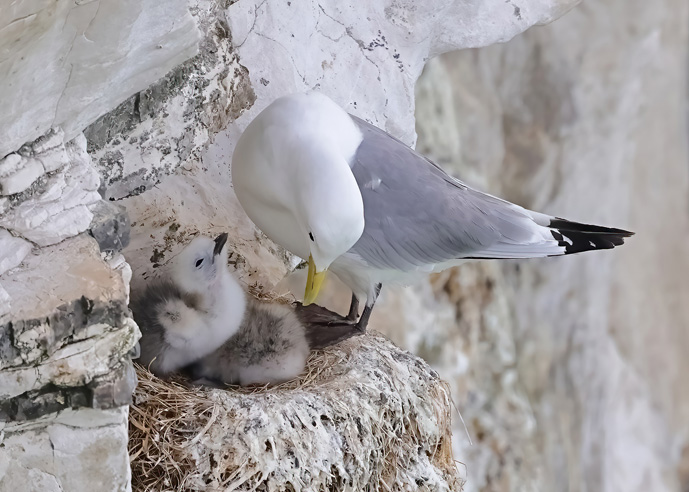
Seabirds put under unusually heavy energetic strain during one breeding season may improve their prospects of raising chicks the following year, but only by accepting a greater risk of not surviving or returning to breed, according to new experimental research.
The study followed Kittiwakes Rissa tridactyla at Middleton Island in Alaska and provides rare experimental evidence of how the cost of reproduction can continue to shape migration, survival and breeding success long after birds have left their nesting colony.
Researchers studied 251 adult kittiwakes nesting on a modified radar tower during 2021 and 2022. To alter the birds' energy balance, they supplied 105 adults with herring during incubation and chick-rearing, increased the flight costs of 57 birds by clipping flight and tail feathers, and left a further 89 as an unmanipulated control group. The birds carried light-level geolocators, while colour rings allowed the team to record which individuals returned in later years.
The difference during the experimental breeding season was stark. Only an estimated 10% of nests in the wing-clipped group fledged at least one chick, compared with 43% in the control group and 44% among food-supplemented birds. Hatching success was similar across all three groups, suggesting the higher energetic burden had its main effect during chick-rearing.
The high-cost birds then changed the timing of their annual cycle. They left the colony on average on 16 August, around nine days earlier than supplemented birds and 10 days earlier than the controls. Data from the 203 geolocators recovered the following year showed that earlier departure was associated with covering a greater total distance during the non-breeding season.
Those longer winter movements were in turn linked to a higher probability of successful breeding the next year. The authors suggest that greater mobility may have helped birds recover from the energy deficit of the previous summer, perhaps by finding richer feeding areas or reaching more favourable conditions at lower latitudes.
That delayed benefit came with an apparent survival cost. The estimated probability of surviving and returning in the following year was 67% for wing-clipped birds, compared with 83% for controls and 90% for food-supplemented birds. The difference between the high-cost and supplemented groups was statistically significant, while the comparison with controls was weaker after correction for multiple tests.
The researchers describe this ability to move energy between competing demands as "energetic flexibility". Rather than simply exhausting themselves in an attempt to save their current chicks, the high-cost birds appeared to protect their own immediate physical condition, abandon or fail in the present breeding attempt, leave earlier and redirect effort towards migration and a later chance to reproduce.
Measurements of oxidative stress supported that interpretation. Despite their heavier workload, the wing-clipped birds did not show greater oxidative damage than controls. Their reduced fledging success may therefore reflect energy being withheld from current reproduction and reserved for self-maintenance and later stages of the annual cycle.
The result does not mean that every bird experiencing a difficult breeding season will later raise more chicks. Direct comparisons found no significant difference in the following year's breeding success between the three treatment groups. Instead, modelling revealed a step-by-step pathway linking higher costs to earlier departure, greater winter travel and better subsequent breeding prospects among birds that returned.
The authors also caution that "apparent survival" cannot distinguish death from permanent movement to another colony, and no migration data could be recovered from birds that failed to return. Wing-clipping may also have affected energy use beyond the breeding period until the altered feathers were replaced during moult.
Even with those limitations, the experiment shows why the consequences of a poor breeding season cannot be judged from chick numbers alone. Decisions made under pressure can carry through the rest of the year, altering migration and shifting the balance between present reproduction, future breeding and survival.
The researchers say this flexibility could become increasingly important as climate change makes marine food supplies and ocean conditions less predictable. Understanding how seabirds redistribute energy across the full annual cycle may help improve models of population resilience in changing seas.
The open-access paper, Energetic flexibility as a hidden axis of life-history trade-offs: experimental evidence from a long-lived seabird, is published in Proceedings of the Royal Society B.
4 Aug 2026
Get Breaking Birdnews First
Get all the latest breaking bird news as it happens,
download BirdAlertPRO
for a 30-day free trial. No payment details required and get exclusive first-time subscriber offers.
Share this story