Pallid Harriers fledge four young in Northern France
A pair of Pallid Harriers has successfully nested in France's Nord department for the first time, with four young fledging from a protected nest.
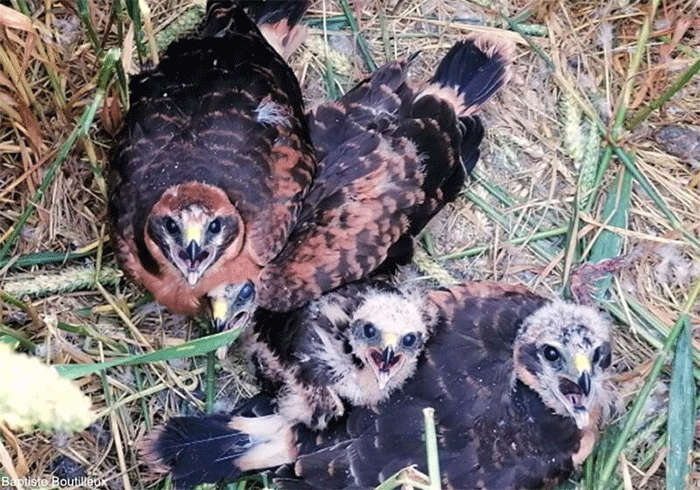
Ornithomedia is reporting that a pair of Pallid Harriers has bred successfully in the Nord department of northern France for the first time, raising four young to fledging.
The nest was discovered by chance during the 2026 breeding season and was subsequently protected by members of the local harrier conservation network. All four young survived to leave the nest and were ringed and fitted with Darvic colour rings, allowing them to be identified if they are encountered again elsewhere in Europe.
According to the Groupe ornithologique et naturaliste (GON), which coordinates harrier monitoring in Nord and Pas-de-Calais, this was the only known nesting by Pallid Harriers in France in 2026.
Although the species remains an exceptionally rare breeder in France, the Nord record continues a remarkable run of nesting attempts in the country. The first contemporary French breeding by a pair of Pallid Harriers was recorded in Pas-de-Calais in 2020. Another pair bred there successfully in 2023, fledging five young.
In 2024 two pairs attempted to breed in northern France. One in Pas-de-Calais successfully fledged four young, while a second nesting attempt in neighbouring Somme failed following predation. In 2025 a pair nested much farther south-west in Deux-Sevres and fledged one young.
The recent French breeding records form part of a broader westward shift in the distribution of Pallid Harrier in Europe. The species' main breeding range lies across eastern Europe and Central Asia, but sightings, prolonged spring stays and breeding attempts have become increasingly frequent farther west in recent decades.
Researchers studying the French records have cautioned that the increase in western European breeding should not necessarily be interpreted as evidence of overall population growth. The pattern may instead reflect a redistribution of birds from traditional breeding areas farther east.
Pallid Harrier is now a familiar scarce migrant to many western European birders, including in Britain, but successful nesting so far west of its traditional range remains a notable event. The fledging of four young in Nord adds another successful breeding site to the species' developing foothold in France.
14 Aug 2026
Get Breaking Birdnews First
Get all the latest breaking bird news as it happens,
download BirdAlertPRO
for a 30-day free trial. No payment details required and get exclusive first-time subscriber offers.
Share this story