Osprey comeback powered by a few pioneering pairs
A 54-year study of Ospreys in northern Scotland has found that rare long-distance settlers are disproportionately important in expanding the breeding range and founding new populations.
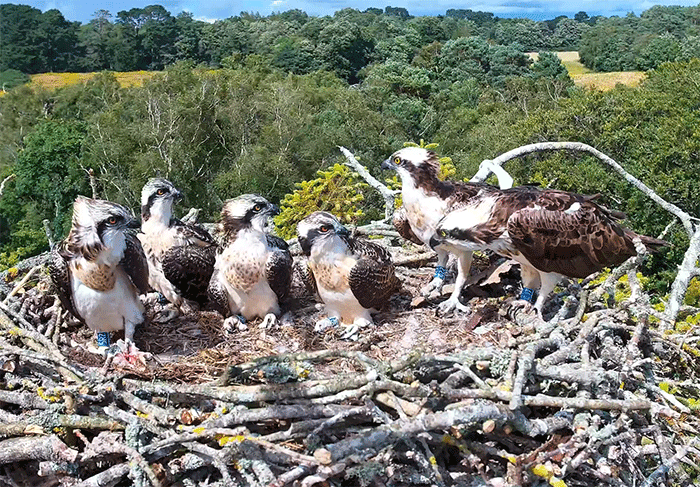
The recovery of Ospreys across Britain depends disproportionately on a small number of birds willing to establish territories well away from existing breeding pairs, according to new research based on more than half a century of nesting records from northern Scotland.
The study, led by Brittany C. Maxted of Bournemouth University and Birds of Poole Harbour with colleagues from Bournemouth University and the Roy Dennis Wildlife Foundation, analysed 54 years of recolonisation between 1954 and 2007. It is published in the Journal of Animal Ecology.
Ospreys disappeared as a confirmed breeding species from Scotland in the early 20th century, with the last confirmed pair recorded in 1916. Their modern recovery began when a pair nested at Loch Garten in 1954. The researchers used records from Highland and Moray to examine not only how numbers increased, but how the breeding range actually spread across the landscape.
Across the study period 149 nest sites were identified, of which 132 were occupied by a breeding pair in at least one year. The population reached a maximum of 73 occupied nests in 2004 and spread as far as 143 km from the original Loch Garten population source.
That expansion was far from steady. Using a conservative measure based on the combined area occupied by separate breeding subpopulations, the researchers estimated an average increase of about 53 sq km a year, yet there was no increase at all in 20 of the 54 study years. Large jumps in range were instead associated with occasional pairs settling well beyond the existing breeding population.
Spatial analysis identified eight distinct subpopulations. The nests which founded these groups were, on average, 33.8 km from the nearest nest that had already been occupied, compared with an average of just 4.7 km for nests established subsequently. Once a pioneering pair had settled, later birds tended to fill in the surrounding area and create a new cluster of breeding Ospreys.
We call these 'pioneering pairs' as they recolonize new areas, and in doing so create separate subpopulations and increase the speed of recovery.
Brittany Maxted, Bournemouth University and Birds of Poole Harbour
The effect of those pioneers was substantial. At the population scale, the annual increase in breeding-range area averaged 1,102 sq km in years when a new subpopulation was founded, compared with 151 sq km in years without a new founder.
The pattern helps explain why Ospreys can increase strongly in number without rapidly occupying all suitable parts of their former range. Ospreys are attracted to areas where other Ospreys are already breeding, while males also tend to return to breed relatively close to where they hatched. Females generally disperse further, but because males commonly select the nest site, the authors suggest that the scarcity of long-distance pioneering males can act as a brake on range expansion.
The researchers describe the resulting spread as 'stratified diffusion': long periods of local growth and infilling are punctuated by rare long-distance jumps, after which a new breeding cluster develops around the pioneers. They found that this pattern closely resembles the way biological invasions can spread, suggesting that techniques developed to model invasive species may also help predict the recovery of formerly lost native species.
The findings also have direct implications for conservation. Three of the eight Scottish subpopulations were founded at human-established nest sites, indicating that artificial nest provision can help birds settle beyond the existing range, although the study could not determine whether it actually increased the rate of expansion. The authors also argue that translocation can effectively replicate the rare pioneering movements that drive natural recolonisation, and that encouraging long-distance dispersal by males should be a particular management priority.
That approach is already familiar in England. A translocation project run by the Roy Dennis Wildlife Foundation and Birds of Poole Harbour began moving young Scottish Ospreys to Dorset in 2017. The first breeding pair there, translocated male 022 and female CJ7, raised two chicks in 2022, becoming the first Ospreys to breed successfully in southern England since 1847. The pair has continued breeding, while further birds associated with the growing Dorset population are now beginning to establish territories elsewhere.
The Scottish data also provide a warning against assuming that natural recolonisation will proceed smoothly simply because a species is increasing. The paper concludes that models based on average dispersal or expansion rates risk overestimating how quickly empty parts of a former range will be recolonised, because most of the real spatial recovery is delivered by a very small number of exceptional movements.
The full research paper, Long-term patterns of breeding range expansion mirror invasion dynamics during recolonisation of a semi-colonial raptor, can be read in the Journal of Animal Ecology.
14 Aug 2026
Get Breaking Birdnews First
Get all the latest breaking bird news as it happens,
download BirdAlertPRO
for a 30-day free trial. No payment details required and get exclusive first-time subscriber offers.
Share this story