


Mute Swans hide nests when breeding near Whooper Swans
Polish research suggests Mute Swans choose more concealed nest sites when breeding alongside larger, territorial Whooper Swans.
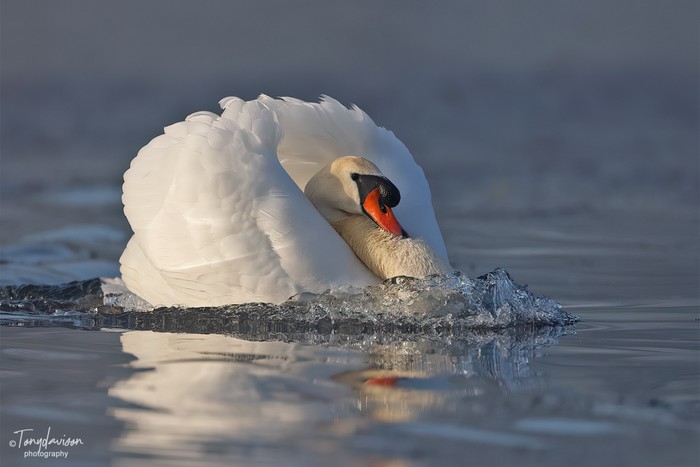

Mute Swans nesting in Polish fishpond complexes chose more concealed sites where they shared the breeding landscape with Whooper Swans, according to research examining how an expanding, strongly territorial neighbour can alter another species' behaviour.
Ornithomedia are reporting the study after it compared nest placement at two sites in central and southern Poland. The underlying paper in European Zoological Journal asked whether the presence of Whooper Swans was associated with greater concealment or isolation of Mute Swan nests.
Whooper Swans have expanded their breeding distribution in parts of lowland Poland. They are larger than Mute Swans and can defend territories aggressively, creating a natural opportunity to test how an established species responds when a close relative begins to occupy the same ponds.
The researchers measured habitat around nests and the spatial relationships between neighbouring pairs. They then combined multiple variables into three indices describing concealment, isolation and the joint effect of those two strategies. Mixed-species systems were compared with sites occupied only by Mute Swans.
The clearest signal concerned vegetation rather than distance. Where Whooper Swans also bred, Mute Swans placed nests deeper within concealing habitat. The index of spatial isolation contributed less to explaining the variation, suggesting that screening a nest could be a more practical response than simply moving farther away in a bounded fishpond landscape.
Wiktoria Szewczuk and colleagues describe the result as a behavioural adjustment associated with interspecific competition. Their models found that the response to Whooper Swans was more pronounced than patterns linked to interactions among neighbouring Mute Swan pairs.
Mute Swans adjust their nesting behaviour in the presence of Whooper Swans.
Wiktoria Szewczuk and colleagues
Concealment could reduce the chance of a nest being detected or approached by a territorial rival, but it may carry trade-offs. Dense reed vegetation can restrict visibility and access to open water, while nest placement also has to account for flooding, predators, human disturbance and suitable construction material.
The study does not show that a particular bird observed a Whooper Swan and then deliberately moved its nest. It compares breeding systems and habitat choices, so unmeasured differences between ponds may contribute to the pattern. Repeated observations of marked individuals would be needed to demonstrate behavioural change within the same pair.
Nor does concealment necessarily mean better breeding success. A related Polish study of 80 Mute Swan pairs found that competition with Whooper Swans was associated with changed habitat use and reproductive output, but nest-site selection and the number of young produced can be influenced by many local conditions.
The result matters because range expansions do not affect only food supplies or the number of occupied territories. A new competitor can reshape where another species breeds within the same wetland, potentially changing exposure to predators, people and extreme weather even before a population decline is visible.
Fishponds are managed habitats, and water levels, reed cutting and access rules can determine whether concealed nest sites remain available. Conservation decisions based on a simple count of ponds may therefore miss the finer structure that allows two large swans to breed in the same complex.
Further work across more sites is needed before the Polish pattern can be generalised across Europe. For now, it provides evidence that the northward and westward expansion of Whooper Swans is producing a measurable ecological response in a familiar resident species, expressed in the hidden architecture of its nest sites.
17 Oct 2026
Get Breaking Birdnews First
Get all the latest breaking bird news as it happens, download BirdAlertPRO for a 30-day free trial. No payment details required and get exclusive first-time subscriber offers.




