How beak size affects the singing and evolution of songbirds
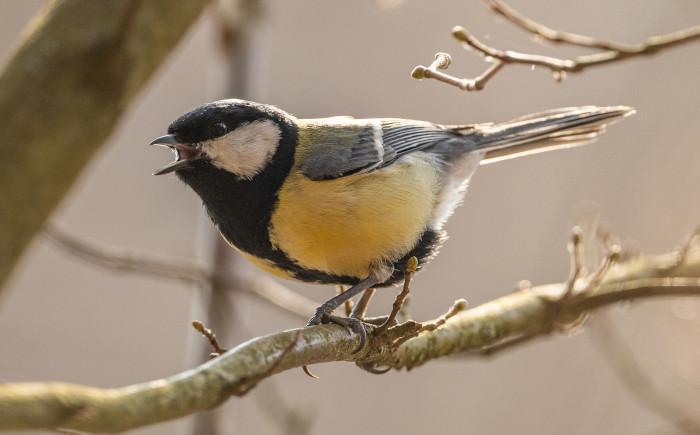
The Java sparrow is ready for the video recording. As I hold it carefully in my hand in order to transfer it to the recording cage, the little gray bird bites my finger with its thick red bill. Ouch! Though the bite isn't serious, my finger still hurts the next day.
With my Ph.D. project at the Functional Morphology Lab of the University of Antwerp, I aim to understand how songbirds use their beaks to feed on seeds. How do they remove the husk of a seed without crushing the nutritious inner kernel? Which beak movements are involved in such a sophisticated task? How fast does the beak move? To answer these questions, I'm recording high-speed X-ray videos of the feeding birds. Interestingly, I discovered some fascinating differences in beak movement between hard-biting and weak-biting songbirds.
There is huge variability in beak size and bite force among songbird species. In the famous Darwin's finches from the Galápagos Islands, for instance, there is a 40-fold difference in bite force between the tiny-beaked Green Warbler-finch and the massive-beaked Large Ground-finch. Relative to their body size, Large Ground-finches have the strongest bites of all birds. I would never handle one without gloves.
In my research, I work with Java sparrows and domestic canaries. The bite of the former is more than three times stronger than that of the latter. But when analyzing the videos of the feeding birds, I observed that the hard-biting Java sparrows often crushed the whole seed and were left with broken bits of kernel and shell, most of them falling out of their beaks. This almost never happened with the canaries, who removed the husk with extraordinary diligence and skill. Furthermore, the hard-biting Java sparrows "chewed" at about 35% lower frequencies than the weak-biting canaries. Thus, stronger beaks are slower. We call this a force-velocity trade-off.
Such a trade-off between force and speed is nothing unexpected or new. It is a mere consequence of the properties of muscle fibers and the function of joints in vertebrates in general. But for songbirds in particular, it has consequences that go far beyond feeding performances.
Songbirds with strong bites are not only slow eaters, they are also slow singers. My colleague Jana De Ridder recorded Java sparrows singing and discovered that they oscillate their large beaks on average at three times lower frequencies than canaries. Similar patterns have been described in Darwin's finches. We can say that, in general, large-billed species produce fewer syllables per second; they sing at lower trill rates. But that's not all. They also sing with a lower vocal range and at a lower pitch!
It might not be a huge surprise that birds with enormous differences in biting force sing differently. But interestingly, even birds of the same species show small differences in their song based on much subtler differences in beak size. And such variations within species are essential if we want to understand how the force-velocity trade-off affects songbird evolution.
When birds need to adapt to new food sources, beak size can change within a few generations due to natural selection. With the force-velocity trade-off at play, this will change a songbird's way of singing as well. Over time, individuals in a given population may develop and get used to their own variants of birdsong. And because songbirds mostly choose their mates based on song, they might start to prefer mating with each other over mating with their conspecifics from other populations. Researchers think that such picky mate choices may initiate reproductive isolation, which could eventually lead to the emergence of a new species. This idea was recently confirmed once again. In a study published in Science in October 2024, researchers from the University of Massachusetts demonstrated that Darwin's finches no longer recognize the songs of conspecifics whose beak shape has evolved due to ecological adaptation.
The evolutionary history of songbirds is more than 40 million years old. The lineage has thus far evolved into approximately 5,000 species, each producing their own unique song. We'll never be able to reconstruct the cause of events in that many speciation events, but it is likely that force-velocity trade-offs have made a difference.
I want to invite you to listen carefully to the birds around your neighborhood. Do you recognize differences in trill rate and pitch? Without seeing the birds, can you guess which ones may have stronger beaks than others? You will notice that harder-biting birds might sing more slowly, but that doesn't make their song less beautiful.
Maja Mielke, The Conversation
6 Feb 2025
Share this story