


Honey Buzzards sometimes take nestling birds
Camera traps in Russia and Spain reveal a little-seen side to a raptor famous for feeding on social wasps.
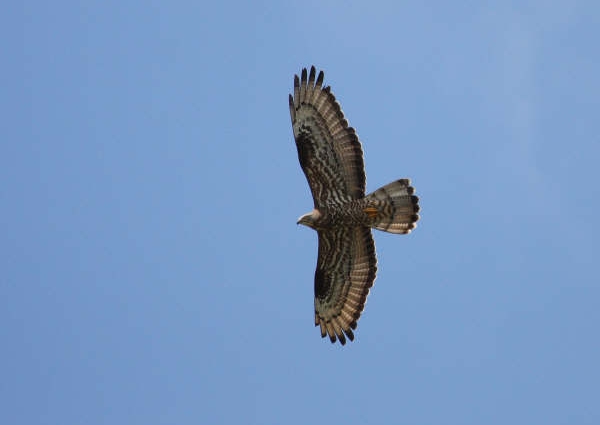
Ornithomedia are reporting evidence that European Honey Buzzards sometimes raid the nests of woodland passerines, adding an unfamiliar detail to the feeding ecology of a raptor best known for excavating the combs of social wasps.
The report draws together camera work in Russia and Spain. It does not overturn the familiar picture of a wasp specialist: insects remained the main food in the Spanish study. Instead, the observations show how vertebrate prey can supplement that diet, particularly around the start of the Honey Buzzard breeding season.
At Voronezh Nature Reserve in south-western Russia, V S Shevchenko and P D Vengerov placed cameras at 147 nests belonging to seven passerine species during 2024 and 2025. The sample included Song Thrush, Blackbird, Chaffinch, Blackcap, Garden Warbler, Hawfinch and Common Chiffchaff.
Predators destroyed 85 of the monitored nests and could be identified in 48 cases. Male Honey Buzzards were responsible for six recorded raids: two Blackbird nests, two Chaffinch nests, one Blackcap nest and one Hawfinch nest.
All six attacks occurred between 14 May and 1 June, when the raptors were beginning their own breeding cycle and many passerines were already feeding young. Most involved nests containing chicks rather than eggs.
It mainly attacked nests with nestlings, eating them on the spot or carrying them away.
Shevchenko and Vengerov, Nauka Yuga Rossii
The authors describe the behaviour in their paper, The European honey buzzard (Pernis apivorus) is an active nest predator of forest passerine birds, published in Nauka Yuga Rossii. Cameras showed nestlings being consumed at the nest or removed, although the destination of birds carried away could not always be established.
A complementary view comes from north-west Spain, where cameras watched 24 Honey Buzzard nests between 2018 and 2021. The Journal of Avian Biology study recorded food brought to the raptors' own young rather than attacks at passerine nests.
Social wasps accounted for about 82% of the prey delivered in Spain, confirming the species' central dependence on that resource. Vertebrates nevertheless formed most of the remaining items, and featherless nestlings were delivered more often than feathered birds. Reptiles were also represented.
The proportion of vertebrate prey fell as the Honey Buzzard chicks grew. It was highest early in the nesting period, when established wasp colonies may be harder to find and small vertebrates can offer an alternative source of protein. The researchers proposed that vertebrates complement rather than replace wasp brood.
Neither study establishes how often nest predation occurs across the species' European range. Cameras at passerine nests are more likely to detect a raid than observations centred on the raptor, while cameras at Honey Buzzard nests record only prey that adults choose to bring home. Together they document a real but apparently secondary part of the diet that direct field observation can easily miss.
11 Oct 2026
Get Breaking Birdnews First
Get all the latest breaking bird news as it happens, download BirdAlertPRO for a 30-day free trial. No payment details required and get exclusive first-time subscriber offers.




