


First Ospreys hatch at RSPB reserve in England since Victorian times
Three chicks have hatched at RSPB Campfield Marsh in Cumbria, marking the first successful breeding by Ospreys on an RSPB nature reserve in England since the Victorian period.
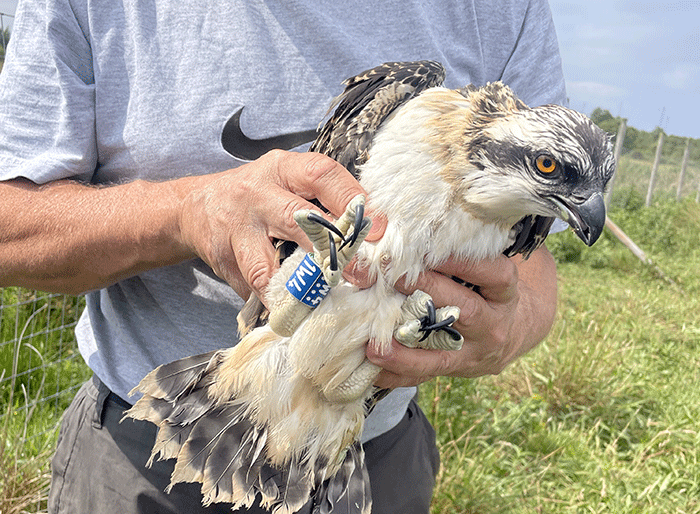
Ospreys have bred successfully at RSPB Campfield Marsh in Cumbria, producing three chicks in what the RSPB says is the first successful breeding by the species on one of its English nature reserves since the Victorian period.
The chicks hatched between 7 and 14 June after a pair settled on an artificial nesting platform at the reserve on the southern shore of the Solway Firth. They were fitted with leg rings in July, allowing future sightings to help track their movements after fledging.
The adult male, Blue 571, was ringed in Dumfries in 2021, while the female is unringed and of unknown age and origin. The pair, believed to be first-time breeders, arrived at Campfield Marsh in April and eggs were laid between 30 April and 6 May.
A local primary school helped name the chicks. Ash, ringed 1W5, is of unknown sex; Bowness Bobbi, 1W6, is a female; and Beau, 1W4, the smallest of the three, is a male. The young birds are expected to fledge during August and are likely to remain around the Solway for a period while they develop their fishing skills.
We are incredibly excited to be the first RSPB reserve in England to host a pair of breeding Ospreys. We were on tenterhooks after the eggs were laid and throughout the incubation period until they hatched. There was a huge collective sigh of relief when they did.
Mhairi Maclauchlan, Site Manager, RSPB Campfield Marsh
Osprey disappeared as a breeding species from the UK in the early 20th century following centuries of persecution. Natural recolonisation began in Scotland in the 1950s, and the species has since expanded into other parts of Britain. The RSPB now puts the UK population at an estimated 316 breeding pairs, with Scotland remaining its main stronghold.
Campfield Marsh supports a mosaic of saltmarsh, peat bog, farmland and wet grassland. Management of water levels, ditches and drains benefits wintering waders and wildfowl, while the Osprey nesting platform was installed specifically to encourage the species to breed at the reserve.
The chicks are expected to begin their first migration towards West Africa from September, a journey likely to take around four to six weeks. Ospreys often show strong fidelity to breeding sites, raising hopes that the adults will return to Campfield Marsh in future years and that some of their offspring may eventually establish breeding territories of their own.
The RSPB is encouraging visitors to see the Ospreys at Campfield Marsh during August before the birds depart on migration. Further information about visiting the reserve is available on the RSPB Campfield Marsh website.
11 Aug 2026
Get Breaking Birdnews First
Get all the latest breaking bird news as it happens,
download BirdAlertPRO
for a 30-day free trial. No payment details required and get exclusive first-time subscriber offers.
Share this story




