How high do Curlews fly over the North Sea?
Tracks from 335 Curlews show why a single average flight height is a poor guide to their exposure to offshore turbines.
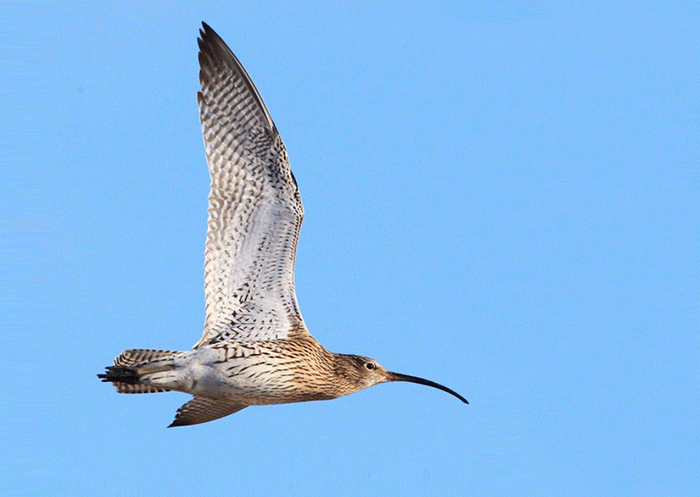
A Curlew crossing the North Sea might fly little more than a hundred metres above the water, or several times higher. In a tracking study of 335 birds, the median flight height was 108 metres, yet the average was 338 metres. For anyone assessing where migrants might encounter offshore wind turbines, the gap between those two figures is one of the most useful findings.
Chris Thaxter and colleagues brought together GPS tracking data collected between 2014 and 2025. In their Movement Ecology paper, they asked four questions about Eurasian Curlews: where they flew, when they made the crossing, how high they travelled and how quickly they moved over the ground. The tracks were concentrated in the southern North Sea. Many followed coasts or crossed shorter stretches of open water between Britain and the Continent, rather than cutting across the widest part of the sea.
The busiest periods for passage were an hour in the evening, from 20:00 to 21:00, and another in the early morning, from 03:00 to 04:00. Both were generally periods of low light. It was not simply that more birds were travelling after dark. The researchers also found lower flight heights at night, particularly between about 20:00 and 04:00, and in autumn rather than spring.
Weather helped explain why birds on the same migration could be recorded at very different heights. With a stronger following wind, Curlews tended to fly higher and make faster progress over the ground. Headwinds and crosswinds showed the opposite pattern. Rain mattered too, as the team notes in its account of the results:
Lower flight altitudes were recorded during periods of higher precipitation.
Chris Thaxter and colleagues, Movement Ecology
Spring migrants generally travelled faster than autumn ones. A west-south-westerly wind is more likely to help a bird on the spring leg of its journey, but that was not the entire explanation. The researchers found that spring birds also moved faster relative to the air itself. They suggest that the difference may reflect how the birds undertake spring migration, as well as the wind available to carry them. They found no difference in ground speed between males and females.
A median of 108 metres means half of the measured heights fell on either side of that value. The much higher mean reflects the influence of higher flights. Neither number, on its own, describes the height of a bird approaching a particular turbine on a wet autumn night. For an offshore assessment, the tracks instead offer a way to match the likely route, time of passage and weather to the location under consideration. They do not establish how many birds struck turbines, or how many changed course to avoid them.
16 November 2026
Get Breaking Birdnews First
Get all the latest breaking bird news as it happens, download BirdAlertPRO for a 30-day free trial. No payment details required and get exclusive first-time subscriber offers.