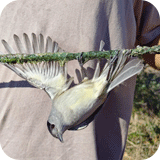
Citizen science images help identify elusive Kermadec Storm Petrels
New study resolves long-standing identification problem and reveals rare seabird occurring beyond its known range
A new study has used thousands of photographs from birdwatchers to solve a long-standing identification challenge among White-faced Storm Petrels, allowing researchers to reliably distinguish between similar-looking forms at sea. The research, published in Diversity and Distributions, focused on the White-faced Storm Petrel Pelagodroma marina complex in the Southwest Pacific, where three subspecies occur but are rarely identified with confidence in the field.
By applying a new trait-based method to more than 1,000 individuals, the study was able to confirm the presence of the poorly known Kermadec Storm Petrel P. m. albiclunis away from its core breeding range in the Kermadec Islands. Records from south-eastern Australia were identified, representing rare and previously uncertain occurrences of this ‘Nationally Critical’ taxon at sea.
Although nine physical traits were assessed, the study found that just two features - rump colour and tail shape - were sufficient to reliably separate the three forms. Birds with a predominantly white rump and square tail corresponded to Kermadec Storm Petrel, while grey-rumped birds could be split between Australian and New Zealand forms based on tail shape. This provides clear, evidence-based criteria for field identification, something that has previously been poorly defined and inconsistently applied.
The analysis also showed that all three forms occur outside their core breeding areas, with movements between Australia and New Zealand more frequent than previously understood. These findings suggest that the at-sea distributions of these birds overlap more extensively, with implications for understanding their ecology and exposure to threats.
The study highlights the growing importance of large photographic databases, particularly those contributed by birders, in tackling difficult identification problems. By combining these datasets with statistical analysis, researchers were able to validate identification features and uncover distribution patterns that would otherwise remain undetected.
Improved identification allows more accurate mapping of rare and poorly known taxa such as Kermadec Storm Petrel, helping to inform conservation planning and future at-sea survey efforts. The authors suggest that the same approach could be applied to other difficult or cryptic species, offering a practical way to close long-standing gaps in knowledge.
April 2026
Get Breaking Birdnews First
Get all the latest breaking bird news as it happens, download BirdAlertPRO for a 30-day free trial. No payment details required and get exclusive first-time subscriber offers.
Share this story