Captive-bred Great Indian Bustards take first steps in the wild
Two males released in Rajasthan mark the transition from building a conservation-breeding population to testing reintroduction methods.
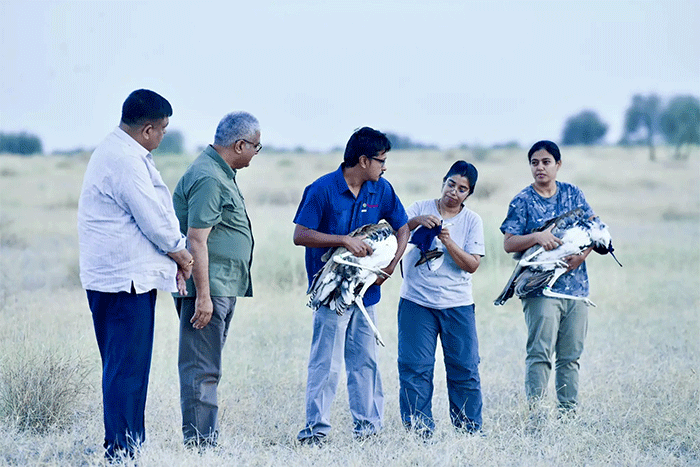
Two captive-bred male Great Indian Bustards have been released in Desert National Park, Rajasthan, beginning the first field test of reintroducing birds produced by India's decade-long conservation-breeding programme.
The birds left a soft-release facility at Sam, Jaisalmer, on 4 October. India's Ministry of Environment, Forest and Climate Change describes the move as a transition from establishing a viable captive population towards rewilding and strengthening the remaining wild population.
Great Indian Bustard is Critically Endangered and survives mainly in the Thar Desert. Current estimates put the wild population at about 150 birds. Habitat loss, disturbance and collisions with overhead power lines have contributed to a collapse that left the species absent from much of its former range.
The release is part of a programme run by the environment ministry, Rajasthan Forest Department and Wildlife Institute of India, with technical support from the International Fund for Houbara Conservation. Eggs have been collected from wild nests since 2019 for artificial incubation and hand-rearing at centres in Sam and Ramdevra.
The facilities currently hold 97 bustards: 40 hatched from wild-laid eggs and 57 bred in captivity. Eighty-six are being retained for reproduction and 11 have been identified for eventual release. The programme produced 24 live chicks in 2025 and 29 in 2026.
The release marks an important transition in India's GIB conservation programme.
India's Ministry of Environment, Forest and Climate Change
Managers are also testing a "jumpstart" method intended to preserve natural parental care. Captive-laid eggs were placed into wild nests and accepted by incubating females, producing six chicks in Rajasthan and two in Gujarat. The approach may increase output without requiring every chick to be reared in captivity.
Habitat work is being carried out alongside breeding. Rajasthan has established about 200 sq km of fenced grassland enclosures inside Desert National Park. Long-term telemetry by the Wildlife Institute of India identified these areas as important breeding habitat, and fencing is intended to reduce disturbance and other pressures.
The released males will supply evidence rather than an instant population boost. Researchers need to learn how captive-bred birds forage, avoid hazards, range through the desert and interact with wild bustards. Those results will be used to refine preparation, timing, soft-release procedures and the selection of later birds.
Reintroduction cannot remove all the threats outside managed enclosures. The Supreme Court of India has considered the collision risk from power infrastructure in bustard habitat, and conservation action is being guided by recommendations from an expert committee established through that case.
Neither survival nor successful integration of the two males has yet been reported. Their release is nevertheless a distinct milestone: India now has enough captive-bred birds to move from emergency insurance breeding to cautious, monitored trials in the landscape where recovery must ultimately take place.
8 Oct 2026
Get Breaking Birdnews First
Get all the latest breaking bird news as it happens, download BirdAlertPRO for a 30-day free trial. No payment details required and get exclusive first-time subscriber offers.