Bird surveys enter the AI age, but drone disturbance concerns remain
A new global dataset shows how machine learning can identify birds in drone imagery far faster than human observers, but other research has warned that drones can also disturb sensitive shorebirds and wintering waterbirds.
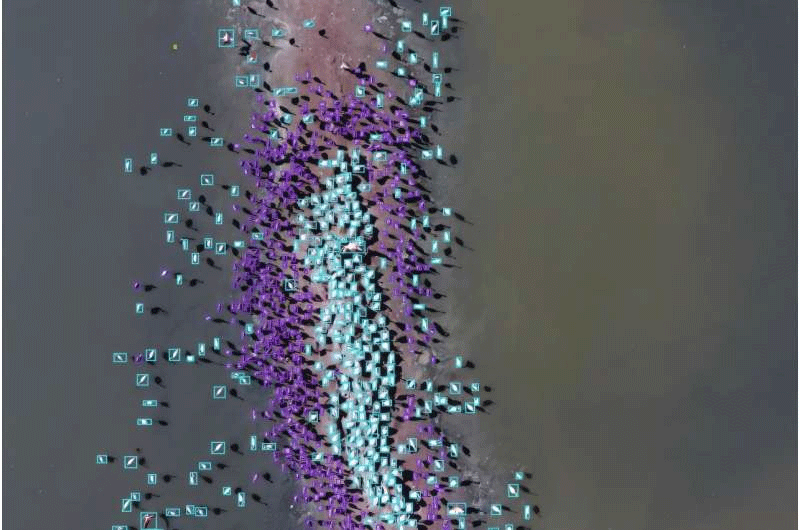
Drones and artificial intelligence could help researchers monitor birds at a scale that would previously have been difficult, expensive or impossible, according to a new study bringing together one of the most detailed global datasets of birds photographed from the air.
The paper, published in Remote Sensing in Ecology and Conservation, describes “Big Bird”, a global dataset of drone images annotated to species level. The project brought together contributions from 33 researchers and includes 23,865 images taken using 21 different cameras across 11 countries and all seven continents.
Of these images, 4,824 were labelled in detail, covering 49,990 individual birds from 101 species. Each bird was marked in the image and annotated with biological information including species, posture, age and, where possible, sex. The researchers then used the dataset to train a computer vision model capable of detecting and identifying birds in drone imagery.
The results show the promise of combining drones with AI. Once trained, the model processed images 85 times faster than manual methods. It performed strongly at detecting birds, achieving a mean average precision of 0.91, although identifying birds to species, age and sex was more difficult, with a lower mean average precision of 0.65.
That distinction matters. Counting birds from aerial imagery is useful, but many conservation questions require more than a total number. Researchers may need to know which species are present, how many chicks are visible, whether adults and juveniles can be separated, or whether different species are using the same site in different ways.
The study also shows where the technology still has limits. Performance was better when birds were larger in the image, when the model had more training examples, and when the test images were more similar to the images used during training. Accuracy fell where birds were similar in size and plumage, or where there were fewer examples for the model to learn from.
The dataset is dominated by medium to large waterbirds, with small terrestrial birds less well represented. This means the approach may currently be most useful for colonies, flocks and open habitats where birds are visible from above, rather than for small, cryptic or canopy-dwelling species.
The paper makes a strong case for the value of drones in conservation. They can reach places that are hard or unsafe for people to survey, cover large areas, and create permanent image records that can be checked and reanalysed. Used carefully, they may help monitor seabird colonies, waterbird gatherings, wetland birds and remote breeding sites with less need for repeated ground access.
However, the wider evidence also shows why drone surveys cannot be treated as automatically low-impact. Research in Moreton Bay, Queensland, found that many shorebird species were not strongly disturbed when a small drone remained above 60 metres, but the critically endangered Eastern Curlew reacted even when approached at Australia’s maximum legal altitude of 120 metres. When Eastern Curlews flushed, other nearby birds could also take flight, creating a wider disturbance effect across mixed flocks.
Another study, led by the British Trust for Ornithology, found that wintering waterbirds including ducks, geese, swans and waders could be scared into flight by drones. Larger flocks were more likely to flush, and birds in some habitats, including coastal and arable farmland sites, appeared more sensitive than those at inland lochs with regular human activity.
This matters because disturbance is not just a momentary inconvenience. Birds forced to take flight use energy, lose feeding or resting time, and may abandon favoured areas if disturbance is repeated. For migratory shorebirds and wintering waterbirds, which depend on limited windows for feeding and recovery, even small additional pressures can become significant.
The new AI work therefore points towards a more balanced future for drone-based bird surveys. The technology could make monitoring faster, cheaper and more consistent, but its use will need clear protocols that reflect species sensitivity, flock size, season, habitat and local regulations.
The study itself took steps to reduce disturbance during fieldwork, including launching drones away from birds and stopping approaches when birds showed alarm behaviour. That kind of caution is likely to be central if drone surveys are to deliver better conservation data without adding to the pressures faced by the birds they are intended to protect.
June 2026
Get Breaking Birdnews First
Get all the latest breaking bird news as it happens, download BirdAlertPRO for a 30-day free trial. No payment details required and get exclusive first-time subscriber offers.
Share this story