


After dark, Bobolinks tell a different story
Satellite tracking reveals a little-seen side of this grassland bird’s summer life, with implications for how to protect its habitat.
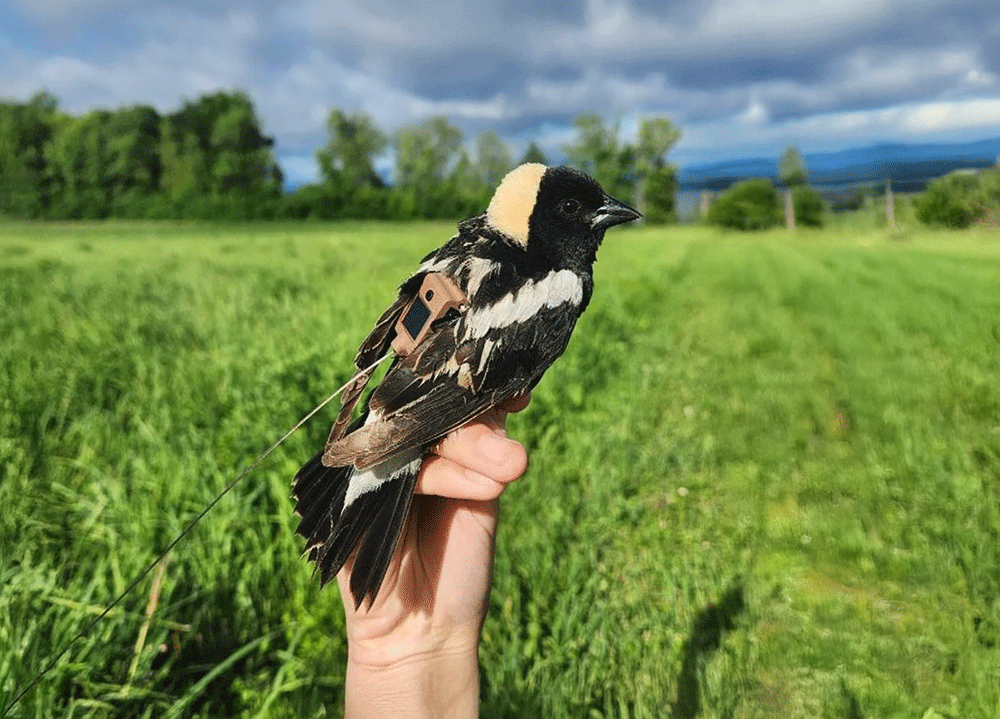
Miniature satellite transmitters have revealed that some male Bobolinks make temporary journeys of up to 17 km away from their established breeding-season home ranges.
Researchers tracked 26 adult males between 2021 and 2024 at two agricultural sites in the north-eastern United States: an 800-hectare landscape of connected hayfields and pasture at Shelburne Farms in Vermont, and an isolated eight-hectare hayfield at the Hudson Valley Farm Hub in New York.
The birds weighed an average of 32.5 g and carried two-gram solar-powered Argos tags. Including the harness, the equipment represented about 6% of average body mass during breeding, above the conventional preferred range of 3-5%. The researchers said a pilot study found no observable effect on flight performance and restricted tagging to the heavier males.
Nine of the 25 birds with sufficient breeding-period data made temporary forays beyond their normal ranges. These included four of 17 tracked in Vermont and five of eight in New York, with the longest journey reaching 16.7 km.
The authors suggest that extra-pair mating could be one explanation, because male Bobolinks sometimes travel beyond their territories in search of additional breeding opportunities. The tags could not reveal the purpose of an individual journey, however, so the connection remains a hypothesis rather than a demonstrated cause.
Landscape context also affected how the birds used space. During nesting, males at the large Vermont site occupied larger home ranges and retained more grassland within them than birds based at the small, isolated New York field. Those differences in range size disappeared after fledging, although the Vermont birds continued to use landscapes with more grassland cover.
The tags also recorded nocturnal flights before migration in most individuals. These movements may help birds assess conditions, relocate to moulting or staging areas or prepare for the much longer journey south, but their precise function is not yet known.
Bobolinks travel about 20,000 km each year between North American breeding grounds and wintering areas in South America. They depend on grasslands at both ends of the route and on stopover habitat in between, while mowing and grazing can destroy nests during the breeding season.
Because the study followed only two sites and a modest number of males, the authors treated the site comparisons as detailed descriptions rather than a test of a universal landscape rule. The satellite data nevertheless show that the area used by a small songbird can extend far beyond the field in which it was first observed.
The researchers argue that maintaining networks of connected grasslands, rather than isolated breeding patches alone, will be important for Bobolinks. They also highlight the need to protect Caribbean stopover sites used during the species' transcontinental migration.
24 Sep 2026
Get Breaking Birdnews First
Get all the latest breaking bird news as it happens, download BirdAlertPRO for a 30-day free trial. No payment details required and get exclusive first-time subscriber offers.




