Finders-in-the-field: Least Sandpiper, Isles of Scilly, July 2015
by Bob Dawson

At around 2pm on Thursday July 16th, as part of my recuperation from lower back trouble, I went for a shuffle around the meadow on St Agnes with Wilf the faithful (if slightly goofy) hound. Looking over the Big Pool, among the usual swallows and house martins I saw a mixed group of Dunlin and Sanderling flying back and forth as if trying to land. As with a redshank the day before, they couldn’t find anywhere to pitch down and cleared off over Periglis bank.
Cursing the fact that water levels hadn’t dropped quite low enough for waders (!) I shuffled on in their direction to try and see them again, check for colour rings etc. As an afterthought, I scanned the margin that I could see, and was amazed to see a small wader settled on the edge. ‘Hallelujah, a Common Sand!’ I thought. Er. No. Not. I was now distinctly curious – all I could see was an apparent pectoral band and white belly. Then the bird started moving about, feeding. Pec Sand? Surely too small. A stint then. Mooching about. Temminck’s? Hmm. Looks a bit bright. Little? At this point I phoned Doug Page to say I had a stint on the pool, and made my way around the pool for a closer look. I soon relocated the bird, and almost immediately it walked around a muddy clump revealing yellow legs – yikes! Could this be a Least Sand?!
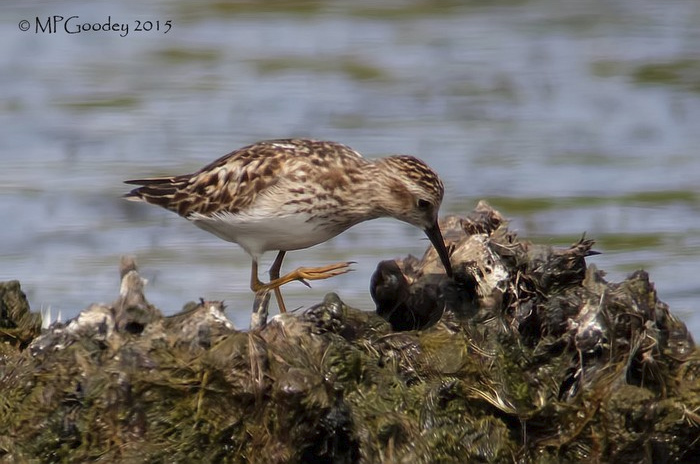
Doug arrived shortly after and I said about the pale legs. We had a look at the bird and knew we had something good. Least Sand was looking very, very good. However, what about ‘the other one’? You know, ‘that one’? Fortunately Doug had seen Long-toed Stint and was pretty confident that this wasn’t one. But that didn’t prevent a whole lot of double and triple-checking, trips to drop Wilf off, get a scope, field guides and a camera for some kind of record shot.
The bill looked a little long (a female perhaps?) and one or two other small features were naggingly perhaps not quite ‘perfect’. However, I told birders on St Mary’s that it was 90% Least Sand and when Doug got back to check his books, he was convinced it was. A group of birders made it across from St Mary’s on the Spirit and quickly and unanimously the verdict of an adult Least Sandpiper was upheld. I was relieved that it had stuck around for the three hours since I first found it until the guys arrived. It was also still present the next day when light conditions were much better, and it also called once (matching the call of least) in one of its occasional short fluttering flights from mud clump to mud clump.
Despite having seen many Least Sandpipers in North America over the years, the lone bird out of context caused no end of problems – thankfully resolved with minimum fuss! And there were three common sands the next morning...
Bob Dawson
20 Jul 2015


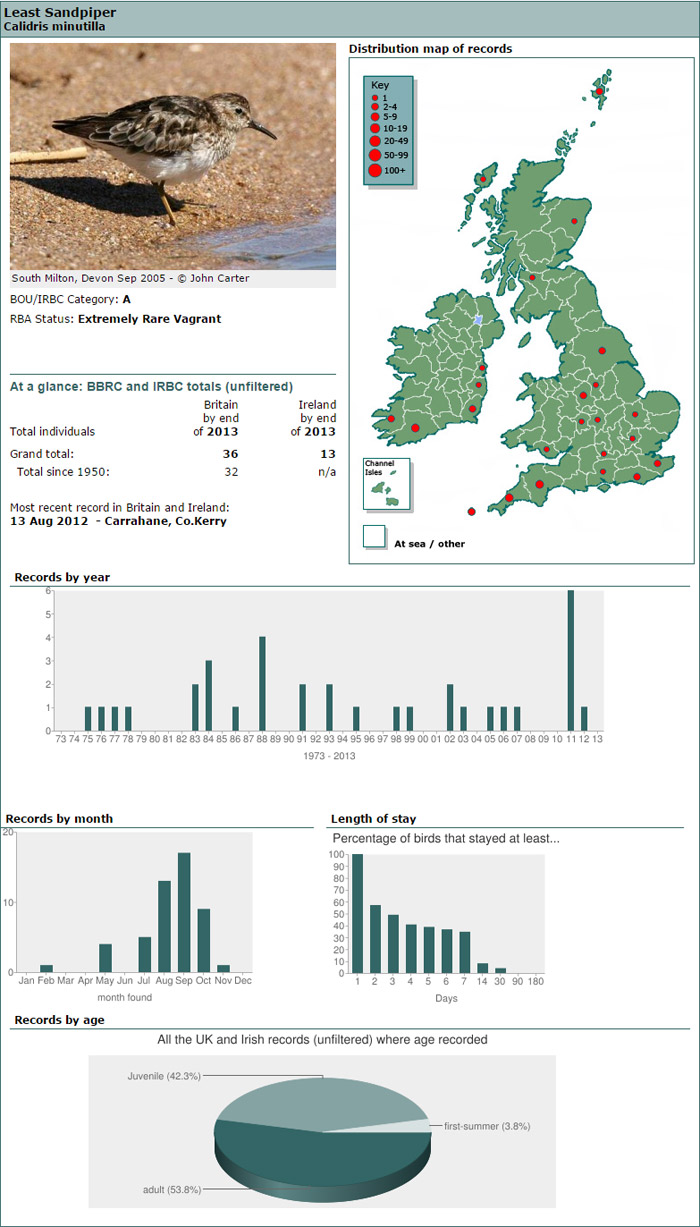
Least Sandpiper in Britain and Ireland
Write for Rare Bird Alert
Do you have a birding story you would like to share? From foreign birding trips to your local patch, finders accounts and more, we would love to hear from you.
All our articles are free for anyone to view and we include them in our weekly newsletter which goes out to thousands of birders every Wednesday. We also share them on our Twitter and Facebook pages, making sure your article will get read by as many people as possible.
If you would like to write an article please for us please get in touch with your ideas, thank you.
The RBA team