Finders in the field: Black-billed Cuckoo, North Ronaldsay, Oct 2014
Mark Warren - North Ronaldsay Bird Observatory
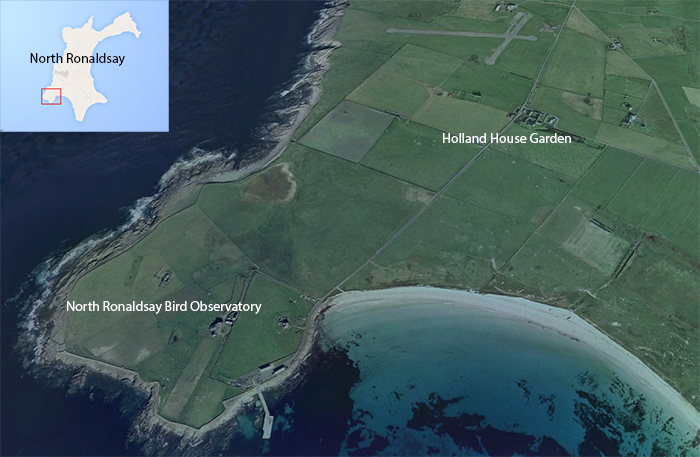
Having completed my designated census route by about 1pm, I was passing through Holland House Garden and heading for home when a ‘frosty’ looking Redpoll caught my eye which I considered to have a chance of being a Hornemann’s Arctic Redpoll. It was generally elusive in the fuscia and even some 20 minutes later, by the time Rael Butcher and Sara Macias had finished their respective routes and arrived at the garden too, I still hadn’t had a decent view. What happened next will be birding memories none of us are ever likely to forget!!!
With Rael and Sara on the front lawn of the garden, I was in the middle when I became aware of a bird dropping from the sky, darting one way and then making for the sycamores to evade a Merlin which was hotly in pursuit. This Redwing-sized bird with grey-brown upperparts and clean, white underparts glided right past me and as it did so I could see it had a long, floppy tail a bit like a Cuckoo….. “What the….” and then I clocked the contrasting brown primaries.
“No Way-that’s a…but hang on those primaries weren’t edged as bright, chestnut coloured as they should be if it was a…. Oh, my god”.
Dropping to my knees (which was lucky as my legs were pretty much turning to jelly anyway) the bird continued through the trees to a perch at the back, but still only ten to twelve meters away. Its wings were held ‘drooping’ at its side, below its body in that pose I’d seen so many times in photographs or illustrations, but initially the head and bill were obscured by another branch. I shuffled to my left and I could now see the birds face and bill and “YES WAY” the lower mandible was greyish-black!!! I was looking at a BLACK-BILLED CUCKOO!!
Quite frankly, I was now on the verge of a complete meltdown but I did manage to remain calm enough to take in some of the other features. I noted a yellowish eye-ring, the decurved bill shape, white ‘wedge’ shaped markings on the greater coverts with larger, more prominent such markings on the tertials, while the long tail seemed plain and un-marked on the upperside.
I instinctively began to reach for my camera, but then realised Rael and Sara had not joined me. Surely they’d seen the bird drop into the garden, but why hadn’t they appeared or tried to get my attention?! Realising they might not have, I had to go and get them and after nervously, slowly backing away until out of sight of the Cuckoo, I sprinted the 20 or so meters out onto the front lawn and just blurted out “Black-billed Cuckoo” I didn’t even wait for a reply just saw Rael’s jaw hit the ground as I turned and legged it back to my original position to be joined by the two of them within seconds.
BOU/IRBC Category: A
RBA Category: Extremely rare vagrant
Accepted British records: 13
Accepted Irish records: 1
Most recent record: 10 Oct 1990, St.Mary's, Isles of Scilly, found dead
Month most likely to occur: October, 9 records
Eight of the fourteen birds to occur have either been dead when found or are later known ot have died.
The bird was deep in the sycamores and it took some time to get both onto it ~ Rael’s response being best not repeated when he saw it for the first time. Shuffling around on our knees to get better views from different angles I could now see the underside of the tail ~ pale grey with a couple of narrow white bands (the tail tips) which were emphasised by a slightly darker grey subterminal mark just inside the white ~ which I think I noticed as small spots on the underside to the tips of the tail feathers when it initially flew into the garden. These marks were nothing like the large, obvious markings I’d expect to see on a Yellow-billed Cuckoo.
With the three of us having all had a decent look I made for my camera again, but the bird shot from its perch and strongly flew out of the back of the garden heading west and we didn’t see it again. Later we learnt it had been seen briefly by the Holland House caretaker perched on a wall just after our sighting but despite all those available searching the southern end of the island, agonisingly there was no further sign. We would have loved to have a photographic record of to show the world of this, the first for Orkney, but for the three of us, there’s a mental image of this quite unbelievable bird which we will never forget.
However, the 23rd October didn’t quite end there….
…..with about half an hour of daylight left I ran into Peter Miller, who like myself had spent all afternoon searching for the Cuckoo. He was troubled, having seen a bird at Cruesbreck which he couldn’t put a name too and though his description was a little baffling, the general gist was that he had seen a Thrush-like bird but smaller. I regret not phoning everyone at this point but with little daylight left, those who hadn’t seen the Cuckoo were still involved in the search for it, so I rapidly ‘frogmarched’ him back to the site insisting we had to make sure it wasn’t a ‘Catharus’!
When we arrived, almost immediately, the mystery bird hopped up onto a wall in front of us and my eye’s popped out of my head for the second time that afternoon. Was I dreaming all this-only a few hours ago I was losing my mind watching a Black-billed Cuckoo and now here I was looking at a GREY CHEEKED THRUSH, here on North Ronaldsay!!

I quickly rattled off to Peter the features ruling out the other ‘Catharus’ Thrushes and the bird duly re-appeared at the back of the croft where it showed well for a minute or so, but due to the lack of daylight my attempts to photograph it were shambolic. It then flew up and over the building and I caught a glimpse of the black and white underwing just as it landed on a fence in the driveway. Phoning news out there and then was just too late though, as despite Peter and I watching it in the driveway in the near darkness, it vanished into a field just as the Landrover pulled up.
The whole of the next day was spent searching for both birds, while my wife answered numerous calls from those waiting beside chartered planes, but sadly neither was seen again. It’s a grand shame that not all present on the isle were as fortunate as myself that day, but for the North Ron faithful who shared a slice of the 23rd October 2014, they’ll certainly never forget it.
Black-billed Cuckoo in Britain and Ireland

So a big thank you to Hurricane Gonzalo, a big thank you to Lady Luck and the biggest thank you of all goes to that Redpoll! And what of the Redpoll? It wasn’t a Hornemann’s, rather an ‘islandica’/north-western type’…
Mark Warren
North Ronaldsay Bird Observatory
October 2014