Drone used to feed Griffon Vulture chick after parent is electrocuted
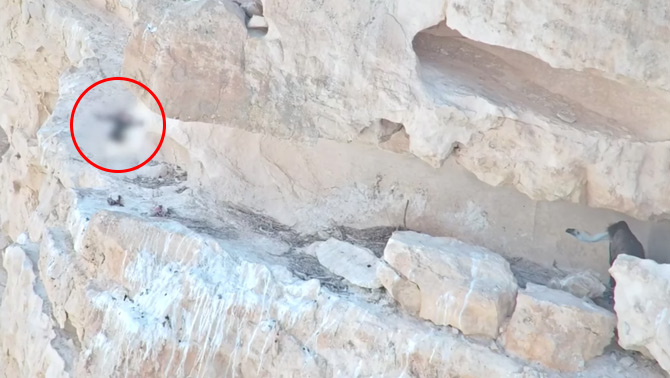
A story like no other. Conservationists in Israel took a new approach to save a Griffon Vulture chick that lost its mother due to electrocution. As the Griffon Vulture dad could not provide enough food for the chick to grow strong and healthy, conservationists had to intervene. The first thought was to capture and include the chick in captivity, which was not ideal. But then they thought of something never done before, to deliver food with a drone.
The evolution of the chick
The story began in the winter of 2019 when the beginning of the breeding season of the female Griffon Vulture K74 and male T49 was documented on camera by the Israeli Raptor Nest Cam project. This project is coordinated among the Israel Nature and Parks Authority and the Israel Ornithological Center of the Society for the Protection of Nature in Israel.
The new pair had a significant age gap between them, but 'love' had no boundaries! The male T49 hatched in 2013 in southern Israel and was marked the same year it hatched. In contrast, the female K74 was at least ten years older because she hatched in 2003 (the latest). On 29 December, K74 laid an egg, and on 23 February, after 56 days of incubation and care by the parents, their chick hatched! Both parents were busy bringing food to the chick and protecting it from intruders, and the little one was gradually developing. But then disaster struck. Unfortunately, the Griffon mother met a tragic end on 4 June as she collided with a powerline, which poses a significant risk to vultures and soaring birds. This meant that the Griffon dad had to feed and tend to the chick alone, and conservationists feared that he wouldn't provide enough food.
Drone to the rescue
After closely monitoring the situation, conservationists realized that the chick was not getting the necessary food intake. They had to intervene to ensure that the vulture would grow to be healthy. At first, conservationists thought that the only solution seemed to be climbing to the nest, capturing the chick and placing it in captivity to ensure it ate enough, which was not ideal. But then someone suggested another option that was a bit far-fetched but intriguing. What if a drone dropped food to the nest, allowing the vulture could remain in the wild. To achieve this challenging task, several preparations took place. The Israeli Army prepared for the mission by making a mock-up of the nest site in one of their bases and conducting several practice flights to be ready to attempt the real thing. Thanks to this and the help by Xtend, 'Mama Drone' successfully delivered food to the nest every two to three days and all worked out perfectly. And a few weeks later, the chick was ready to take its first flight. It fledged on 26 July, and so far, it is doing well in the wild.
13 Aug 2020
Share this story