Why Anna's Hummingbird flashes magenta
A test that stripped material from the surface of a throat feather helped reveal where the blue part of its colour comes from.

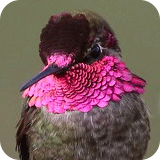
The throat of a male Anna's Hummingbird can flash a vivid magenta as the bird turns. Red light accounts for much of that display, but it cannot account for all of it. Magenta has no single wavelength of its own: the feather must also send shorter wavelengths back towards the observer. Researchers have traced that blue reflection to a part of the feather easily overlooked between its surface and its deeper layers.
Sangyeop Kim and colleagues describe the work in the Journal of the Royal Society Interface. The October paper, reported by Phys.org on 9 November, addresses a precise gap in the explanation of a familiar field mark. Researchers already knew that stacks of flattened structures inside the throat feathers produced the strong red reflection. What they could not explain was a second peak at the blue end of the measured spectrum.
The team examined barbules, the fine branches of a feather, with electron microscopy and reconstructed their internal structure in three dimensions. Inside are flattened bodies called melanosomes, embedded in feather protein and containing pockets of air. Light is reflected at boundaries between materials. Whether those reflections reinforce or cancel one another at a given wavelength depends in part on how far apart the boundaries are.
Seen in cross-section, the stack was not simply a thin outer layer over a series of thick, identical plates. The smallest melanosomes lay at the surface. Beneath them were two of intermediate size; deeper still the melanosomes were larger. The researchers could now test what that gradual change meant, by comparing computer models with different arrangements of the same components.
When the model treated the deeper material as uniform, it recovered the strong red reflection but missed the separate blue peak. Putting the intermediate structures back restored the missing part of the spectrum. The crucial point was that the middle layers did not act as a blue reflector in their own right. They had to work with the material above them. As the researchers put it in their paper:
Neither layer alone was sufficient; blue peak generation required their combined optical interaction.
Sangyeop Kim and colleagues, Journal of the Royal Society Interface
That prediction could be tested on the feather itself. The team used an oxygen plasma treatment to progressively remove material at the surface, then measured the reflected light. Once the outer layer was removed, the blue peak disappeared. The deeper stack contributed chiefly to the strength and sharpness of the red reflection.
The experiment explains how an existing feather makes the colour; it does not show how a growing feather builds the stack with that particular progression of sizes. Nor is it known whether other hummingbirds that flash similarly mixed colours produce them with the same arrangement.
19 November 2026
Get Breaking Birdnews First
Get all the latest breaking bird news as it happens, download BirdAlertPRO for a 30-day free trial. No payment details required and get exclusive first-time subscriber offers.