When seabirds take flight, sharks follow
New research reveals how seasonal seabird nesting reshapes the movements of top marine predators in one of the world’s most remote reef systems.
A remote atoll where land and sea collide
In the far reaches of the Pacific, the low sandy islets of French Frigate Shoals sit within the, one of the largest protected marine areas on Earth. Each summer these tiny islands come alive with nesting seabirds, green turtles and monk seals. New research shows that this brief pulse of life on land sends ripples far beyond the shoreline, reshaping how sharks move through the surrounding lagoon and reefs.
The study, based on multi-year acoustic tracking of more than 120 sharks, demonstrates a clear and previously underappreciated link between seabird breeding seasons and the spatial behaviour of marine apex predators. In short, when seabirds fledge, sharks reorganise their world.
Seabird chicks as a seasonal energy pulse
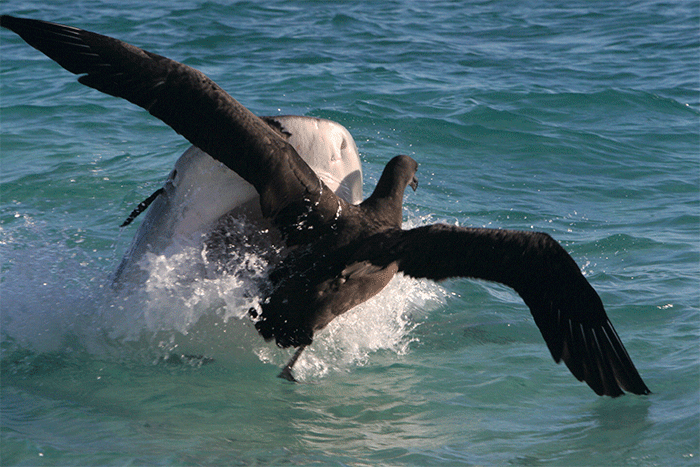
During early summer, thousands of albatross chicks fledge from the sandy islets of French Frigate Shoals. These naïve, surface-bound birds represent a short-lived but highly concentrated food source, unavailable to most reef predators but readily taken by Tiger Sharks.
The research shows that Tiger Sharks respond strongly to this seasonal bounty. As fledging begins, they move decisively into shallow lagoon habitats surrounding the nesting islands, particularly East Island. Acoustic detections peak sharply during this period, indicating focused and sustained use of these seabird-rich areas.
When the fledging season ends later in summer, Tiger Sharks relax this tight spatial focus. Their movements spread more evenly across the atoll, suggesting that the presence – or absence – of seabird prey is a major driver of their habitat use.
A cascade through the shark community
The influence of seabirds does not stop with Tiger Sharks. By drawing this dominant predator into specific lagoon habitats, seabird fledging indirectly reshapes the behaviour of other shark species.
Gray Reef Sharks, which are smaller and vulnerable to predation by Tiger Sharks, actively avoid the lagoonal islets during the summer seabird season. Instead, they concentrate their activity on the outer forereefs and deeper habitats, effectively “risk-matching” their movements to avoid dangerous areas when Tiger Sharks are most abundant.
In winter, when seabirds are absent and Tiger Sharks reduce their use of the islets, Gray Reef Sharks expand back into lagoon habitats. This seasonal ebb and flow highlights how the breeding cycle of seabirds governs not just predator–prey interactions, but also predator–predator relationships.
Competitors respond differently
Galapagos Sharks, which overlap in size and diet with Tiger Sharks but rely less on seabirds, show a more nuanced response. They share lagoon habitats with Tiger Sharks at times, but often shift their peak activity to different seasons or times of day. This temporal partitioning reduces direct competition and suggests that multiple strategies are at play within the shark community.
Crucially, reef fish biomass was found to be broadly similar across habitats. This rules out fish distribution as the main explanation for these movement patterns and strengthens the conclusion that seabird nesting – not reef prey – is the key seasonal driver.
Seabirds as hidden ecosystem engineers
The study identifies seabirds as indirect architects of marine predator behaviour. By providing a predictable seasonal food source, they influence where Tiger Sharks concentrate, which in turn shapes how other sharks use space. In ecological terms, seabirds help mediate intraguild interactions within the shark community.
This finding has important conservation implications. The loss of nesting islands through erosion or storms would not only affect seabirds, but could trigger wider changes in shark movements, with knock-on effects for reef ecosystems and other vulnerable species such as Hawaiian Monk Seals.
A powerful reminder of land–sea connections
In one of the planet’s most pristine marine ecosystems, this research reveals how tightly connected land and sea really are. The brief moment when young seabirds take their first flight sets off a chain reaction that reshapes predator behaviour across kilometres of ocean.
Protecting seabird colonies, the study suggests, is about far more than safeguarding birds alone – it is about maintaining the hidden ecological links that structure entire marine communities.
December 2025
Get Breaking Birdnews First
Get all the latest breaking bird news as it happens, download BirdAlertPRO for a 30-day free trial. No payment details required and get exclusive first-time subscriber offers.
Share this story