The UK Is Naming Roads After Birds It's Losing
RSPB says the irony exposes deep failures in how nature is considered in development.
RSPB says the irony exposes deep failures in how nature is considered in development.
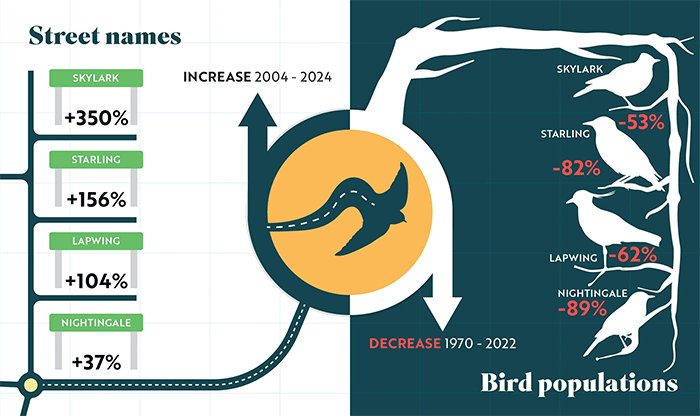
New analysis from the RSPB reveals a striking – and deeply ironic – trend: while some of the UK’s most threatened birds continue to slide towards the brink, new housing developments are increasingly borrowing their names. From Skylark to Swift, Lapwing to Nightingale, nature-themed road names have surged across Great Britain over the last 20 years, even as the wildlife they reference experiences dramatic real-world declines.
Drawing on two decades of Ordnance Survey data, the RSPB found huge rises in streets named after red-listed species. Roads featuring Skylark have increased by 350%, Starling by 156%, Lapwing by 104% and Swift by 58%. Yet these are among the birds suffering the steepest losses, with long-term declines reported across all of them.
The picture is similar for other species. Puffin-related road names have risen sharply despite major population losses in recent decades. Even references to “meadow” have risen by a third, despite Britain having lost almost all of its wildflower meadows over the last century.
The charity says the surge in nature-inspired street names stands in stark contrast to the state of nature on the ground – and warns that current legislation could make a bad situation worse.
Warnings over nature protections
The RSPB says that unless changes are made, the Government’s Planning and Infrastructure Bill could strip away vital safeguards for species and habitats. Vulnerable wildlife including the Dormouse, Red Squirrel, Otter, Barn Owl and Bittern could all face further pressure if protections are weakened during development.
Beccy Speight, Chief Executive of the RSPB, said councils and developers appear increasingly happy to name streets after beloved birds while the species themselves continue to vanish. She warned that the UK risks ending up with “silent streets with ironic names” if wildlife declines continue unchecked.
Business leader and RSPB ambassador Deborah Meaden echoed the warning. While she welcomed public affection for nature, she criticised tokenistic gestures, saying nature needs to be considered from the outset of planning rather than compensated for in branding.
Dr Amir Khan, NHS GP and RSPB President, highlighted the wellbeing benefits that real nature brings to communities, stressing that road names cannot replace thriving wildlife where people live.
Public strongly opposes weakening protections
Recent polling shows that the public wants new homes built in harmony with nature, not at its expense. Most people believe politicians should champion developments that work with the natural world, and many feel decision-makers underestimate how strongly the public values wildlife.
A cross-party committee of MPs also criticised claims that environmental protections block new housing, warning that shifting blame onto nature distracts from the real challenges facing the planning system.
Examples show nature-friendly housing is possible
The RSPB points to its long-running partnership with developers at Kingsbrook, Aylesbury, as proof that housebuilding and wildlife recovery can go hand in hand. The development integrates extensive greenspace, wildlife-friendly features and new habitats, and has already recorded increases in species such as Starling, Whitethroat and House Sparrow.
“A choice between real wildlife or nostalgic names”
The charity warns that without urgent changes, the Planning and Infrastructure Bill risks accelerating the decline of already vulnerable species. While developments celebrate birds on their street signs, the birds themselves continue to disappear from the landscape.
The RSPB argues that the UK must choose genuine wildlife recovery over nostalgic naming – ensuring Nightingales, Swifts and other much-loved species remain part of daily life, not just wording on metal signs.
November 2025
Get Breaking Birdnews First
Get all the latest breaking bird news as it happens, download BirdAlertPRO for a 30-day free trial. No payment details required and get exclusive first-time subscriber offers.
Share this story