Study raises concerns for Adders in Scotland
Evidence from a new report raises concerns about the status of Adders in Scotland.
The latest Scottish Adder Survey found that the reported distribution of Britain’s only venomous snake shrank significantly in Scotland between 1994 and 2024.
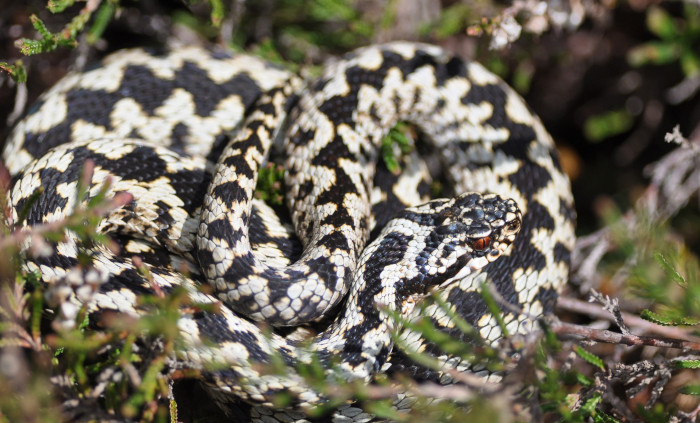
It found that the number of ten-kilometre squares in which Adders have been reported in Scotland has substantially declined, from 567 pre-1994 to 364 from 1994 onwards – a 36% decrease.
The overall range of Adders is largely the same as 1994, with the native snakes remaining absent from the Central Valley, Outer Hebrides and Northern Isles, as well as a large proportion of the upland region between Glasgow and Inverness.
The study, a partnership between NatureScot, Amphibian and Reptile Conservation, and Amphibian and Reptile Groups of the UK, also reported distinct gaps in Adder distribution across Scotland, and perceptions that the Adder is now becoming less common.
Thirty years on from the first Scottish Adder Survey, the research repeated the work carried out in 1994 using similar methods: a questionnaire and a re-survey of the original ten-kilometre square study sites, combined with historic Adder records from several different sources.
The Great Britain IUCN Red List assessment considers Adders to be Near Threatened in Scotland, Wales, and Britain as a whole, and Vulnerable in England. Their declines have been attributed to several pressures, including habitat loss and fragmentation, disturbance, and a lack of conservation management.
NatureScot’s Amphibians and Reptiles Advisor, Catherine Whatley said:
“Reptiles are a challenging species to study in Scotland, due to their low detectability combined with how vast and remote Scotland can be, so we haven’t been able to draw robust conclusions about changes in the Adder population size. The evidence we have gathered points to a picture of decline, with the contraction in Adder distribution quite alarming.
“We’re very grateful to all the people who took part in the Scottish Adder Survey, from the surveys and questionnaire participants to everyone who has submitted Adder records in Scotland.
“The Adder, along with all Scotland’s reptiles, is an important species that contributes to Scotland’s biodiversity, so it’s vital that we have a picture of how they are faring. Further research is needed to give a clearer picture of their status, so that we can carry out the most effective conservation work.”
Adders are Scotland’s only native snake, and Britain’s only venomous snake, although reactions to its bite are usually mild. Adders are secretive and timid, and usually stay away from humans. They can be found in grassland, woodland, upland moors, and coastal areas. Though they can be sensitive to disturbance, they are also sometimes found in human-modified environments such as railways, road embankments, and golf courses.
In Scotland, Adders are protected under the Wildlife and Countryside Act 1981. They are also protected from reckless and intentional harm and death. They appear on the Scottish Biodiversity List as a species that Scottish Ministers consider to be of principal importance for biodiversity conservation in Scotland.
NatureScot
23 April 2025
Share this story