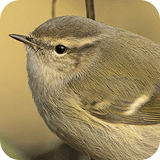
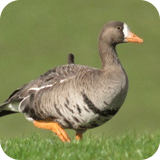
What's on the end of the stick, Vic?
RBA Meets: Jim Moir
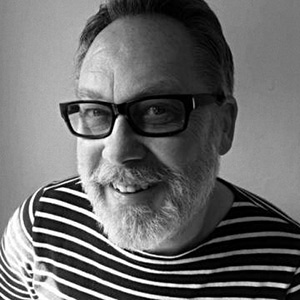
Recently I was watching a couple of re-runs of Vic & Bob’s Big Night Out on BBC iPlayer by way of distraction from the global chaos we all find ourselves immersed in. Afterwards I took a quick look at Jim Moir’s Twitter feed for further fun and looked again at some of his striking recent bird art.
A very random idea came into my head; I emailed his agents with a suitably random request to maybe have a chat on the phone with Jim about birds and painting. Daisy at PBJ Management emailed me Monday morning and I spoke to one of my comedy heroes an hour and half later.
This is what we talked about for 15 minutes on a sunny late March Monday morning…
Rare Bird Alert: "What was the first thing that piqued your interest in birds when you were growing up?”
I don’t know what it is, I was thinking about this I was used to like aeroplanes as well, so maybe its just things that fly!”
RBA: I read that when you were younger, you were always sticking your nose in bushes, looking for birds…
JM: "Well yeah, I don’t know what it was really, I think it was probably what everyone did, and it never really left me. I’ve got a garden with a huge bird station which I spend too much time looking at”.
RBA: When I was growing up my parents were very encouraging in my interest in birds. Did your parents encourage you to take an interest in the outside world?
RBA: Whereabouts did you grow up?
JM: "I was born in Leeds, my dad worked for the Yorkshire Post and ten when I was five we moved to Darlington on the border of Durham and Yorkshire, so I was right on the edge of town so I was out in the fields all the time. There was plenty of opportunity to get out, they wouldn’t stop me.”
RBA: That interest in birds and birdwatching when you were young, has that stayed with you? I know some people got into adolescence and the interest can wain and then resurface. Has it always been there for you?
JM: "I don’t think it ever disappeared. I come and go from it. When I was young it was every day and then in my 20’s it was once a month. It comes and goes, its in waves, but I find myself going out a lot more now, out to RSPB places and actually going looking for things.”
RBA: When you get interviewed, a little bit like this one, do you ever shrug your shoulders and go "oh, they’re going down the "Jim’s a birdwatcher line”.
JM: (laughs…) "I don’t know what kind of…you do get a bit of that it’s like, y’know, bobble hat and people think its cute. My wife Nancy has recently, I’ve never forced anyone into anything like that but yesterday, no, the day before yesterday, I was looking, there’s a lot of Avocets around at the moment and she got really interested, so I might have a partner!”
RBA: Going back to when you were younger: did painting come hand in hand with watching birds? Where you painting birds at an early age?
JM: "I was actually. You paint things that you know about and like, so I did, it was wildlife, it was actually birds and aeroplanes when I was a kid.”

RBA: I read again that, certainly at one point, you didn’t really paint birds from life, you’d copy the basics from the Collins Bird Guide.
JM: "Yeah, you know its one of the many varied bird guides. I’ve got some old ones, some Victorian ones but now I just go online. In fact, this morning I did a couple of Macaws, so I just looked online! But it’s mainly for reference, for colour reference really more than anything.”
RBA: I think it was in the same interview, in Time Out, that you take the basics of the Collins Guide and then you make them a bit scruffy! Its like my Little Egret, I knew what you meant, its not a typical painting, it has got a scruffy edge that suits it perfectly.
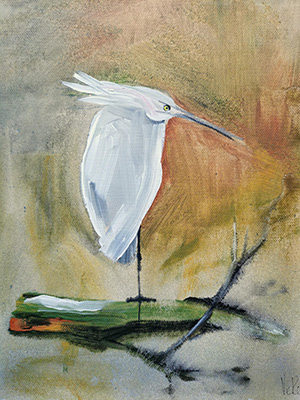
If you look online and put in a painting of an egret you’ll get millions of paintings that all look like (and there’s nothing wrong with it), someone’s tried really hard to make it look lifelike and it’s the same with painting anything, you can take a photograph or you can paint things that are absolutely spot on, I find, but its not as easy to paint things that aren’t.
I like Craigie Aitchison birds which look like a 4-year old’s done them, that’s what it looks like to a lot of people, but to me, it doesn’t and it I quite difficult to do things like that.”
RBA: I don’t know whether it may just be me, I’ve noticed with some of the paintings you’ve posted on Twitter recently, in the last month, there was the fantastic Firecrest, the Bearded Tit, a Swallow and there’s the fabulous Long-tailed Tits, all of a sudden, compared to my Little Egret here, there’s a contrast now in the way these are now striking and startling, you’re using lots of bold primary colours, is that a change that’s deliberate for you?
JM: "Well, the Firecrest…I went to look for some Firecrests at Dungeness and they weren’t there, well, they were there but I didn’t see them so in a fit of anger I painted a massive one! I had a great big canvas and I thought (I wasn’t angry at all) I thought "I’m going to do a great big one.
I had a load of really big primary pigment sticks, so I wanted to use them, so I did that Bearded Tit, I wasn’t intending to, but I just used them and changed the colour and made it yellow with the big red background and I thought that’s just, I really like that, so I’m going to do some more like that. It was kind of semi-intentional and, quite like a lot of things, you use what’s around you and it just happens.”

RBA: "But it’s interesting as I look at your line drawings, sketches and your other paintings and they all follow, stylistically, the same thing, but this seems like quite a departure ~ I really like the bold colours, they really suit it.”
JM: "I really like it. I like doing small birds on a massive scale with bright, bold colours that aren’t necessarily accurate. I change me style all the time and I’m always looking for something new every day, in fact I’m doing something new today which I haven’t done before, but I’m really going to do a lot more. I’m going to have to get some more canvasses from somewhere before all the shops shut.”
RBA: Have you ever held a specific "Bird Art” exhibition?”
JM: "No but what I was thinking about was doing some, (laughs…) …its really hard not to make a pun, but I really wanted to do some big tits (laughs…), y’know like that Bearded Tit you were talking about, its about four foot square, so I wanted to do small birds on big canvasses. And I might do larger birds on small canvasses. It’s kind of been on my mind to do.”
RBA: You’ve exhibited at the Royal Academy in the past, how does it work in terms of getting work accepted by them or, perhaps, galleries too?
JM: "There are thousands and thousands of people who all send in paintings and then you get through to the final committee and then it goes in. I’ve got through this year, but I don’t know if it’s going to happen.”

RBA: Going into Covid-19 and Coronavius, presumably you can aim, once you have some canvasses, to spend a lot more time in the studio, perhaps painting more birds?
JM: "I do that anyway, that’s what I do every day, so it’s not going to make much difference to me. The good thing is I don’t need anyone around me, so I’ll just carry on what I’m doing.”
RBA: You mentioned Nancy is maybe taking up a bit of an interest, have any of your kids taken up birdwatching or painting, have they followed in your footsteps?
JM: "Not birdwatching but painting. I’ve got two daughters who paint avidly. I’ve got one son who makes films, he’s a producer, he went to film school, but the bird element is sadly lacking. But I’ve got the bird station out here, tons of feeders out n the garden so they can’t miss them! I’m not going to force them to look…(laughs…).”
RBA: I ought to ask one specific bird thing; in terms of things that come into your garden do you actually have a favourite species that comes into the garden?
JM: "I like to watch the way that the Long-tailed Tits creep in. The hierarchy, which is Blue Tits are above Long-tailed Tits and watching the Long-tailed Tits looking at the Blue Tits and when they clear off, they come in really quick and get out really quick.
RBA: One last question, does Bob (Mortimer) look at birds or his be always busy doing other things?
JM: "Yes, actually he does. He says to me "I saw this bright yellow bird, what was it?” and I say give me more and I’ll say that’ll be a Yellowhammer, so he does ask.
He says, "I saw what was like a big Green Woodpecker, but it was on the grass” and I said "yes ‘cause that’s a Green Woodpecker and that’s what they do.
So, he asks the questions and I give him the answers.”

With grateful thanks to Jim Moir for his time and also thanks to Daisy Skepelhorn at PBJ Management for all her help and assistance.
Follow Jim Moir on Twitter @JamesMoir10 for all his latest bird art
Mark Golley
30 March 2020
Share this story