


One of UK's rarest butterflies sees surge in numbers in 2025
One of the UK’s rarest butterflies has seen a significant rise in numbers and range on Exmoor thanks to work supported by Butterfly Conservation.
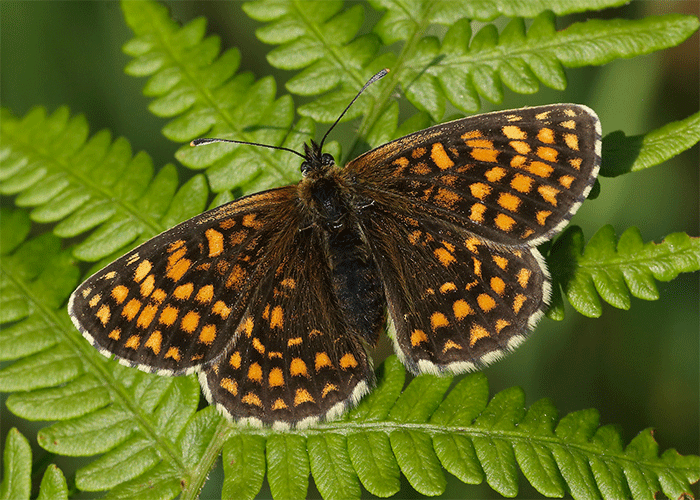
More than 1,000 Heath Fritillaries have been recorded so far this year on the National Trust’s Holnicote estate in Somerset.
This is a significant rise from around 600 at the same time last year.
The Heath Fritillary was almost extinct in Britain in the early 1980s but targeted conservation work has brought it back from the brink.
An exceptionally warm and sunny spring has also prompted the butterflies to emerge two to three weeks earlier than usual.
Staff and volunteers have adjusted their monitoring accordingly, although there is concern that climate variability could impact the butterfly’s life cycle if wet weather arrives before the flight peak.
Butterfly Conservation South West England Conservation Manager Jenny Plackett said: “It’s wonderful to see such strong numbers of Heath Fritillary on Exmoor this year. They’ve clearly benefited from the warm, sunny spring, emerging as adults weeks ahead of schedule.
“We’ve recorded butterflies at several new sites, including areas where they haven’t been seen since the 1990s. The Heath Fritillary is generally very sedentary, so this kind of expansion is highly unusual and suggests that recent habitat management is working. We’re hopeful these populations will establish and extend their range across the estate.”
Butterfly Conservation have worked with the National Trust on strategic bracken control, conservation grazing and targeted vegetation management at Holnicote to create the ideal conditions for the Heath Fritillary to thrive.
Basil Stow, a National Trust ranger at Holnicote, said: “We’re really pleased to be seeing such healthy numbers of Heath Fritillaries at Holnicote this year. It’s a real testament to the dedication of our teams, volunteers and partners who have spent a huge amount of time since the 1980s understanding and caring for the needs of this vulnerable species, but the early emergence is a mixed blessing. If unsettled weather follows, it could cut short the butterfly’s flight season and disrupt its life cycle.
“It’s a reminder of how delicately balanced nature is and how climate extremes can threaten even our most carefully-managed landscapes.”
The Heath Fritillary and the High Brown Fritillary are both among the UK’s rarest butterflies and rely on carefully-managed habitats.
While the high brown favours bracken-covered woodland clearings and lays its eggs on violets, the smaller Heath Fritillary thrives in moorland and coppiced woodland where its caterpillars feed exclusively on common cow-wheat.
The Heath Fritillary remains restricted to four core landscapes of Exmoor, the Blean Woods in Kent, the Tamar Valley in the South West, and south Essex woodlands.
Exmoor is now considered the most important stronghold.
The early successional habitats it depends on – dominated by bracken, heather and gorse, with plentiful cow-wheat – require ongoing, sensitive management to sustain.
July 2025
Share this story





