Morlais tidal energy project risks future of Anglesey’s marine wildlife
RSPB Cymru is raising grave concerns over the proposed Morlais Tidal Energy Demonstration Zone off the coast of Anglesey.
The environmental charity fears that the political and economic pressures to complete the application are pushing this development to take unmanageable risks with our fragile marine environment.
We recognise that there is an urgent need for clean, renewable energy generation as an important part of the decarbonisation of Wales. However, poorly located or ill-designed renewable energy generation projects pose significant risks to our natural environment. As we face a dual climate and nature emergency, we must plan our low Carbon and renewable energy projects in harmony with the natural environment and avoid greater impacts on wildlife.
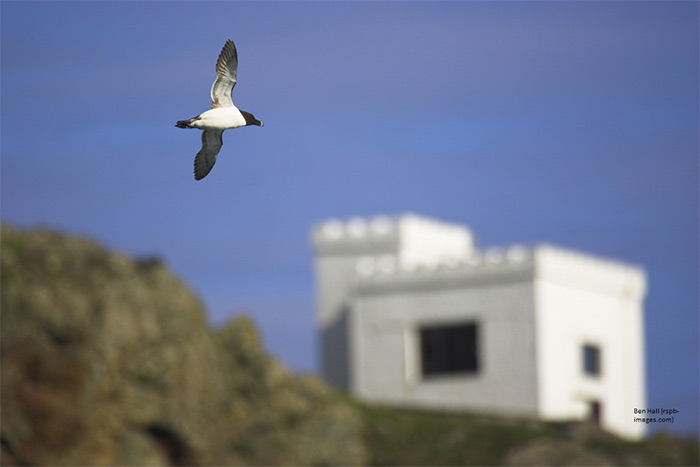
The Environmental Impact Assessment by Menter Môn states that the development has the potential to cause the loss of 60% of the breeding guillemots and 97% of the breeding razorbills from the sea cliffs at the South Stack nature reserve run by the RSPB – which with 250,000 visitors a year is a key tourist attraction on Anglesey.
RSPB Cymru Director, Katie-jo Luxton said: “If this project is serious about being a test bed for new marine energy generation technologies in an environmentally sensitive way, it must proceed in a step-wise manner, learning from each stage. However, our faith in this approach is jeopardised by Menter Môn seeking blanket, large scale consents. We are calling for the large 240MW scale proposal to be withdrawn and be replaced by a smaller scale initial ‘pilot’ project. A smaller scale permission reduces the risks of environmental damage and maximises learning about new technologies in this highly environmentally sensitive location.
RSPB Cymru is proposing this alternative solution due to concerns over the adequacy of the current approach to managing the environmental risks of the project. Our proposed approach still allows further phases of the project to proceed in the future should there be evidence of no impact, while providing the checks and balances needed to ensure sensitive marine wildlife is protected.”
In his speech at the Green Recovery Wales Festival on the 23 July, First Minister Mark Drakeford was clear that “learning by doing” in the marine environment meant ensuring that everything possible should be done to plan against adverse impacts and to deploy devices that are modest in scale to contain any unintended, unanticipated adverse effects and damage. He also stressed that monitoring must be good enough to identify adverse impacts. We wholeheartedly agree with these remarks but as currently designed, the Morlais project does not meet these standards.
“Currently, we are being asked to trust that the serious environmental risks to our seabirds and marine mammals will be managed through ‘Adaptive Management Plans’. However, there is just too much uncertainty in this project to go down this route. The types of novel technology that will be deployed at the sites are undefined, so their impacts are unknown and there is uncertainty whether monitoring systems are possible given the limitations of current technology. We can’t see how adverse impacts will be identified, let alone alleviated or avoided.
Put this alongside the acknowledged potential for very significant environmental impacts – including the potential near complete loss of some seabird populations at South Stack – and we do not believe that consenting a project at this scale, via a process that currently has no environmental safeguards as the project is rolled out, could ever be acceptable,” says RSPB Cymru Director, Katie-jo Luxton.
We believe that either the developer, Menter Môn or Welsh Government (given the £4.5m investment from the public purse in the scheme) should now reduce the project scale. This would turn our objection into support for the test bed of clean, renewable energy in harmony with nature.
There are also economic opportunities from a smaller test bed approach, as the project would need to work in tandem with researchers and academia to develop the environmental evidence base, such as developing the monitoring technology that is required to assess the impacts of the novel technologies, alleviate many concerns and also stimulate a genuine Green and Blue Recovery from Covid-19.
11 Aug 2020
Share this story