Marsh Harriers breed in Ireland for first time since 1917
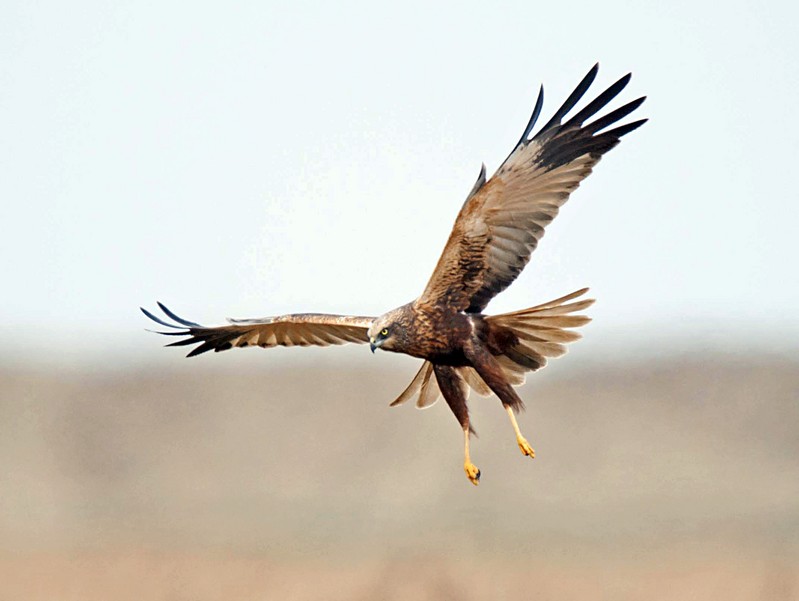
The Irish Raptor Study Group, a voluntary organisation committed to the conservation of birds of prey, is delighted to confirm that two pairs of Marsh Harrier have successfully bred in Ireland in 2020. The Marsh Harrier was last known to have bred in the Republic of Ireland around 1917. The two pairs were confirmed from Co. Galway and Co. Westmeath with both pairs successfully fledging two young.
The Marsh Harrier is a large and dark coloured bird of prey with a long tail and light flight with wings held in a shallow ‘V’. Adult males have smoky grey tails and wings with chestnut belly and shoulders, while females are dark brown with a creamy head crown. Marsh Harrier can be found on open freshwater wetlands and extensive reedbeds, selecting to nest on piles of reeds surrounded by dense marshy vegetation. Marsh Harrier is a generalist wetland predator with a mostly aquatic diet including small birds, mammals, reptiles and amphibians.
Marsh Harrier were adversely affected by prolonged persecution and widespread wetland/fen destruction during the late eighteenth and nineteenth centuries. Approximately 80% of the original extent of fens in the Republic of Ireland has been lost to drainage for peat extraction and reclamation for agricultural land. The cumulative impact of wetland loss due to the Arterial Drainage Act 1945 and the preparatory drainage across bogs in Galway and Roscommon for energy production by Bord na Mona from 1946 limited any real prospect of Marsh Harriers returning in Ireland.
We are delighted to confirm that two pairs of Marsh Harrier Cromán Móna successfully bred in Ireland in 2020. The two pairs were confirmed from Co. Galway & Co. Westmeath, both pairs successfully fledging two young. The first since 1917. Full PR here: https://t.co/SA4KSituxc pic.twitter.com/vBhtBlLnP7
— Irish Raptor Study Group (@IrishRaptorSG) December 15, 2020
Marsh Harriers are scarce summer visitors to Ireland but more likely to be seen in winter along the south east coast. The last 20 years has seen the recovery of the breeding population of Marsh Harrier along the east and south eastern coastal band of England to more than c.430 breeding pairs. The steady population recovery elsewhere in Europe, especially in the Netherlands, has almost certainly assisted the current increase in England, with a spill over of individuals into Ireland. However, the scale of habitat loss in Ireland may make recolonisation of breeding Marsh Harrier a very slow process.
The Marsh Harrier, like the Common Crane, Osprey and the Bittern is one of our lost wetland treasures. Recent ambition within our Programme for Government to rehabilitate and re-wet peatlands provides an amazing opportunity for ecological restoration. Both the €108 million funding for Bord na Móna rehabilitation plan and the European Innovation Partnerships Initiative (EIP) on the rewetting of farmed peatlands are strategic actions contributing to the governments climate change mitigation, however they also provide the chance to maximise other ecosystem service co-benefits such as protection of biodiversity and benefit our rare wetland species. These initiatives could also foster opportunities for re-establishing and/or reintroducing the Crane and Bittern.
17 Dec 2020
Share this story