Finders-in-the-Field: Pied-billed Grebe, Chelmarsh Reservoir, Shropshire
Thursday 26th November dawned clear and frosty in Shropshire, and only -2°C when I walked out of the door, but a brief thaw during the night meant my car was encased in ice and a challenge to get into. The journey to work was a mix of clear skies and foggy patches, and the morning’s Staffordshire bird survey was a joy, crunching through frosty fields and icy marshes in the company of Woodcock, Snipe and at least 6 Jack Snipe.
I headed back to Shropshire early afternoon, and as I was passing, I swung into the layby at Priorslee Lake for a quick scan in the hope of one of the recent Caspian Gulls dropping in for a lunchtime bathe. A smattering of Black-headed Gulls and just half a dozen Lesser Black-backs didn’t fill me with hope, and I was about to start the engine again when an oddly white-flanked duck caught my eye – a smart drake Red-crested Pochard! Maybe not high on many people’s wishlists, but less than annual in the county. You can’t deny their handsome looks, and on a crisp wintry day you could almost imagine a cold weather continental movement… almost.
Jack Snipe and Red-crested Pochard, I was on a roll! So with a couple of hours of light left, I decided to make the detour to Chelmarsh Reservoir before heading home – surely the recent Glaucous or Azorean-type from Belvide would grace the roost?! A layer of cloud slid across as I arrived, meaning I shouldn’t be staring into the setting sun – it was all dropping into place. The first bird I saw was the long-staying juvenile Great Northern Diver fishing along the edge of the reeds by the causeway, a really smart and unusually showy individual. I walked on, eager to be in position for the gull roost before the light started to fade, with a couple of Kingfishers on the way, and then a Great Crested Grebe flew the length of the reservoir. I lifted my bins just to double check it, and in the process noticed a small grebe swimming away from me, out in the centre of the water. Funny place for a Little Grebe…
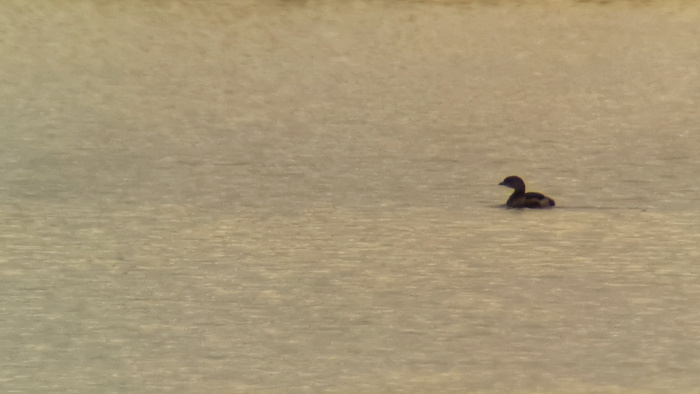
In the scope, and always swimming away from me, it never quite looked right for the common option, a bit too broad-beamed maybe, too big-headed? But what do Little Grebes actually look like?! I attempted to get a few phone-scoped record shots, but the distance and the light were against me, so I kept on walking, trying to catch it up. Another stop, another distant view, still silhouetted, but now the bird stopped and began to preen, occasionally lifting its head, and suddenly there was the profile – a long oval head with a steep forehead, front-heavy, and the bill, stout and chunky and… pale?
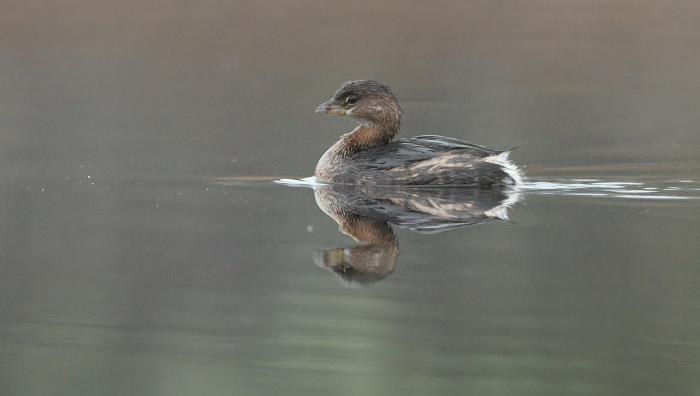
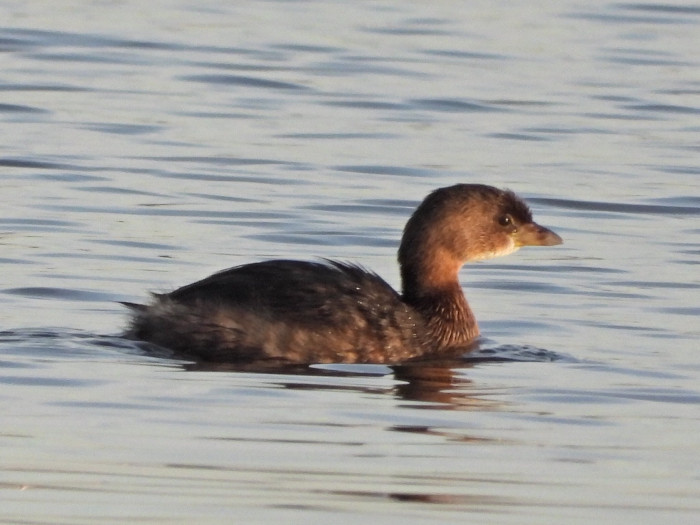
My brain was reluctant to agree with my eyes, but I messaged John ‘Bushchat’ Reeves: “90% sure I’ve got a Pied-billed Grebe at Chel”. Two minutes later the grebe swam into darker water, and I could finally see some colour on it – the creamy-white bill with a hint of a dark mark across it, a white chin and white spot just behind the base of the lower mandible, and generally warm, non-contrasty plumage. John got another message: “it ****ing is! **** ”. A Pied-billed Grebe in the middle of open water, in Shropshire!?!
As the bird and I continued towards the dam, I noticed three birders setting up to scope the gull roost from near the sailing club. “Have you seen the grebe?” I spluttered, to which they looked perplexed. Surely I meant the diver? “There’s a Pied-billed Grebe swimming towards the dam!”. Within seconds they were on it, and I’d got some back up, I wasn’t going mad, and I put the news out. It was 3.19pm, less than 45 minutes from sunset. We rushed around the dam, but by the time we were in a position to see the water again, the grebe was starting another lap of the reservoir, so after grabbing a few more record shots, I set off back again.
By the time the sun dropped below the horizon, half a dozen locals had seen the new arrival, back at the other end of the reservoir, fishing off the causeway with the Great Northern Diver (often in the same scope view). Much closer views were now possible, although the light was fading. It was essentially shades of chestnut brown all over, darkest on the back and across the top of the crown and forehead, whilst the sides of the head and the neck were almost rufous. A tiny spiky tail stood above the fluffy white rear, and when it briefly flapped, the upperwings were seen to be completely dark. The stout, blunt bill varied from creamy to greyish white, depending on light and angle, and a ghost of a black band ran across both mandibles 2/5 back from the tip. On the best views, a thin whitish eye-ring could be seen, boldest in front of the eye.

Over the following days Pied-billed Grebe was added to many Shropshire lists, and as well as being a county first, it was the first to be found in the Midlands in the autumn/winter and away from the eastern counties of Northamptonshire (at Ravensthorpe Reservoir on 26th April 1997) and Rutland (at Rutland Water 9th-10th April 2014). Interestingly, a bird on the Severn Estuary in Gloucestershire on 24th April 2015 was relocated at Leighton Moss RSPB in Lancashire the following day, and the straight-line route between the two sites would have taken it within a few miles of Chelmarsh Reservoir.
Tom Lowe
November 2020
Share this story