Finders-in-the-Field: Indigo Bunting, St.Agnes, Isles of Scilly, Oct 2020
For me, this all started with a trip to Norfolk to see the Rufous Bush Chat. After seeing it very well on the morning of Monday 19th October 2020, paid a visit to Holme nature reserve to see a Red-flanked Bluetail where I met an old mate of mine, Bill Simpson. As we wandered about the reserve we pondered upon the scenario of being confronted with a bird that we could not put a name to. We were thinking along the lines of an empid. or an un-streaked acro. and what we would do... oh how we laughed!
Wind forward nearly a week later, I arrived on Tresco on the Saturday and was staying for a week with my family. I spent early Sunday morning walking along the side of the Great pool, in my "lucky blue coat" - an experimental ploy that I had hatched out to attract passerines. This was discovered whilst out on my mountain bike having pished out (and held out) a flock of Chiffchaffs, tits, treecreepers and crests - bedazzled by the colour of the coat. This is a complete reversal of the camouflage attire normally associated with the birding brigade. (ever been in a South America jungle in with a brightly coloured tee shirt on?-Hummers go mad for it. Well that was my theory!!).
I was with my old Tresco birding mate Marcus Nash. As we walked, we discussed the Rose-breasted Grosbeak that had appeared the previous afternoon on St. Agnes, and the potential for something else to turn up on the conveyor-belt of south westerly winds that had been streaming across from Nova Scotia for the previous few days. We had both talked about going over to St Agnes and Gugh but with early negative news on the Grosbeak Marcus (much to his later regret) had decided to give it a miss this time and stay on Tresco. Thankfully he didn't talk me out of it!
Myself and my family decided to head to St. Agnes on the 10.am inter-island boat from New Grimsby. As we approached St. Agnes the boat dived into some deep troughs indicating some rough weather out to the West, this set my mind to some wild thoughts of what could be. We could see from the boat that the approaching sand bar to Gugh was still covered and was not due to be passable until around 1pm, so we would be unable to go looking for the Grosbeak until later. We disembarked and ambled up the hill via Higher Town to the Red-eyed Vireo at Middle Town. The Vireo showed nicely upon arrival and performed pleasingly in the apple tree. Having had good views of the Vireo we headed to the cafe for a cup of tea.
Having refueled and having 'Van Gough', the one-eared cat, pestering me for tip-bits, we headed out of the cafe to Wingletang Down to follow the coastal path around to Gugh. It was great to see a new plant that was shown to us on the way (Least Adder?s-tongue Fern). By the time we arrived at the Gugh bar it was heading towards the 1pm mark but no news on the Grosbeak so I decided to carry on around the coastal path and back towards the parsonage via the Vireo once again leaving the family to paddle in the sand.
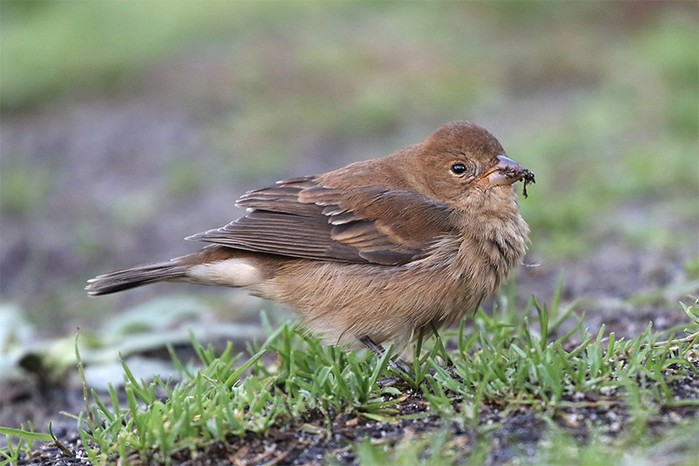
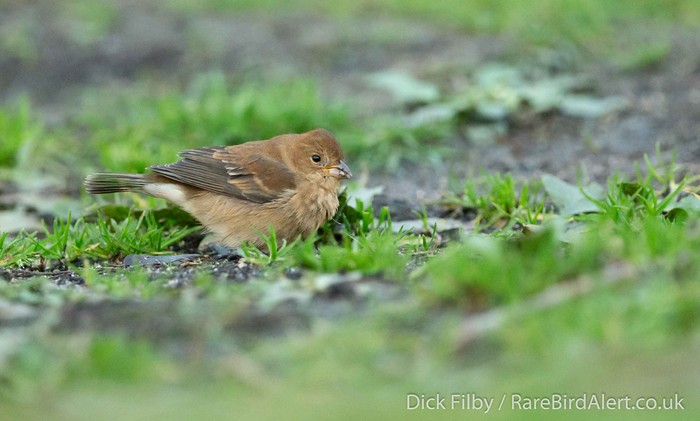
Walking along the coastal path at Porth Killier reminded me of the Northern Waterthrush I'd seen there on a hot late August day in 1989. I spent some time scrutinising pipits and wagtails that were fly-catching on the rotting seaweed. Continuing on, I reached a large pile of hedge cuttings (later referred to as "the Bonfire"). I hesitated to take the shortcut straight across and decided to take the slightly longer path around the bonfire toward the mill entrance and immediately flushed a couple of passerines that had been feeding at the edge of the bracken. A hard metallic short "spik" call reminiscent in tone to that of Hawfinch was given off by one of them as they flew. Fortunately they landed out in the open on the path, a few metres away. I picked up a House Sparrow and something else, something considerably smaller.. "WHAT THE **** IS THAT" I squealed out loud - a small passerine that was rich brown above, a double wing bar and paler brown underparts, conspicuously nondescript.
I knew this had to be something special but I was failing to immediately put a name on it. With adrenalin coursing through my veins I stood there, jaw dropped with a mind in complete meltdown and a bird feeding happily metres away from my feet that I could almost stroke. But what the hell was it? Thoughts of some sort of escaped finch entered my head and I remembered a Canary many years ago on St. Mary's that went out as a Serin.
The call had brought to my mind American buntings, high-pitched and metallic and, with my brain in overdrive, I was thinking 'this thing could fly off at any moment to be lost forever'. I took out my trusty Nikon bridge camera and grabbed a few, trembling, record shots. Once I had some reasonable images in the bag, my thoughts turned back to the identification. So an American bunting, brown with no hint of blue in it! I turned to my Sibley phone app which, ironically, I didn't find all that helpful. In hindsight if I had gone straight for the Collins app I think I could have nailed it, but I was all fingers and thumbs ARGH. I bounced between Painted and Indigo Bunting but in my excitement I was struggling to use intricate items of software, I needed some assistance, someone with a guide that could scroll through coolly without getting muddled up, I knew a man on Tresco who could help.
I called Marcus Nash and explained my predicament, "I've got a bird here and I don't know what it is, I think it's an American bunting, no blue in it?. I sent him a photo, that was upside down with loads of glare on it and probably the worst of all my photos. It had been around 20 minutes since I found the bird and not another birder had passed me by. I called Marcus back after he had had a chance to look at the photo, and discussed the bird with him - he mooted the potential for Indigo Bunting. I was still concerned with the lack of blue in the plumage but he reassured me that Immature females had no blue in them. That had been one of my worries about pulling the trigger, that, and the potential for an escapee or one of the potentially similar small blue American finches/buntings. At that moment it flew along with the House Sparrow, my heart skipped a beat as I imagined them flying off to never be seen again, they headed straight into the middle of the bonfire and out of view.
At that moment two small teams of birders passed by. I called them over and advised that I may have an Indigo Bunting but it had gone into the Bonfire just a couple of minutes ago. I showed them some stills from my camera and one of them ask if he could take a photo of it, not thinking, I agreed. I was again on the phone with Marcus discussing the lack of blue and he told me he had chartered a boat. Then Marcus announced that it had come on as a mega! and there, the trigger had been well and truly pulled but unfortunately not by me, Hey-ho.
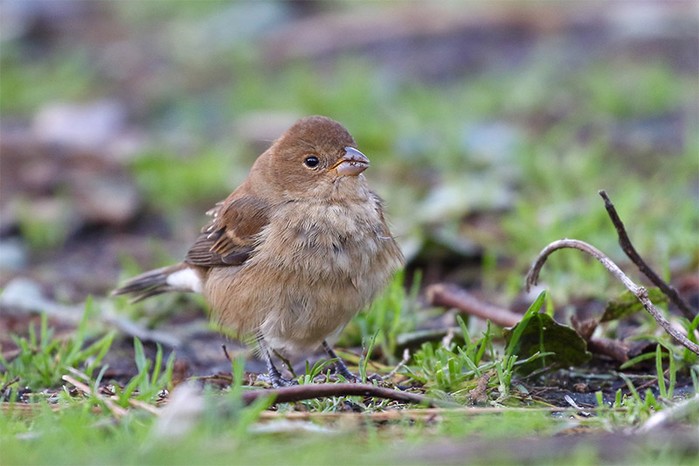
I left people waiting for the bird to emerge whilst I went to get my family. They were already on the way as they had seen people running across the still covered Gugh sandbar and followed. Returning to the bird, a small crowd had converged with a lot of smiling faces. I was congratulated by friends and fellow birders who had just arrived. A boat-full of birders were on their way from St Mary's and Marcus was on his way too.
I met Marcus on the quay and took him to the bird and stayed with him to catch his later charter back to Tresco. We went to the New Inn and had three pints to celebrate, I was supposed to be cooking the tea that evening. We might have stayed in the pub for longer, were it not for that fact and that Marcus was to go to the Ruin Beach Cafe with his crew, the drawbacks of family responsibilities!
Now, if I'd been on St Mary's in the Scillonian Club this story may of had a completely different ending as everyone was offering to "buy me beer and whiskey" - as the Pogues might say.. oh no!
The rest, as they say, is history.
With special thanks to Marcus for his id help and friendship
Lou Cross, Cumbria
Share this story