Finders-in-the-Field: Song Sparrow, Fair Isle, April 2020
Those of us on Fair Isle realise we are in a very fortunate position compared to many when it comes to the lockdown. With only around 50 of us on the Isle, the permitted daily exercise allows us to walk in a variety of locations with little likelihood of encountering anyone else, but a reasonable chance of stumbling upon some decent birds. Of course, it’s frustrating at times not having Obs staff here and being restricted in our daily activities, which leaves us wondering what is being missed, but the important thing is that the Obs does all it can to keep everyone safe, as the challenges of dealing with an outbreak on the Isle are quite concerning. Anyway, I’m sure people have had enough of reading about coronavirus, so onto the birds…
Early April had seen some quite horrible weather and, as is often the case on Fair Isle at that time of year, things were still very wintry. By the end of the first week of the month we enjoyed some calmer days, southerly based winds and the first flush of migrants coming through. Most days were spent working indoors (with birding restricted to the view from the Schoolhouse kitchen window) and trying to get for a walk later in the day. With various people reporting their sightings from the south, I tended to focus on walks north, either Buness or North Light, taking in the traps and Obs on the way.
Having been in the house all day on 9th April, doing a variety of jobs, I decided to have a walk up to the Obs from Schoolhouse as my daily exercise and chance to see what was happening out there. Although the wind was a promising light southerly, the highlight of the day up until then had been a pair of Pintail that dropped into Da Water; the first record of the year.
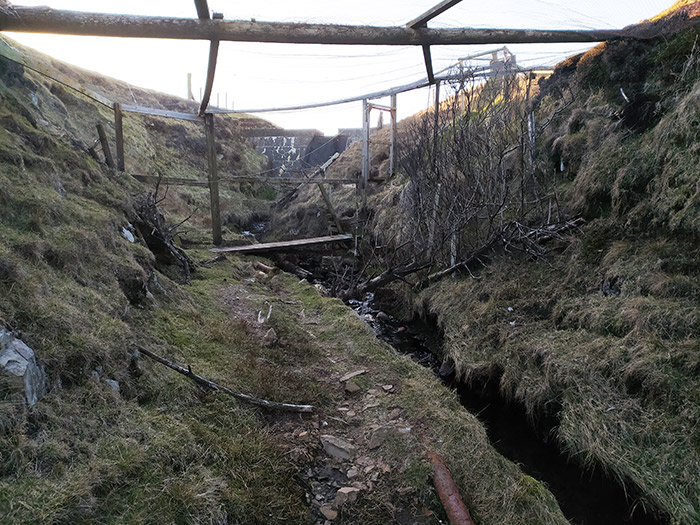
Lockdown rules mean that the Helgoland traps can’t be run, but they are still good areas for migrants, being some of the most vegetated areas in the North of the Isle, so are worth having a look at. An elusive Robin was the only bird present in the Plantation, so I headed up the Vaadal stream, that also has a trap built over it. Heading up the Vaadal, a small bird flew low along the stream in front of me, immediately looking not quite right for Robin, almost Dunnock-like but not as podgy and maybe Blackcapish, but again not quite right. I decided to actually look at it through my bins rather than work out what it didn’t look like and was stunned to be looking at a Song Sparrow.
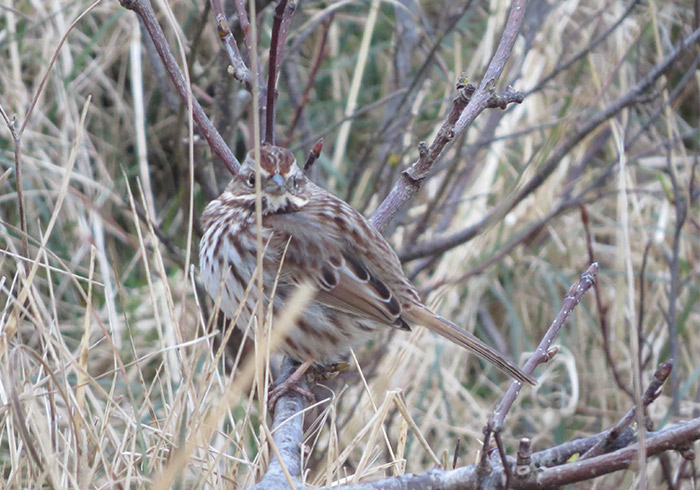
With no camera on me, other than my new smart phone that I was still trying to work out how to use (four lenses meant I couldn’t fathom out how to line it up with my bins!) I thought it would be best to watch the bird for a while and try to take in some details, as ‘it was a Song Sparrow, grey with lots of brown stripy bits, but I can’t remember exactly what was where’, didn’t sound like something that would convince BBRC. Although it was quite content on the ground, it took advantage of the very low water level and the fact that the previous heavy rain had lifted the wire across the stream, to hop out the back of the trap. It flew up onto the Vaadal reservoir dam, called once, and hopped over the top towards the stream. I relocated it by the reservoir and spent a short while with it, including trying to get a record digi-binned shot. My record of seeing American sparrows is very poor, in fact, the only one I’d previously seen was the Song Sparrow found by Richard Cope on Fair Isle in 2018. However, the combination of grey upperparts with brown streaks, the distinctive head pattern, the brown streaking below that coalesced into a bit of a blob on the chest and fairly stout grey bill was distinctive enough to rule out any other options. I made sure I saw the legs to check it wasn’t the returning bird of 2018 that had been ringed, which unsurprisingly, it wasn’t.
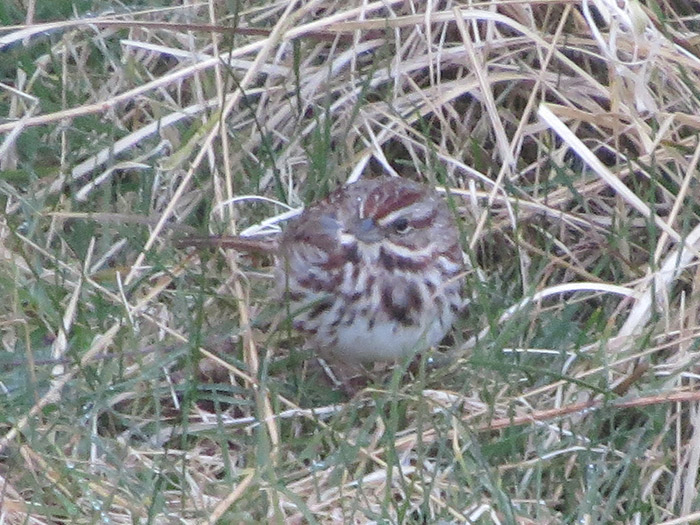
I texted the Islanders who would be interested in such a sighting; thankfully, the decision to put the news out of rarities on Fair Isle is fairly simple at the moment, non-essential travel to the Isle is currently prohibited (no bookings on the planes or Good Shepherd IV are possible and no permission is being given for charter flights to land), so there is no concern about encouraging unnecessary travel.
Although I had lost sight of it for a while before anyone turned up, it was easily found by walking towards the long grass and couple of stumpy bushes at the back of the small reservoir. It hopped up into one of the bushes and stayed there showing quite well, although within half an hour or so it started raining heavily and, as dusk was approaching, the bird dropped into the grass and seemingly went to roost.
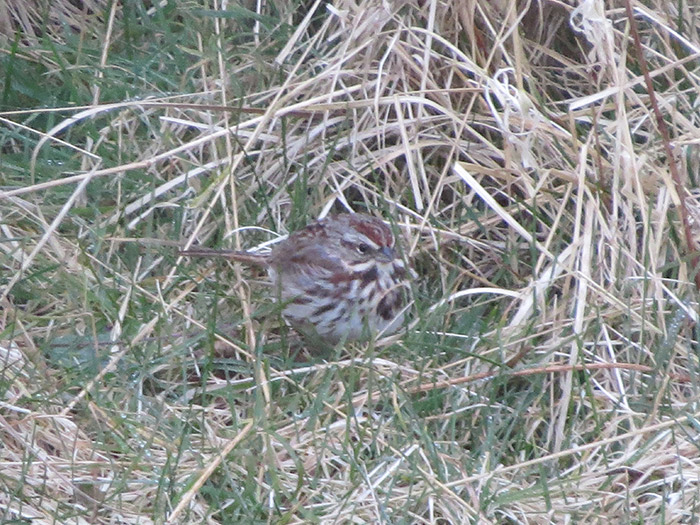
Of course I feel incredibly lucky to still be in with a decent chance of finding rare birds, although I have to say that it was quite pleasing that it was a species that had been well twitched just a couple of years before, so the chances are that not too many people would have been disappointed at missing out. That said, it was a Fair Isle tick for former FIBO Warden and long-term Isle resident Nick Riddiford, who has always been away when previous Song Sparrows have turned up on the Isle. Although he didn’t see it on its first evening, and just missed it the following day when Deryk Shaw relocated it in the Gully, he thankfully connected with it on its third (and final) day when it was still in the Gully, and he became the last of only eight people to see the bird.
David Parnaby
14 April 2020
Share this story