Finders-in-the-Field: Lesser Kestrel, St.Mary's, Isles of Scilly
By Ashley Fisher
At 1145 hrs, I was walking along the footpath by the beach at Porth Hellick when I noticed a kestrel hovering over the adjacent Down. It was fairly distant, and ordinarily I might not have bothered looking at it, but since I had recently acquired a pair of Canon 12x36 image stabilizing binoculars, I thought I’d have a look – the novelty of the IS system not having worn off yet. I raised my bins and pressed the button...
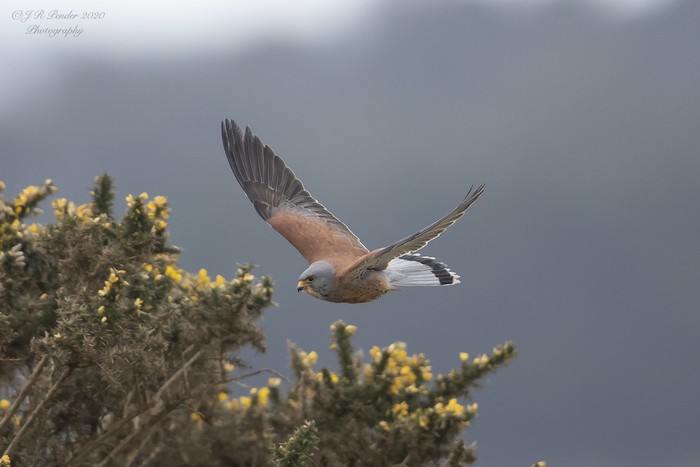
The bird was side-on and completely silhouetted, but even so, it just didn’t ‘feel’ right for Common Kestrel. What really struck me was the junction between the lower belly and the tail. Lesser Kestrel has a chubby rear belly ending rather abruptly at the vent; thus there’s an obvious up-step that gives the tail a ‘stuck on’ impression. In Common Kestrel, the lower belly/vent tapers smoothly into a longer-looking tail. I’ve checked this feature on numerous birds, including the 2002 Scilly bird and others in Europe and the Middle East, but seeing it on a bird in Scilly in early March is another thing all together...
Calmly, I said to myself: it’s a Lesser Kestrel - and then dismissed the idea as ridiculous. Apart from a slight increase in the number of Chiffhaffs and a single Sand Martin, there’d been little evidence of migration and the weather just hadn’t been conducive to movement. In fact, it had been the worst winter/pre-spring in living memory: constant SW gales, lashing rain, mud, and no rare birds (except for a pair of Choughs). In other words, I had zero expectation of anything turning up!
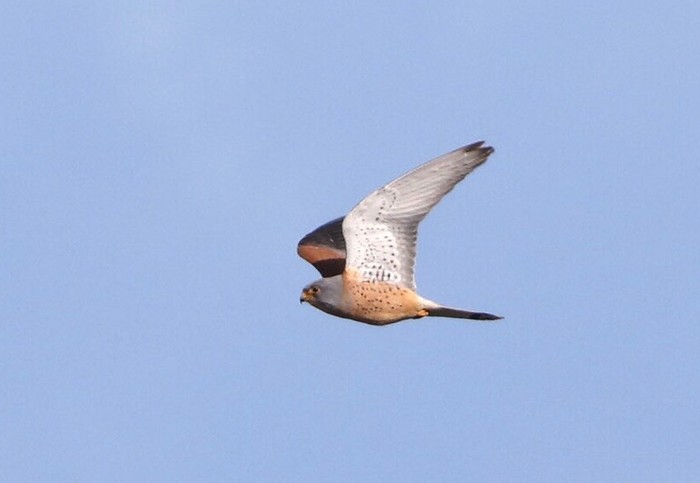
Anyway; as I continued to watch the bird, it swung round giving me a brief view – in decent light – of its underside. The underwing looked alarmingly pale with noticeably darker tips to the outer primaries; the underparts (breast and belly) looked orangey and the central rectrices appeared to be protruding: YIKES! I got a massive jolt of adrenaline – this HAD to be a Lesser Kestrel!!!
I ran, errr... field-crafted, my way up the Down to a good vantage point with the sun behind me. I desperately wanted better views. But, as is typical in such tense situations, the bird had other ideas. Over the next 50 minutes or so, a most frustrating game of cat-and-mouse ensued – the bird seemed to be doing its utmost to avoid giving decent views: it would either go missing, or fly up to Deep Point, or fly across the bay to Salakee Down. Even so, it didn’t once give-off vibes of Common Kestrel.
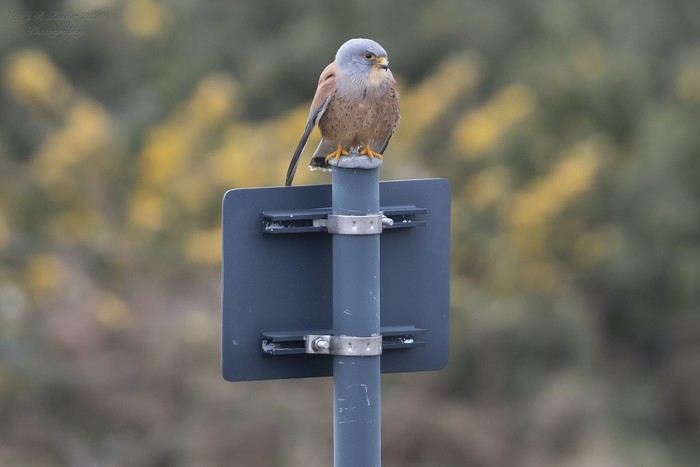
I knew that I was being overly cautious (a legacy of the Godlewski's Bunting) but, I just wanted THAT clinching view. In the end, the strain was just too much: I put out a message on the local birding WhatsApp group stating that I thought I’d got a male Lesser Kestrel, but that it was being difficult. Several minutes later, I saw the bird over Deep Point and in the same field of view as local birder, Rich Aston. I called Rich and explained the situation so far – he’d glimpsed the bird (but of course it had gone missing) and headed in my direction at great speed.
As soon as Rich arrived, the bird reappeared and the views steadily improved; and then [trumpet fanfare], it did the decent thing and gave us the most crippling flyby imaginable!!! Plain rusty mantle, scapulars and upperwing coverts, grey outer greater coverts and lovely blue-grey head (Phwarrr!!!). It then caught an updraft and turned, revealing the underside in all its glory: I went into headless chicken mode, punched the air (3x) and did my ‘happy dance’.

Then, my mobile phone started ringing; it was Joe Pender – he was certain that he’d photographed this bird on the 9th March. His description of the bird and its movements left me in no doubt that he had indeed seen it [as it finally transpired, Joe had also photographed it on the 7th March and had seen it above the Down a couple of days before that!].
Finally, local birders started arriving and the bird put on a really good show (I was a tad cheesed off that it hadn’t done this earlier, but hey ho!) – even dropping down to collect insects from the heath. There was tidal wave of elbow bumps and the inevitable abundance of daft grins. What a crippling bird!
Ashley Fisher
23 March 2020
Share this story