Fewer Puffins breed on the Farnes, but more chicks leave monitored burrows
The 2026 census recorded 33,939 breeding pairs across the islands. On two islands, the burrows rangers followed had their most productive season in three years.

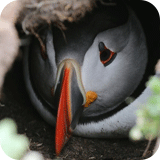
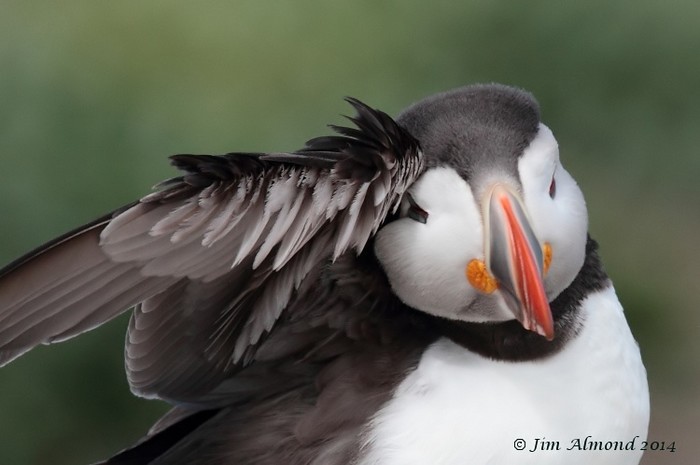
A Puffin burrow on the Farne Islands was more likely to produce a fledgling this summer than last, even as fewer pairs came back to breed. The National Trust's annual census puts the population at 33,939 breeding pairs, down from 38,559 in 2025. That is a fall of 12% in a year and almost 23% since 2018.
The two findings come from different parts of the rangers' work. The island-wide estimate measures the size of the breeding colony. To find out how those birds fared once ashore, rangers followed 132 occupied burrows on Brownsman and Inner Farne. They recorded an average of 0.89 chicks fledging per burrow, against 0.78 last year and 0.51 in 2024.
The National Trust's census report follows a winter in which three severe storms struck the North Atlantic. More than 38,000 seabirds were stranded on the Atlantic coasts of France, Spain and Portugal, and hundreds of Puffins washed ashore in south-west England. A bird feeding far offshore in rough water needs more energy just when its prey may be hardest to find.
When severe storms come one after another there can be very little respite.
Sophia Jackson-Chaytor, National Trust senior ranger, Farne Islands
Shags face a different difficulty. They generally remain closer to the coast and need to come ashore to dry their plumage between periods spent diving. On the Farnes their breeding population fell from 96 pairs to 56. The census records how many birds bred, however; it cannot identify how many missing birds died in the storms.
There were marked differences even between neighbouring islands. Inner Farne held 20,323 Puffin pairs, slightly up on about 20,000 last year. Rangers are examining soil density where Grey Seals congregate and comparing it with ground occupied by Puffins. The question is whether repeated passage by seals compacts burrowing ground. On sensitive parts of Inner Farne the team already uses patrols and deterrents to keep seals away.
Other cliff-nesters had contrasting seasons. Fulmars fell from 235 pairs to 186, while Razorbills rose from 408 pairs to 478. Guillemots also fell, from 44,059 to 39,059, but those figures are counts of individual birds, not pairs. Black-headed Gulls, badly affected by avian influenza in 2022, increased from 128 pairs to 198.
The contrast with 2024 is particularly sharp. That year's full Puffin count came to 50,103 pairs, with Inner Farne alone accounting for 26,552. A slight increase on that island this summer therefore follows a much larger fall; it does not bring the colony back to its earlier size.
Rangers will continue to record what food Puffins bring ashore as well as which burrows produce chicks. A productive summer tells them something valuable about the birds that returned. It does not tell them how many of this year's fledglings will survive their first winter at sea.
11 November 2026
Get Breaking Birdnews First
Get all the latest breaking bird news as it happens, download BirdAlertPRO for a 30-day free trial. No payment details required and get exclusive first-time subscriber offers.