Egyptian Vultures may use hedgehog skins to protect their nest
A breeding pair in Bulgaria arranged dozens of spiny hedgehog pelts around their nest, possibly as a defence against Eurasian Eagle Owls and other predators.
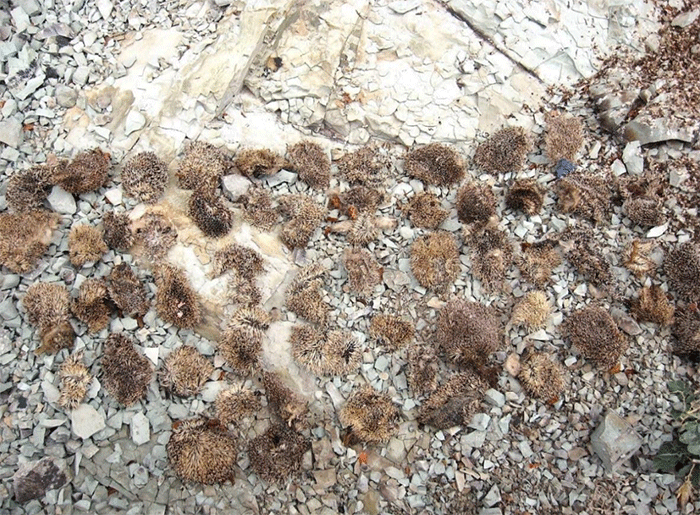
An Egyptian Vulture pair in Bulgaria appears to have used the skins of hedgehogs to create a protective barrier around its nest, according to a newly published study of the unusual behaviour.
Researchers monitored the pair over five breeding seasons between 2007 and 2011. Their nest contained an exceptionally large accumulation of Northern White-breasted Hedgehog pelts, many of which had been carefully incorporated into the nest structure with their spines facing upwards.
When the site was inspected in November 2008, the remains of at least 56 hedgehogs were collected from inside and immediately below the nest. Hedgehogs represented 76% of the identifiable prey remains associated with the pair, while the site accounted for more than half of all hedgehog remains recorded at Egyptian Vulture nests across Bulgaria during the wider study.
Such a concentration is highly unusual. Previous dietary studies in Bulgaria found that hedgehogs generally comprised only a small proportion of the species’ food, typically between 1% and 3% of identified prey. Egyptian Vultures are also not known to capture healthy, living hedgehogs.
The researchers believe some of the skins may have been obtained from Eurasian Eagle Owls. Hedgehogs are an important part of the owl’s diet in Bulgaria, and Egyptian Vultures are known to steal food from the nests and feeding places of larger raptors. Eurasian Eagle Owls were recorded within 200 metres of the studied vulture nest during two of the five years.
An earlier observation from western Bulgaria also documented an adult Egyptian Vulture stealing a hedgehog from an Eurasian Eagle Owl nest and carrying it back to its own nest. Road-killed hedgehogs may have provided another source, although the road network within the territory occupied by the studied pair was limited.
The scientists considered three possible explanations for the presence of so many skins: that they were simply accumulated food remains, that they served as a visual signal of the pair’s quality or status, or that they were deliberately positioned to discourage predators.
The first explanation was considered unlikely because the pelts were not scattered randomly. Instead, they were carefully distributed through the nest, embedded among its other materials and positioned almost entirely with their sharp spines uppermost. Some occupied a substantial part of the nesting area and may even have made the surface uncomfortable for the vultures and their chicks.
The researchers therefore suggest that protection from predators is the most likely explanation. Eurasian Eagle Owls can prey upon Egyptian Vulture chicks and may pose a serious threat when the two species breed close together. A dense layer of spines could make the nest more difficult to enter or provoke an avoidance response in an approaching predator.
Egyptian Vultures are already recognised as unusually intelligent and adaptable birds. They are among the few avian species known to use tools, employing stones to break large eggs and, in one documented case, using a stick to gather wool for a nest. The arrangement of hedgehog skins may represent another previously unknown example of their behavioural versatility.
The researchers caution that the defensive purpose of the skins cannot yet be proven, but say the systematic way in which they were positioned strongly suggests that they served a function beyond feeding. They also argue that more detailed inspections of raptor nests could reveal other overlooked examples of nest decoration and defensive behaviour.
July 2026
Get Breaking Birdnews First
Get all the latest breaking bird news as it happens, download BirdAlertPRO for a 30-day free trial. No payment details required and get exclusive first-time subscriber offers.
Share this story