Cowbirds change their eggs' sex ratio based on breeding time
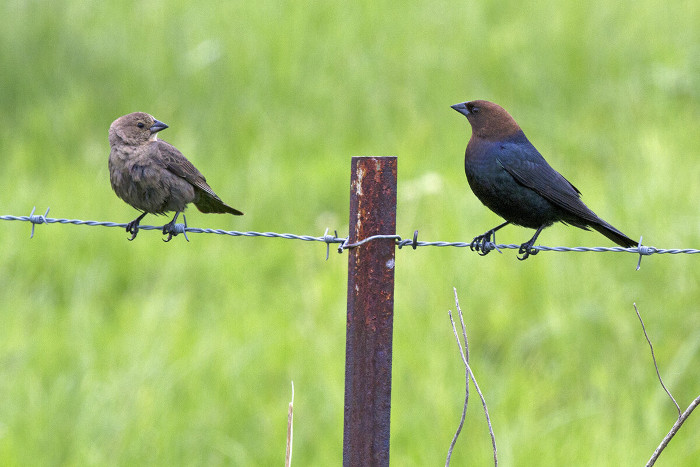
A female, left, and male Brown-headed Cowbirds. Both birds are adults. (© Michael Jeffords and Sue Post)
Brown-headed cowbirds show a bias in the sex ratio of their offspring depending on the time of the breeding season, researchers report in a new study. More female than male offspring hatch early in the breeding season in May, and more male hatchlings emerge in July.
Cowbirds are brood parasites: They lay their eggs in the nests of other birds and let those birds raise their young. Prothonotary warblers are a common host of cowbirds.
"Warblers can't tell the difference between their own offspring and cowbirds," said Wendy Schelsky, a principal scientist at the Illinois Natural History Survey and co-author of the study. "They do a really good job of raising cowbirds, even though cowbird chicks are larger and need more food."
The researchers studied the interactions between cowbirds and warblers for seven years to determine whether there was a difference in the relative number of males and females among cowbird offspring. They collected DNA samples from cowbird eggs or newly hatched chicks.
"Other scientists have not seen any difference in the sex ratios of brood-parasitic birds," said study co-author Mark Hauber, a professor of evolution, ecology, and behavior at the University of Illinois at Urbana-Champaign. "This is the first time anyone has detected a seasonal bias and we believe that it is due to our large sample sizes."
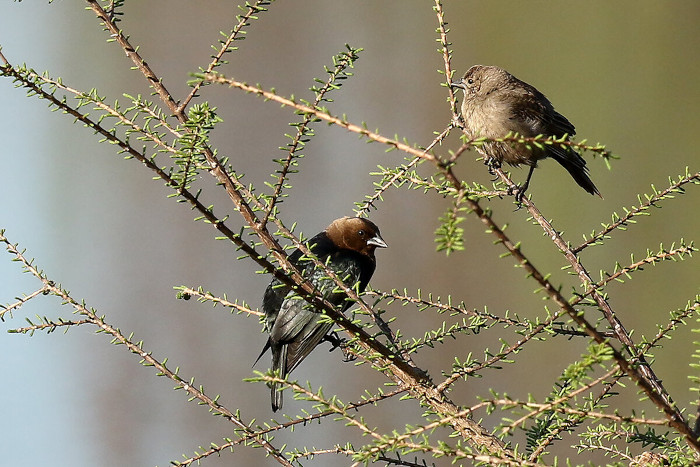
An adult female cowbird, upper right, perches on tree stems above an adult male cowbird (© Michael Jeffords and Sue Post)
The researchers think their results may reflect the different developmental trajectories of male and female cowbirds.
"Male cowbirds take longer to mature and are unlikely to breed in their first year as adults," Schelsky said. "However, since most adult females breed in their first year, they have a better chance of being in good shape if they are produced earlier."
Although the eggs and newly hatched chicks both show the seasonal sex bias, it is unclear whether the differing sex ratios persist in birds that grow up and leave the nest.
"We have not looked at what happens to the chicks after they fledge," Hauber said. "We know that adult cowbird flocks are heavily male-biased, so perhaps increased mortality or dispersal by early-hatched female cowbirds impacts the eventual adult sex ratios."
The researchers hope to understand the molecular mechanisms that female cowbirds use to influence the sex of their offspring.
"It would be interesting to know if the females change their hormone levels across the season to influence the sex ratio of the eggs," Hauber said.
Ananya Sen, University of Illinois at Urbana-Champaign
24 June 2020
Share this story