Cherry-throated Tanager is still clinging on
It was what he had been hoping to find, but Gustavo Oliveira (Tele Junior, to his friends) still couldn’t believe his eyes. For a minute or two, he even forgot to take photos. He had been coming to this site for six years in search of the Cherry-throated Tanager, yet despite hearing its calls once in the middle of the forest, he had never set eyes on one. Now he was watching a group of five hop and flit busily through the canopy of the Atlantic Rainforest in its last stronghold in Espírito Santo, Brazil. Many birders have tried and failed to see this species, including multiple groups from across Brazil and beyond who visited the area in July 2019 after the Brazilian Ornithological Congress.
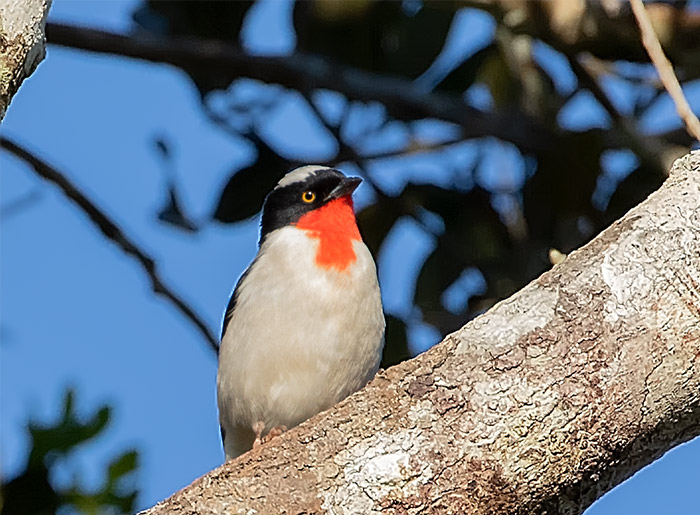
Gustavo quickly recovered his composure and was able to take the photos you see here. Keeping the best interests of the birds foremost, he was at pains to mention that at no point did he use playback. He followed the birds along the forest edge for about 40 minutes before they flew out of sight. Unusually for tanagers, they do not appear to feed at all on fruit, focusing invariably on insects, which they seek out in the manner of foliage-gleaners, peering under branches and leaves and occasionally making small sallies to pluck their prey out of the air.
The Cherry-throated Tanager is among the very rarest birds in the world, with all recent records coming from just this single site, 350 km northeast of Rio de Janeiro. As with many of the other 212 endemic bird species of the Atlantic Forest, the vast majority of its habitat is gone, cleared for pastures, quarries, and to grow coffee, Eucalyptus, bananas and other crops. The species is listed as Critically Endangered by BirdLife International.
First described from a specimen collected in 1870, the Cherry-throated Tanager never seems to have been common or easy to find. The next recorded sighting was in 1941, and after that, in 1994. Even until the 1990s, some ornithologists suspected the species to be a hybrid or a hoax, perhaps a modified skin of one of the Neotropical cardinals. But the Tanager was emphatically reaffirmed to exist in the 1990s, when individuals were photographed, tape-recorded and mist-netted in Espírito Santo.
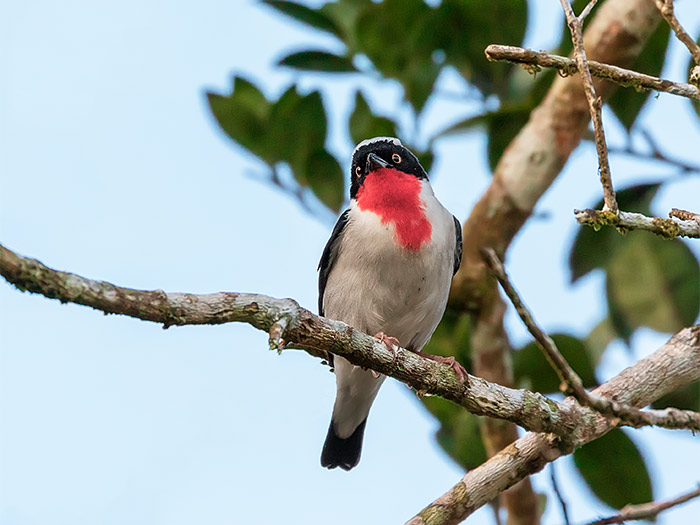
The bird has vanished from view again several times, with months or even years passing between sightings. Each time, there are fears that it could be gone forever, following other species driven to extinction in recent years in the Atlantic Forests – most recently the Alagoas Foliage-gleaner and Cryptic Treehunter. The total population is probably now down to a handful of birds and teetering on the brink of extinction. Gustavo’s sighting provides a welcome ray of hope.
This latest sighting, the first in 2020, is also the first of as many as five birds together for several years, which makes it especially significant. The group was likely a pair with three of their young, and a strong indication of successful breeding. The sighting gives new impetus to a project focused on saving the species (https://www.imd.org.br/programa-saira-apunhalada), coordinated by Marcelo Santos and Gustavo Magnago of Instituto Marcos Daniel and funded by compensation paid by an electrical company which is constructing a power line not far away. The project will focus on securing protection for more of the bird’s habitat, surveys and observations in the field, and raising the profile of the species among local communities. Anyone interested in supporting the project can get in touch with Marcelo at imd@institutomarcosdaniel.org.br. If you wish to support the threatened species of this biome, there also are several other organisations working to save the threatened species of the Atlantic Forest, including World Land Trust, Rainforest Trust and SAVE Brasil (BirdLife in Brazil).
Likely the same group of five birds was seen and photographed again by other observers on 11 and 13 June, raising concerns among those working with the species of an influx of observers and photographers, and the potential for disturbance if even a small proportion of them use playback. With such a small population (these are the only five birds known with certainty to exist, although there are likely others) any additional stress or loss of feeding time could put the species at even greater risk. Marcelo and Gustavo urge any observers visiting the area to stay on trails and avoid the use of playback.
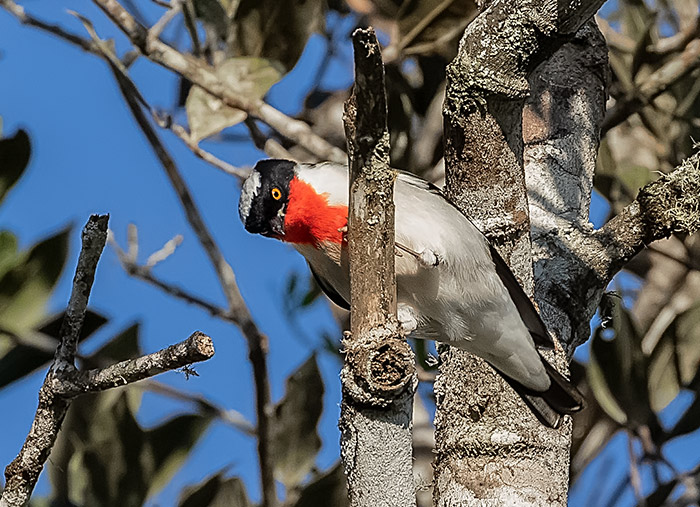
The Cherry-throated Tanager has been living on the edge for some time. Who can tell for how much longer? But while there are still birds, and increasing efforts to help them, there is room for optimism.
Ben Phalan
15 June 2020
Share this story