Camera Traps Lead to the Discovery of a Striking New Jewel-babbler
Surveys on a remote limestone ridge in Papua New Guinea’s Southern Fold Mountains have revealed a striking new species, the Hooded Jewel-babbler.
A remarkable find in an understudied landscape
Scientists have described a new species of jewel-babbler from the isolated Iagifu Ridge in Papua New Guinea’s Southern Fold Mountains. Named the Hooded Jewel-babbler Ptilorrhoa urrissia, the bird was identified entirely from camera-trap photographs and videos taken across seven years of monitoring, revealing a secretive ground-dwelling species confined to a tiny patch of montane forest. The discovery highlights both the extraordinary biodiversity of New Guinea and the vast gaps that still remain in our understanding of its avifauna.
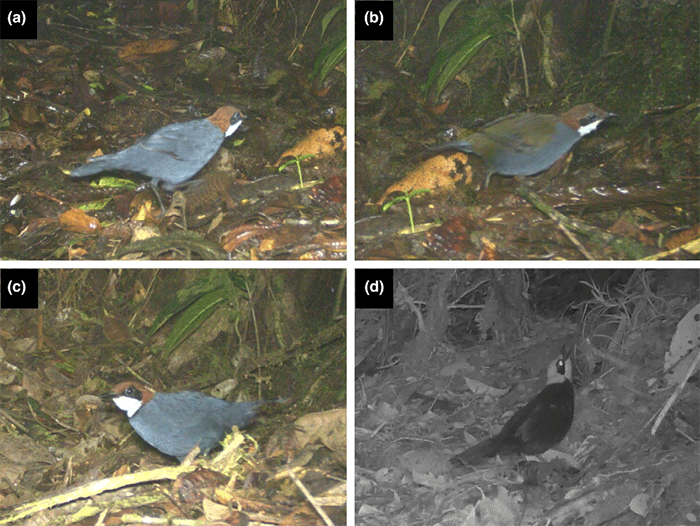
The Iagifu Ridge surveys documented a distinctive bird with chestnut crown, black facial mask and sharply contrasted plumage that differs markedly from all previously known members of the genus Ptilorrhoa. Detailed comparisons with more than 700 museum specimens confirmed that no described species matches the form captured in the images, leading researchers to formally name the new species using provisions that allow description without a collected specimen.
What the cameras revealed
Across 94 photographs and multiple video sequences, researchers detected at least three to six individual Hooded Jewel-babblers within a tiny home range of just seven hectares. Both sexes showed distinct plumage: males displaying rich powder-blue underparts and upperparts below the hood, while females were predominantly olive-green with blue wing patches. The camera-trap footage also recorded juveniles with mottled transitional plumage, offering rare insights into age structure and family groups.
Two call types were captured on video - a harsh, rasping four-note call and a shorter, rising contact call - both notably different from vocalisations of the region’s other jewel-babbler species. No song has yet been identified, reflecting the species’ elusive and apparently quiet behaviour.
A species with an extremely small known range
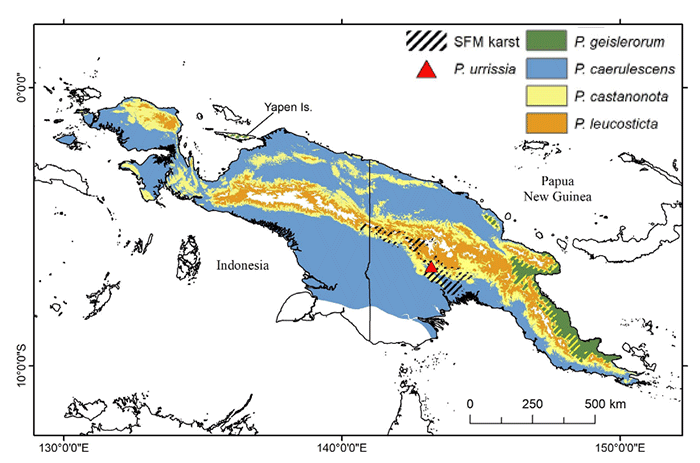
The Hooded Jewel-babbler is currently known only from 1335–1400 metres on Iagifu Ridge, a rugged limestone anticline cloaked in continuously wet lower montane forest. Over seven years of monitoring, detections were scarce - sometimes a single image per month - indicating that the species is genuinely uncommon within its already tiny documented range.
The surrounding landscape includes deep karst valleys, steep ridgelines and moss-laden forest floors, a terrain that has historically hindered biological exploration. The species appears sedentary, with individuals photographed throughout the year while foraging quietly on the forest floor.
Isolated, vulnerable, and potentially fragmented
Despite occupying the same ridge as Chestnut-backed Jewel-babbler Ptilorrhoa castanonota, the new species shows no signs of hybridisation and is morphologically distinct. Its extremely limited range, combined with the competitive exclusion seen in other Ptilorrhoa species pairs, suggests that P. urrissia may survive only in small montane “islands” where other jewel-babblers are absent.
The Iagifu Ridge population is threatened by several pressures, including predation from native marsupials and raptors, intrusion by domestic and feral cats, disturbance from nearby industrial activity, and the impacts of climate change on tightly bounded montane habitats. Habitat fragmentation from roads and associated clearings may further restrict movement between suitable microhabitats.
Conservation status and the urgency of further surveys
Based on the restricted extent of suitable habitat and the small number of known individuals, researchers recommend listing the Hooded Jewel-babbler as Endangered. The species may occur on a handful of other isolated ridges in the Southern Fold Mountains, but these areas remain unsurveyed and difficult to access. If further searches fail to locate additional populations, the species could warrant listing as Critically Endangered.
Formal description of the species aims to direct attention to its conservation needs and to accelerate fieldwork in similar habitats. Camera trapping has proven essential to discovering and documenting this shy ground-dweller, and extensive deployments will likely be required to determine the true range and population size of P. urrissia.
A reminder of New Guinea’s undiscovered richness
The discovery of a striking new bird species from a well-studied family underscores how much biodiversity in New Guinea remains hidden. The Hooded Jewel-babbler adds another remarkable chapter to the region’s natural history - and emphasises the urgency of protecting isolated montane ecosystems before species vanish unnoticed.
December 2025
Get Breaking Birdnews First
Get all the latest breaking bird news as it happens, download BirdAlertPRO for a 30-day free trial. No payment details required and get exclusive first-time subscriber offers.
Share this story