New technique allows scientists to identify individual birds migrating at night
Researchers using thermal imaging and photography have, for the first time, been able to directly observe and identify birds migrating through the night sky.
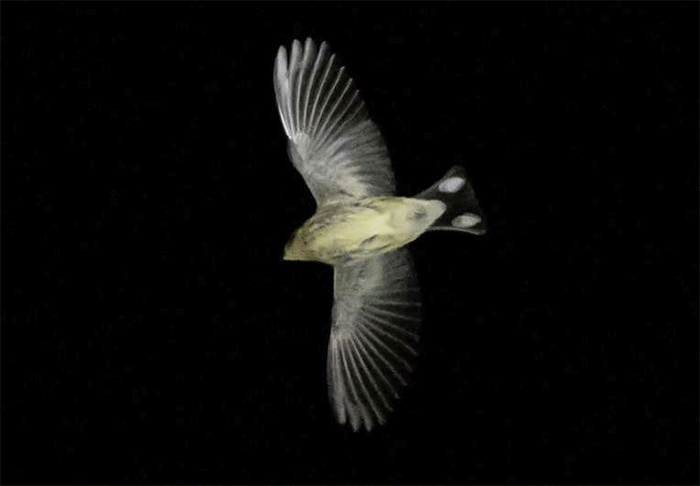
Making nocturnal migration visible
For centuries, nocturnal bird migration has remained one of the most mysterious aspects of bird behaviour. Millions of birds travel under the cover of darkness each year, yet the details of these journeys have largely remained hidden from view.
A new study has now revealed a method that allows scientists to detect and identify individual birds flying at night. By combining thermal imaging, powerful handheld lights and high-resolution photography, researchers have been able to directly observe nocturnally migrating birds and identify them to species in flight.
The technique opens a new window into the study of migration, making it possible to watch and document birds travelling through the night sky rather than relying solely on indirect detection methods.
A breakthrough in studying night migration
Traditionally, scientists studying nocturnal migration have relied on tools such as weather radar or acoustic monitoring of night flight calls. These methods can reveal how many birds are migrating and sometimes which species are present, but they cannot directly show the birds themselves.
Radar can detect large movements of birds over wide areas, but cannot identify individual species. Acoustic monitoring can identify species that produce distinctive night calls, yet many birds migrate silently and therefore remain undetected.
The new approach combines several technologies to overcome these limitations. A thermal imaging device is first used to detect the heat signature of birds flying overhead. Once detected, the bird is illuminated using a powerful flashlight and photographed with a telephoto camera, allowing researchers to identify the species visually.
Thousands of birds identified in the night sky
Researchers tested the technique during autumn migration at Cape May, New Jersey, one of North America’s best-known migration hotspots.
Over three migration seasons between 2020 and 2022, the team conducted nearly 200 hours of night-time observations. During this time they documented thousands of birds flying overhead and identified more than one hundred species using the technique.
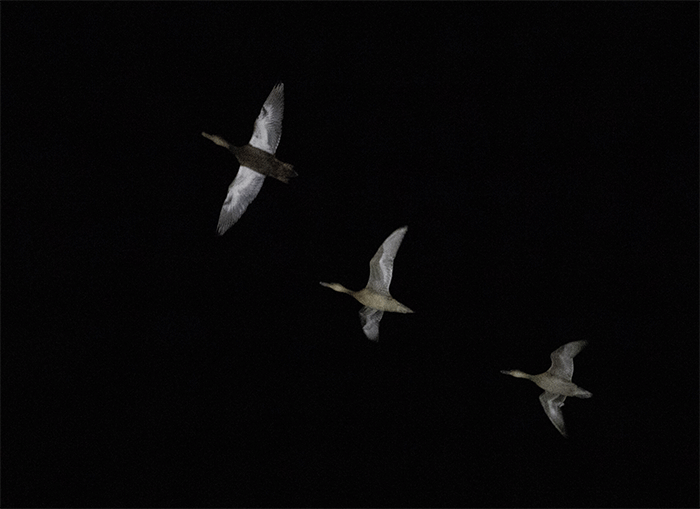
Most strikingly, the study showed that many nocturnally migrating birds pass silently overhead. In one detailed dataset, around two-thirds of birds were identified visually without producing any detectable calls, meaning they would have been completely missed using acoustic monitoring alone.
Revealing new insights into migration behaviour
The observations also provided new information about how birds behave during night migration.
Many species previously thought to travel in groups at night were found flying alone rather than in tight flocks. Compact groups of passerines were rarely seen after dusk, even among species that form flocks during the day.
The researchers also recorded unexpected nocturnal movements by species often regarded as largely sedentary, including Red-bellied Woodpeckers and Northern Cardinals, suggesting that short-distance dispersal flights at night may be more common than previously realised.
Complementing radar and acoustic monitoring
Despite its promise, the technique is not intended to replace existing monitoring methods. Because it requires skilled observers and specialised equipment, it cannot easily be scaled up for large continental monitoring programmes.
Instead, scientists suggest it could complement radar and acoustic studies by providing detailed local observations. By directly identifying birds flying at low altitudes, the method can help confirm which species are present during migration and provide new insight into how birds behave in the airspace closest to the ground.
Researchers say the technique could also help scientists understand how birds interact with structures such as wind turbines and tall buildings, and could ultimately contribute to efforts aimed at reducing risks to migrating birds.
March 2026
Read the full paper here
Get Breaking Birdnews First
Get all the latest breaking bird news as it happens, download BirdAlertPRO for a 30-day free trial. No payment details required and get exclusive first-time subscriber offers.
Share this story