


Black Stork confirmed breeding in Switzerland for first time
A nest with three young in the canton of Vaud provides the first confirmed breeding record of Black Stork in Switzerland.
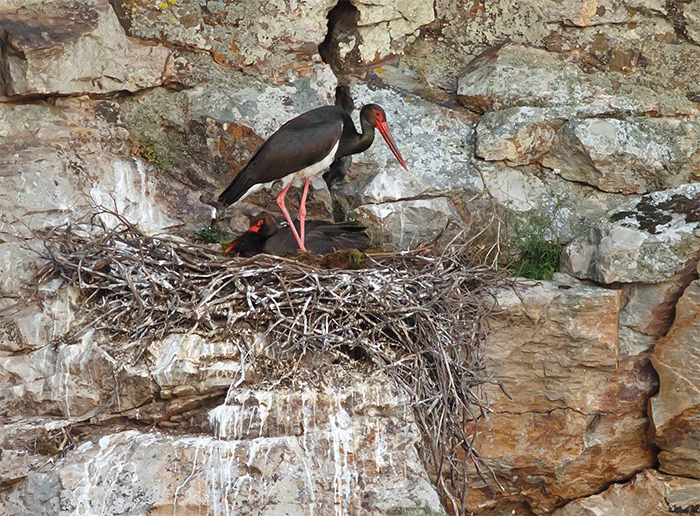
First confirmed breeding record
Black Stork has been confirmed breeding in Switzerland for the first time, after a nest containing three young was discovered in the canton of Vaud.
The discovery, reported by Ornithomedia, marks a notable addition to the Swiss breeding avifauna. Although the species is thought likely to have bred in Switzerland centuries ago, there had previously been no confirmed proof of nesting in the country.
The nest was found in early June 2026 by Vaud-based biologist Lionel Maumary, president of the Cercle ornithologique de Lausanne, following several years of targeted searches.
The exact location of the nest has not been disclosed in order to avoid disturbance to the birds.
Unlike the much more familiar White Stork, Black Stork is a wary and largely forest-dwelling species, typically nesting in extensive, quiet woodland.
It favours mature deciduous or mixed forests, often close to rivers, wetlands, pools or lakes, where it can feed on aquatic insects, small fish and amphibians.
Its secretive habits mean breeding can be difficult to confirm, particularly in wooded landscapes where adults may move discreetly between feeding areas and nest sites.
According to reports from Switzerland, the decisive evidence came on 15 May 2026, when an adult was seen flying directly into a forest edge in the canton of Vaud. Three weeks later, on 7 June, the nest was found, with three young present.
Ornithologists had suspected for several years that Black Stork might be nesting in Switzerland, particularly in the forests of Vaud and possibly in the north-east of the country.
The Vaud discovery follows nine years of unsuccessful searching by Maumary. The find confirms that the species is no longer merely a passage visitor or occasional summering bird in Switzerland, but can now be added to the country’s list of confirmed breeding birds.
Black Stork breeds across parts of Europe and Asia, from the Iberian Peninsula and central Europe eastwards to China and Korea. In western and central Europe, its fortunes have improved in some areas following better legal protection, reduced persecution and the recovery of suitable woodland and wetland habitats.
The Swiss breeding record fits into a broader pattern of recolonisation in neighbouring countries.
In France, Black Stork returned as a confirmed breeding species in the late 20th century, with the first modern nests found in the Ardennes in 1997 and in Haute-Marne in 1999. Since then, the species has continued to spread into suitable forested regions.
The Swiss record is therefore not entirely unexpected, but the confirmation of an active nest with young is a significant milestone for the species in the country.
With three young recorded at the nest in Vaud, the 2026 breeding attempt provides the first firm evidence that Black Stork has successfully established itself as a breeding bird in Switzerland.
July 2026
Get Breaking Birdnews First
Get all the latest breaking bird news as it happens, download BirdAlertPRO for a 30-day free trial. No payment details required and get exclusive first-time subscriber offers.
Share this story





