Two letters link a Spoon-billed Sandpiper in Hainan to Arctic Russia
Haikou on the Chinese island of Hainan has recorded it first Spoon-billed Sandpipers in 18 years included a juvenile that had not been reported since it left its breeding grounds.
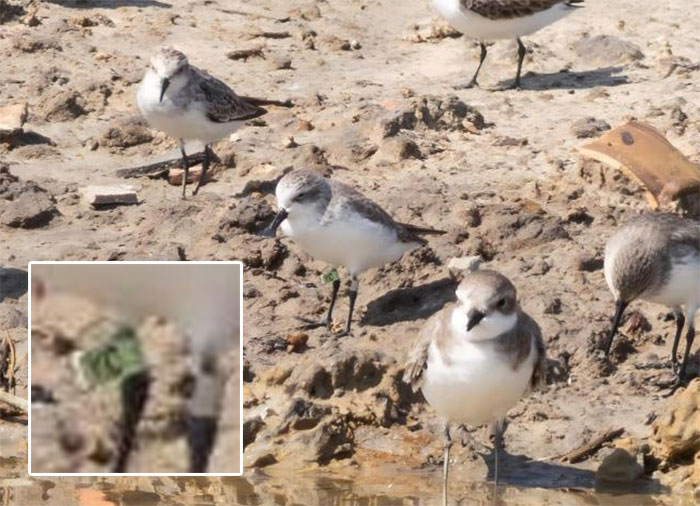
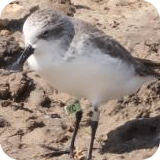
The bill settled the identification; two letters on a leg flag told the observers where one of the birds had come from. Two Spoon-billed Sandpipers feeding and resting on the mudflats of Beigang Island on 18 November were the first records for Haikou in 18 years, according to Lu Gang, director of the city’s Duotan Wetland Research Institute. One was a juvenile, marked YC on a green flag.
The first sighting came three days before the survey. A visitor from Changsha, identified as Ms Xie, had photographed a Spoon-billed Sandpiper on the island on 15 November. On the morning of the 18th, a member of the Shenzhen Bird Watching Society passed her pictures to Ren Rongxia at the institute. Ren and colleagues from the Hainan Zhiyu research centre already had a routine survey on Beigang that day. They now had a particular bird to look for. They found two.
“Finding such a rare bird during our own survey excited me so much that my hands were shaking as I typed the message!” Ren Rongxia, in the English translation published by Hainan International Media Center
Green YC had been marked on 8 July in Chukotka, in the far north-east of Russia. The Hainan account identifies this as the first reported sighting since it left the breeding grounds. A flag small enough to be carried by a wader of this size need not transmit anything. It works when someone gets a view good enough to read the inscription and passes on the record.
The marking scheme gives each part of the inscription a purpose. Under the Spoon-billed Sandpiper Task Force’s system, lime-green flags are used for wild birds marked on the southern Chukotka breeding grounds. White flags there identify young from the head-starting programme. The engraved letters or digits distinguish individuals; knowing the colour alone would not have picked out YC. The sighting gives two known places in this youngster’s first year, not a map of the route it took between them.
The long gap in the records belongs to Haikou, not to the whole island of Hainan. At Danzhou Bay, elsewhere on the island, a protection team had already found a Spoon-billed Sandpiper during its October survey. The species uses coastal wetlands in southern China and South-East Asia after leaving the Siberian tundra. Beigang lies beside the Dongzhai Port reserve, where a bird can feed on exposed mud and rest nearby as the tide changes.
| Date, 2026 | What was established |
|---|---|
| 8 July | YC marked in Chukotka. |
| 15 November | A bird photographed on Beigang; not identified as YC. |
| 18 November | Two seen on survey; YC identified. |
For now, the November record establishes that the juvenile used Beigang on passage or at the approach of winter. Only another reading of those same two letters later in the season could show that YC was still there.
26 November 2026
Get Breaking Birdnews First
Get all the latest breaking bird news as it happens, download BirdAlertPRO for a 30-day free trial. No payment details required and get exclusive first-time subscriber offers.