A Rufous Hummingbird's spring journey from Alabama to Alaska
A solar tag weighing about six hundredths of a gram recorded 38 days of travel.

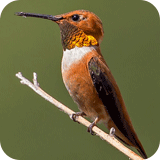
Photograph: Jola Charlton / Flickr.
A male Rufous Hummingbird left the hands of ringers in Lillian, Alabama, on 27 March 2025. On 3 May a signal from its back put it in Juneau, Alaska. The places are 4,730 km apart in a straight line. By joining the places where the tag had actually been detected, researchers measured a spring journey of 6,526 km. That is a record of where the bird went over 38 days, not a claim that it flew without stopping.
For a hummingbird weighing only a few grams, the difficulty has always been finding something light enough to travel with it. A metal ring may establish where a bird started and ended a journey, but only if somebody encounters it again. A transmitter can reveal what happened in between. The battery that makes a conventional transmitter useful can also make it too heavy for the very birds whose movements are least known.
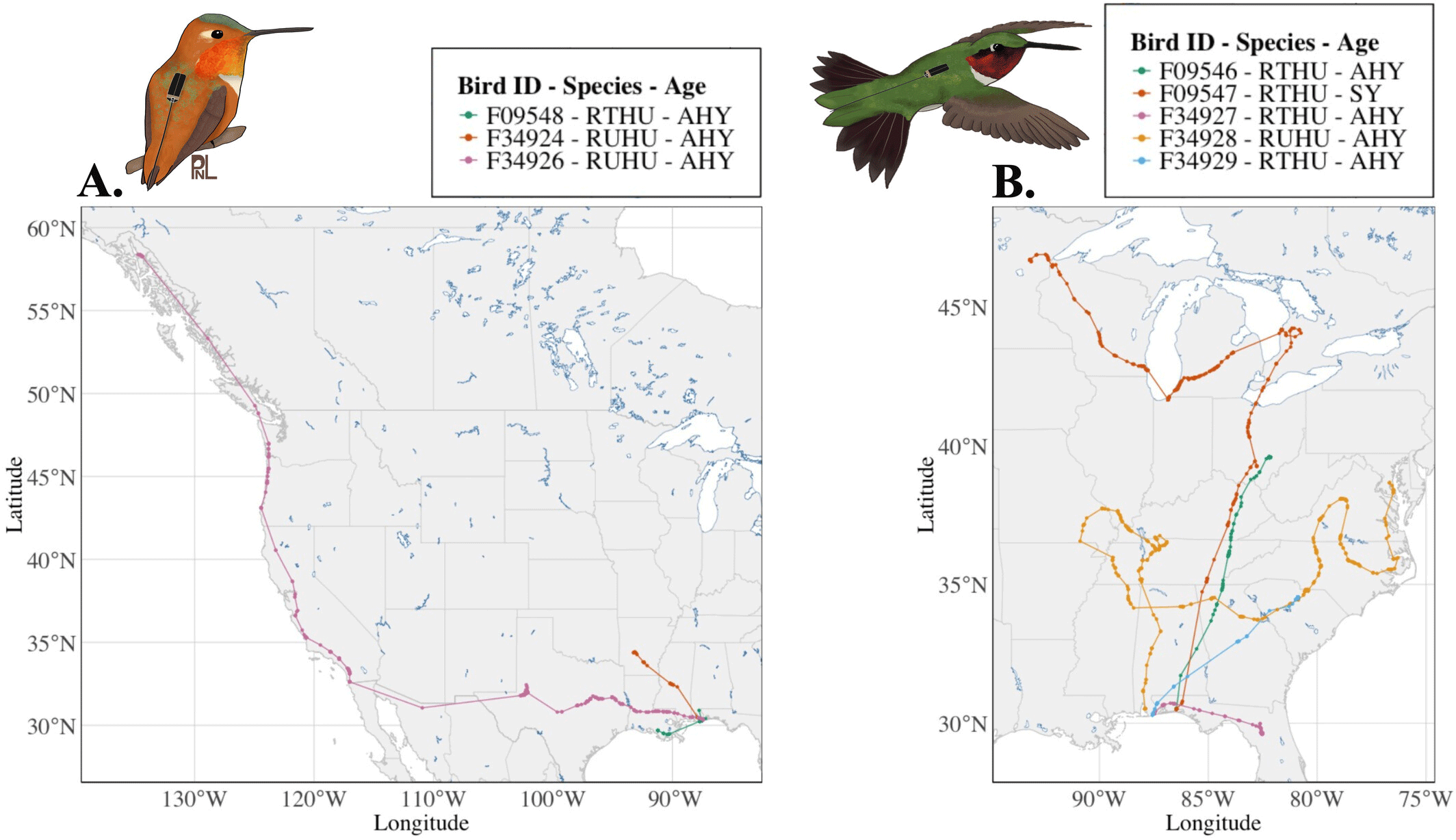
Emma Rhodes and colleagues tested a solar-powered alternative on four Rufous Hummingbirds and seven Ruby-throated Hummingbirds in coastal Alabama and Florida during spring migration. The device weighed roughly 0.06 g; the researchers kept the attached weight below three per cent of the bird’s body mass. In Ecology and Evolution, they describe the 6,526 km journey as:
The tag uses Bluetooth rather than contacting a satellite. It broadcasts an identifying signal which a compatible device passing within range can relay. The network of receivers already exists in the form of phones and other connected devices. A bird does not have to return to a research station to be found, and the ringers do not have to recapture it to retrieve its locations.
“the longest recorded track to date of any hummingbird” Emma Rhodes and colleagues, Ecology and Evolution
A track built this way is a series of encounters. A stretch without a report can mean the bird was beyond reach of a receiver, not that it stayed still. Equally, joining successive locations measures the segments for which there is evidence; it cannot recover every turn between them. Some of the other signals revealed quite different journeys. One Rufous Hummingbird doubled back after heading north; a Ruby-throated Hummingbird moved south-east from Alabama into Florida during what was, by the calendar, spring passage.
Solar power removes one limit on the length of a track, but not the need for the tag to stay attached. The transmitters sat on trimmed feathers between the shoulders, and their working life could outlast their time on an individual bird. The eleven-bird trial was designed to test whether the method worked, not whether carrying a tag has any longer-term effect on survival. Juneau was the last place the male was detected, not necessarily where it ended its journey.
26 November 2026
Get Breaking Birdnews First
Get all the latest breaking bird news as it happens, download BirdAlertPRO for a 30-day free trial. No payment details required and get exclusive first-time subscriber offers.