Finders-in-the-Field: Hudsonian Godwit, Inishdawros, Co. Galway 22 July 2015
by Dermot Breen
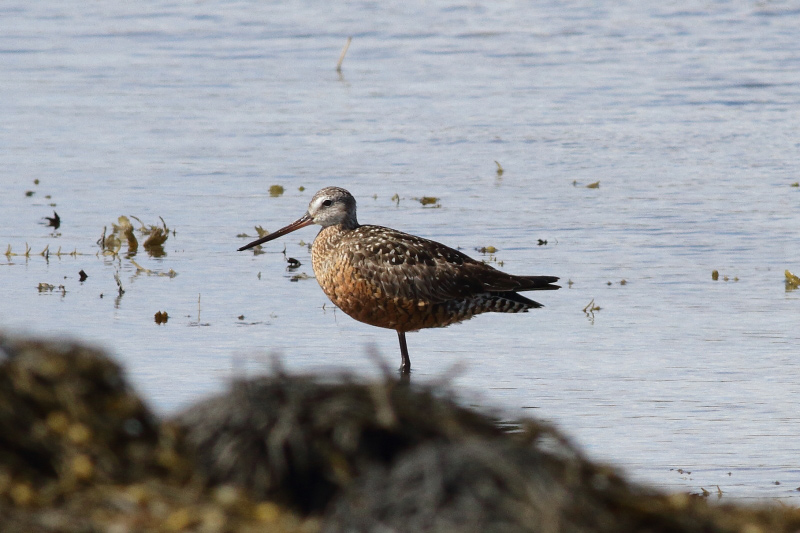
I decided to head down to the Ballyconneely area late in the day to have a quick look around. I took the coastal road from Ballyconneely towards Roundstone village. As I was driving along I saw that the tide was out as I was passing at Inishdawros. This is an area of exposed sand interspersed with seaweed covered rocky outcrops with Inishdawros lying about 250 metres off the mainland. Like many other wader sites in Connemara it’s generally holds very low number of waders even during the height of autumn and winter. I had my first notable bird here only last September in the form of a Curlew Sandpiper.
The Connemara area of Galway, like many parts of Ireland has received scant attention up until relatively recently. In the last ten years though we’ve managed to pick up 15 Dotterel, 10 American Golden Plover, 1 White-rumped Sandpiper, at least 20 Pectoral Sandpipers, 5 Buff-breasted Sandpipers, 1 Long-billed Dowitcher and 1 Lesser Yellowlegs out here. The huge majority of the Nearactic vagrants really only appear from the second week of September onwards and most of these are predominately juveniles. We’ve only ever had one juvenile Pectoral Sandpiper and a second-calendar American Golden Plover in August. So you can imagine I certainly wasn’t expected much on this early date.
I wanted to check through the small waders, the Sanderling in particular. I occasionally come across the odd colour-ringed birds some of which have returned for several years now. There were around 30 Ringed Plover and 12 Dunlin in their usual spot but there was also an adult Little Tern with two flying juveniles. I had driven out across the strand but decided to park up back on the mainland side and come back to try to get a few more shots. I didn’t want to get cut off with the incoming tide. At least I would be able to wade back in if the worse came to the worst. On returning to the area the terns quickly left. I decided to check one area in which they had been feeding a few minutes beforehand.
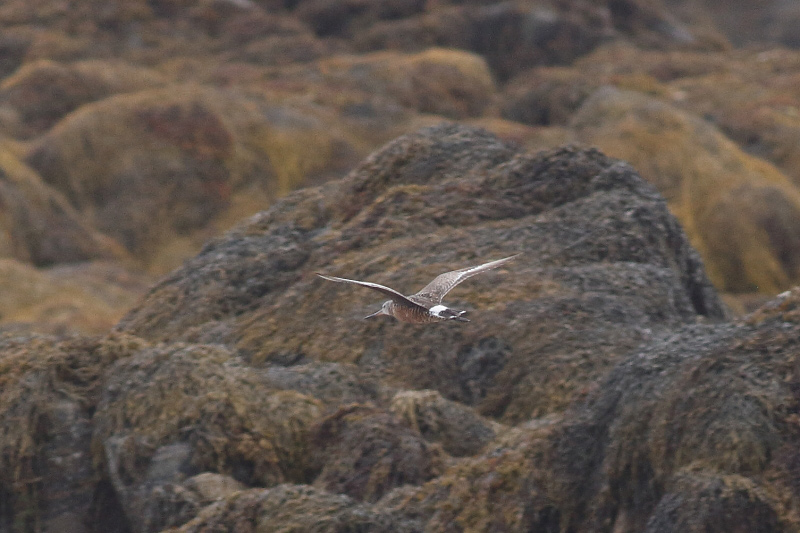
Suddenly a large wader flew from my left to right and dropped behind a large rock. As it passed within 30 metres of me it banked twice as it appeared to land. I didn’t have time to raise my binoculars but even with the naked eye I could see that it had entirely black under wing coverts, rusty underparts and a clean white rump offset by a black tail. It couldn’t be anything else but a Hudsonian Godwit – bloody hell! My heart rate instantly sky rocketed. I just prayed that it would stay still for a record shot. As I peeked my head over the rock a few Redshank and Greenshank exploded off, calling as they went. Not what I needed. Thankfully there it was standing on the water’s edge. It almost looked a big summer plumaged dowitcher species for a split second.
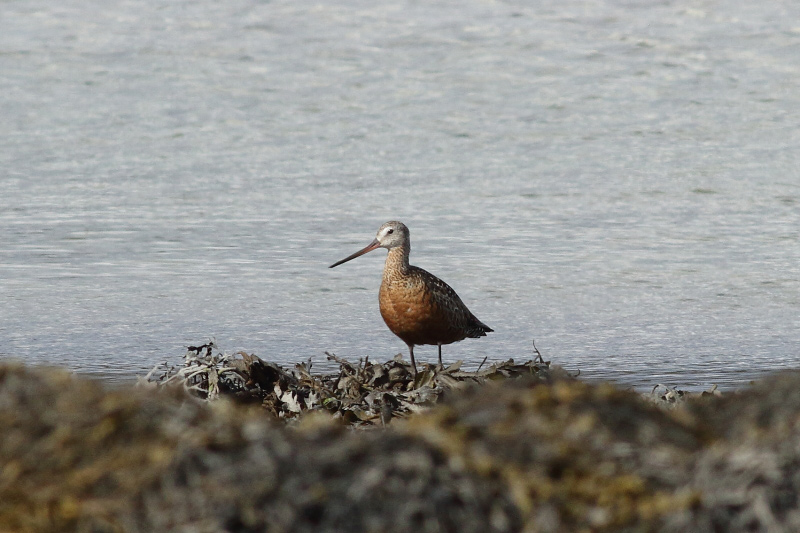
I watched and photographed the bird for about 20 minutes before it got up and flew in a big arc around the strand but quickly appeared to land into amongst more seaweed rocks. There was no sign of it for 30 minutes. I then checked the original spot and much to my relief it was back again. I ran back to the van to get my tripod and scope and it was still in the same spot on my return. After only 10 minutes it got up again and disappeared again into the same spot it had last disappeared into.
The tide was now rapidly rising and I had to head back to the mainland side of the strand before being completely cut off. Around the same time a family with a dog in tow walked through the area I last saw it land in and I never saw the bird after this. I picked it up at about 1625hrs and last saw it at 1725hrs. The nearest birders both live in Galway city which on a good day is an hour’s drive away but to due to rush hour and road works it was nearer to 90 minutes before they managed to get out which was unfortunately too late. A few others from even further afield from Dublin, Cork and Kerry inevitably missed it also as did the fifteen or so the following day.
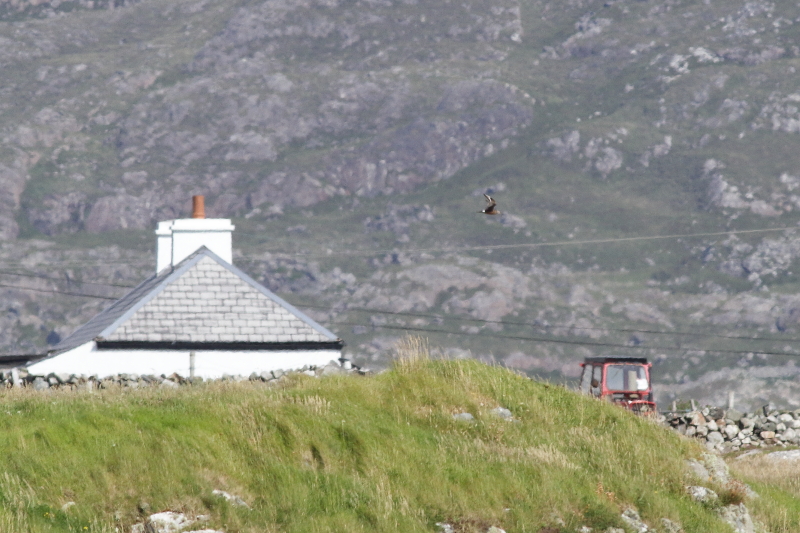
This will be the first record of this species if accepted by the Irish Rare Bird Committee. It would appear that this is a different individual from the one that was seen in Somerset this April/May. While that bird was probably a female, the Galway bird is probably a male. Males are supposed to leave the breeding grounds earlier than females, from late June compared to from mid-July respectively.
Compared to the UK bird the Irish bird had fewer and weaker black barring on a brighter rusty belly and flanks but with bolder black barring on the undertail coverts, less white tips to the under primary coverts, a weaker supercilium behind the eye, a whiter head contrasting with more heavy streaking on the neck and although it was hard to accurately judge size it didn’t seem to be Black-tailed Godwit sized but closer to Bar-tailed Godwit. It’s been some time since I’ve managed to find myself a lifer in Ireland but this was a great one to pick up considering how scarce they are in North America with a total population estimated at only 70,000 birds. I must say the whole thing was a bit surreal but it just goes to show anything can turn anywhere at any time.
Dermot Breen
28 Jul 2015


Write for Rare Bird Alert
Do you have a birding story you would like to share? From foreign birding trips to your local patch, finders accounts and more, we would love to hear from you.
All our articles are free for anyone to view and we include them in our weekly newsletter which goes out to thousands of birders every Wednesday. We also share them on our Twitter and Facebook pages, making sure your article will get read by as many people as possible.
If you would like to write an article please for us please get in touch with your ideas, thank you.
The RBA team