100% of the price of this book will be donated to the African Bird Club's Conservation Fund to further support the conservation of migratory waterbirds along the East Atlantic Flyway
African East Atlantic Flyway Guide
Barlow, C. & Dodman, T.
Wadden Sea Flyway Initiative 2015
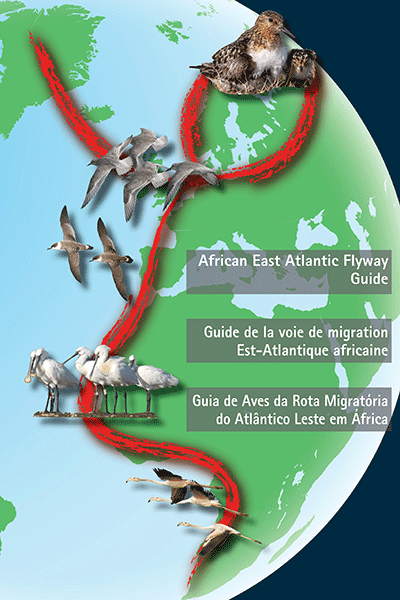
This is a photographic field guide but with a difference. It does not cover, as is traditional, all the species to be encountered in a particular country or region. Instead it covers just the coastal and wetland species to be found along the East Atlantic Flyway, stretching from the High Arctic to South Africa. The focus, however, is very much on West Africa and the book is aimed not at the itinerant tourist birder but at local bird surveyors and conservation organisations.
Africa’s west coast supports some of the most significant waterbird populations in the Old World but, the book argues, they are not sufficiently well known here to permit their effective monitoring and conservation, nor are the sites on which they depend. This book aims to plug this gap by improving identification skills and promoting ecological understanding throughout the twenty-three countries which make up this coast.
The book is published by the Wadden Sea Flyway Initiative and BirdLife International with support from the Federal Environment Ministry of Germany, the Dutch Ministry of Economic Affairs and the MAVA Foundation. It is therefore very much a conservation-focused publication and is distributed free within Africa to wildlife departments, environmental NGOs, universities, national libraries and other relevant institutions.
The book’s focus on the likely end-user is most obvious in its unusual three-language format, with side-by-side columns of text in English, French and Portuguese right through the book. This layout takes a little getting used to (and there is of course less actual text than at first sight) but the practical reasons for this approach are obvious.
An introductory section sets out the book’s rationale followed by information on taxonomy and nomenclature, bird migration and the East Atlantic Flyway, West Africa’s habitats, conservation issues and monitoring techniques and the obligatory guide to bird topography. The first major section of the book introduces the region’s bird families through a short paragraph of text and a selection of representative photographs.
Next come the detailed species accounts, laid out in conventional field guide format with text on the left and photographs on the right. The taxonomy followed is, unsurprisingly, the HBW/BirdLife Checklist. As mentioned above, the species selection is limited to coastal and wetland species (including pelagic seabirds) and there are therefore almost no passerines - just a single page of wagtails.
The text is succinct and fairly basic, not least because of the constraints of the three-column, three language format. The photographs are generally of high quality and have been sourced from a wide variety of photographers but most are reproduced at a rather small scale and the layout is dense and a little cluttered. Commendably, many of the birds are aged and sexed but there are no details of date or location. I only spotted one error amongst the images - the juvenile ‘Montagu’s Harrier’ shows all the classic plumage features of a juvenile Pallid. There are also three plates of colour paintings showing composites of three particularly challenging groups - terns, gulls and skuas.
RRP: £24.99
SPECIAL OFFER:
Softback £19.99

Each species also comes with a range map but these are reproduced very small, squeezed into the outer edge of the right hand page and, as they naturally fall under one’s thumb when leafing through the book, I almost didn’t notice them. They appear accurate, if basic, but the odd error has inevitably crept in. For example, although mentioned in the text, the Moroccan range of Marsh Owl is not mapped.
Despite the inevitable trivial glitch, however, this is a marvellous guide to the birds of this vital flyway. With its clear conservation rationale and practical approach to ornithological capacity-building in West Africa, it deserves to be widely read and used both in the region and beyond.
Andy Stoddart
8 February 2017
Share this review

Commission for Conservation
Rare Bird Alert does not profit from the sale of books through Wildsounds. Instead we are part of their Commission for Conservation programme where a percentage of every sale made through RBA helps supports BirdLife's Spoon-billed Sandpiper Fund.