Wing shape helps swifts glide through storms
A new study suggests that the aerodynamics of swifts' wings enable them to adapt effortlessly to sudden changes in wind speed and direction.
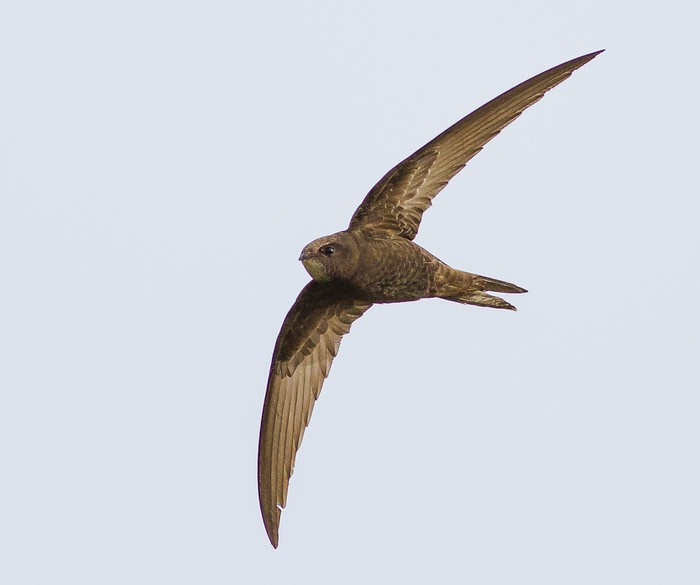
The wings' crescent shape lessens the effects of blustery conditions, helping to stabilise them as they glide during turbulent weather, researchers say.
This means swifts -- which eat, mate and even sleep on the wing -- are not forced to use up vital energy to stay on course.
Scientists at the University of Edinburgh constructed a triangular model wing with the characteristic trailing edge shape of swifts' wings. They studied its aerodynamic properties by fitting it into a water flume that simulated airflow during flight.
Using a laser sheet and a digital camera, researchers tracked the movement of tiny glass balls in the water, to reveal how air flows over the wing.

One of the most fascinating secrets in nature is how birds and insects can fly so effortlessly in turbulence. These results provide a small breakthrough towards unravelling this precious secret.
Dr Ignazio Maria Viola, University of Edinburgh
Results showed for the first time that as air passes over the wing, it can form into two or three circulating regions of airflow -- known as leading-edge vortices, or LEVs.
In aircraft with triangle-shaped wings -- including Concorde -- LEVs can generate extra lift, researchers say. In swifts, however, the formation of LEVs appears to serve a different function. Researchers suggest that it may act as a dampening mechanism that helps stabilise the birds' wings as they glide in blustery weather.
Researchers say the findings could help inform the design of new aerial technology similar to drones -- known as micro air vehicles.
Dr Ignazio Maria Viola, of the University of Edinburgh's School of Engineering, who led the study, said: "One of the most fascinating secrets in nature is how birds and insects can fly so effortlessly in turbulence. These results provide a small breakthrough towards unravelling this precious secret."
29 August 2017
Journal reference: Rowan Eveline Muir, Abel Arredondo-Galeana, Ignazio Maria Viola. The leading-edge vortex of swift wing-shaped delta wings. Royal Society Open Science, August 2017 DOI: 10.1098/rsos.170077
Share this story