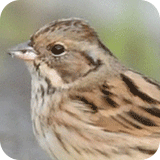
Eastern Orphean Warbler, St Agnes (Scilly), 12-17 & 20 October 2017
An update by Ashley Fisher and Bob Flood
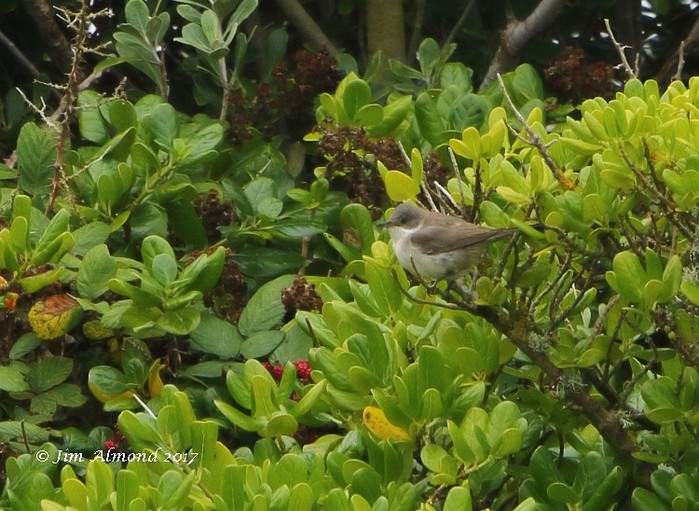
On 22 October, early morning, we published on our Twitter blog and Bob’s FB account a brief note about the ID of the Scilly Orphean Warbler here. The note indicated that photographs point to Eastern Orphean, while pagers and other bird information services had reported Western Orphean.
The sticking point seemed to be with photographs apparently showing a Western pattern to the outer tail feathers (R6). Also, like us, several people we spoke to had seen dark centres to the undertail-coverts, which favours Eastern, but the dark centres barely showed up in the poor-quality photographs that we had seen. On 21 October, in the afternoon, we saw Adrian Webb’s photograph of the undertail-coverts showing dark centres to the longest three pairs, confirming what we had seen in the field, and surely eliminating Western. So, we quickly prepared our note. The note also pointed out that there was evidence of an Eastern pattern in R6. We sent the note to Lars Svensson for his opinion.
Given the photographs, we were of the opinion that BBRC and BOURC would accept the bird as Eastern Orphean. So, our concern was to get the ID issue widely aired since the evidence pointed to Eastern, the bird could still have been present (it had been reported on 20 October), and we felt a sense of responsibility to the birding community. Other birders had an equal opportunity to write such a note, and an equal responsibility, but even so we had images in our minds of a top-lister lynch mob arriving in Scilly to cleanse the islands of local birders.
We were surprised / disappointed that the note generated very little interest. Later, RBA asked if they could post the note on their website and we agreed. This generated a bit more interest. On 23 October, mid evening, Lars Svensson replied to us and stated firmly that the bird was an Eastern Orphean (see below). We immediately put the news out via our social media sites and RBA. This did the trick! It generated massive interest with all kinds of social media postings! We are told that the pager Mega Alert also caused quite a stir at the log-call on St Mary’s, which was mid-way through at the time.
Many congratulations to the Wright brothers, Neil and Paul, for their find, a first for Britain, for their persistence with a hard to observe bird (as we discovered for ourselves), and for putting the news out so that we had the opportunity to get to Agnes at the earliest opportunity. It’s brilliant for Neil and Paul, brilliant for the birders who saw the bird, including us, and brilliant for Scilly birding.
Here is our email to Lars (from Bob on behalf of both of us):
“Dear Lars,
I would be very grateful if you could find 10 minutes to look at the short, attached note about the Scilly Orphean Warbler, October 2017. It has been identified as Western... However, our note raises issues with the ID and we think that it is more likely an Eastern. We don't mind being told otherwise.
Kind regards from Scilly,
Bob Flood”
Lars very kindly replied:
“Dear Bob,
Thanks for your email about the Orphean Warbler on Scilly. I am afraid I cannot tell you ’otherwise’, it is indeed an Eastern Orphean. Although the tail pattern in this case seems to fall into a narrow overlap zone (though looks better for Eastern than Western), the photo of the undertail-coverts conclusively shows that the bird was an Eastern. There is no way a Western could have such well-marked grey central streaks or blotches on the longer undertail-coverts. The undertail-coverts of Western O W vary only slightly, and generally are diffusely tinged rufous-buff without distinct streaks or blotches, only a vague tendency to such at the most. It is typical for Eastern to have darker and greyer central streaks or blotches on these feathers. The pitfall is rather Eastern with poorly marked undertail-coverts, but here you have a bird with obvious flecking, and such birds can readily be referred to the Eastern species.
This opinion is based on the understanding that the image showing the vent and undertail was of the bird in question.
Hope this helped and was what you hoped to hear.
All the best, and do cite me if you want and need.
Lars”
Ashley Fisher & Bob Flood
24 October 2017
Share this story